
7 Camino de Santiago routes to walk in 2026
The Camino de Santiago has many different routes. Each one offers a unique cultural and spiritual experience. The Camino de Santiago is not a single route like some people think referring to the most popular one - the Camino Frances. It's a network of pilgrimage routes that start in different places across Europe and finish in Santiago de Compostela, Spain. In fact, you can start walking to Santiago from anywhere in Europe like people used to do before we had cars, trains, and plains.

As of March 2026, we've completed 11 Camino de Santiago routes: Camino Frances, the 3 routes of the Camino Portuguese (Coastal, Central, and Litoral routes), Camino del Norte, Camino Primitivo, Camino Ingles, Camino Finisterre-Muxia, and Via de la Plata. And two lesser-known Camino routes: Camino de San Salvador, and Camino de Gran Canaria. We're planning to walk more Camino routes in 2026.
We have created the Camino de Santiago resource page where all our Camino posts are divided into relevant groups. It makes it easier to navigate and find the information you're looking for.
Camino de Santiago routes map

What is the most popular Camino route?
In 2025 in total 530 791 pilgrims arrived in Santiago de Compostela after completing one of the Camino routes. 98% of pilgrims walked one of the 6 main routes (excluding the Camino Finisterre).
The Camino Frances is by far the most popular Camino de Santiago route. Most people who complete it walk only the last 100 km from Sarria to Santiago. 162 952 (30.5%) of pilgrims walked the route from Sarria in 2025.
The Portuguese Camino from Tui is the second most popular route. 41 644 (7.8%) of pilgrims completed the Camino from Tui in 2025.
Below you can see the number of pilgrims on different Camino routes according to the information from the Pilgrim’s Receptions Office in Santiago de Compostela.
| Camino route | In 2025 |
| Camino Francés | 45.6% - 242 037 pilgrims |
| Camino Portuguese (Central + Coastal + Litoral Way) | 35.8% - 190 335 pilgrims Central route: 19% - 100 831 Coastal + Litoral route: 16.8% - 89 504 |
| Camino Ingles | 5.6% - 30 202 pilgrims |
| Camino Primitivo | 5.2% - 27 868 pilgrims |
| Camino del Norte | 4% - 21 481 pilgrims |
| Via de la Plata | 1.6% - 8 833 pilgrims |
The Pilgrim's Reception Office in Santiago doesn't have exact numbers for the Camino Finisterre-Muxía. People usually walk this route after finishing one of the other (longer) Camino routes.

What is the best Camino route for beginners?
We often get this question. I'd say one of the most popular Camino routes e.g. Camino Frances or Camino Portuguese from Porto is the best route for beginners. Why? Simply because these routes have a very good infrastructure, many albergues, and are well-marked.
The easiest option is to walk 100 km on one of the main Camino route, e.g. Camino Frances, Camino Portuguese. If you want to complete a longer route then the Portuguese Camino from Porto is one of the best options.

Which Camino is the hardest one?
Out of the seven main Camino de Santiago routes I'd say the Via de La Plata is the toughest route. First of all, because it's the longest route. Second, because the distances between the towns are very long sometimes you walk 20-25 km though nothing which means you have to carry a lot of water and some food with you. Third, it gets very hot in summer and quite cold in winter in that part of Spain.
In my opinion, the Camino del Norte is the second toughest Camino de Santiago route because of its long distance and many ascents and descents.
The part of the Portuguese Camino from Lisbon to Porto is quite challenging as well because of long distances between the towns and limited accommodation options.
The main Camino routes arranged by the distance:
- Via de la Plata - 1000 km/621 mi
- Camino del Norte - 825 km/512 mi
- Camino Francés - 790 km/490 mi
- Camino Portuguese from Lisbon* - between 613 km/381 mi and 650 km/403 mi (depending on the route from Porto)
- Camino Primitivo - 321 km/199 mi
- Camino Portuguese from Porto - 243 km/150 mi (Central Route); 274 km/170 mi (Coastal Route); and 280 km/173 mi (Litoral Way)
- Camino Inglés - 120 km/74 mi
- Camino Finisterre-Muxía - 115 km/71 mi
*I added the Portuguese Camino from Lisbon as a separate route because it is quite different from the Porto to Santiago part.

Which route is the most beautiful?
It's difficult to say which Camino de Santiago route is the most beautiful. Each route has something different to offer. Some people enjoy the forest, some mountains, and some sea.
After walking 11 different routes I'd say the Camino del Norte and the Litoral Way of the Portuguese Camino are our favorite coastal routes. Camino. We enjoy walking next to the sea. There are quite a few interesting cities and towns on the routes.
If you prefer mountainous scenery the Camino Primitivo and Camino del Salvador are the best routes through the mountains. These two routes offer more of a real hiking experience with fewer cities and towns.
Another route with spectacular scenery is the Camino de Gran Canaria. It's a 3-4 day route on the Canary Islands that connects two beaches and takes hikers through the lush-green forest and mountains. It's a great route to walk in winter.
As for the most popular route the Camino Frances it has some incredible days and beautiful cities but I'm not a big fan of walking through the plains which make a big part of it.

Which Camino route is the best for you?
Which Camino route is the best? is one of the most frequently asked Camino questions we get. It depends on several aspects.
- Decide how far you want to walk - short, middle, or long-distance route. You always can start a route not from its official beginning but from the point on the route that suits you the best.
- Choose the best route for the month you want to walk - not too hot, not too much rain.
- Determine what you want to see; coast, beach, forest, mountains, historical cities.
- Decide if you want to walk a busy and very social Camino route or rather have a solitary walk.
The 7 main Camino de Santiago routes
There are seven main routes of St.James;
- Camino Frances (the French Way)
- Camino Portugués (the Portuguese Way)
- Camino del Norte (the Northern Way)
- Camino Primitivo (the Original Way)
- Via de la Plata (the Silver Way)
- Camino Inglés (the English Way)
- Camino Finisterre-Muxía
These routes are well-marked and have enough infrastructure for pilgrims (some more some less).
| Long-distance routes | Middle-distance routes | Short-distance routes |
| Camino Portuguese from Lisbon 613 km/381 mi to 650 km/403 mi | Camino Portuguese from Porto Central Route - 243 km/150 mi Coastal Route - 274 km/170 mi Litoral Way - 280 km/173 mi | Camino Inglés - 110 km/68 mi |
| Camino Francés - 790 km/490 mi | Camino Primitivo - 321 km/199 mi | Camino Finisterre - 118 km/73 mi |
| Camino del Norte - 825 km/512 mi | ||
| Vía de la Plata - 1000 km/621 mi |
As I already mentioned we’ve walked all seven routes. Below I give my personal opinion on each of them.
Disclosure: Stingy Nomads take part in the Amazon Services LLC Associates Program. We earn advertising fees by advertising and linking to Amazon.com. If you click on the link and purchase the item, we will receive an affiliate commission at no extra cost for you. Thank You!
Camino Francés (the French Way)
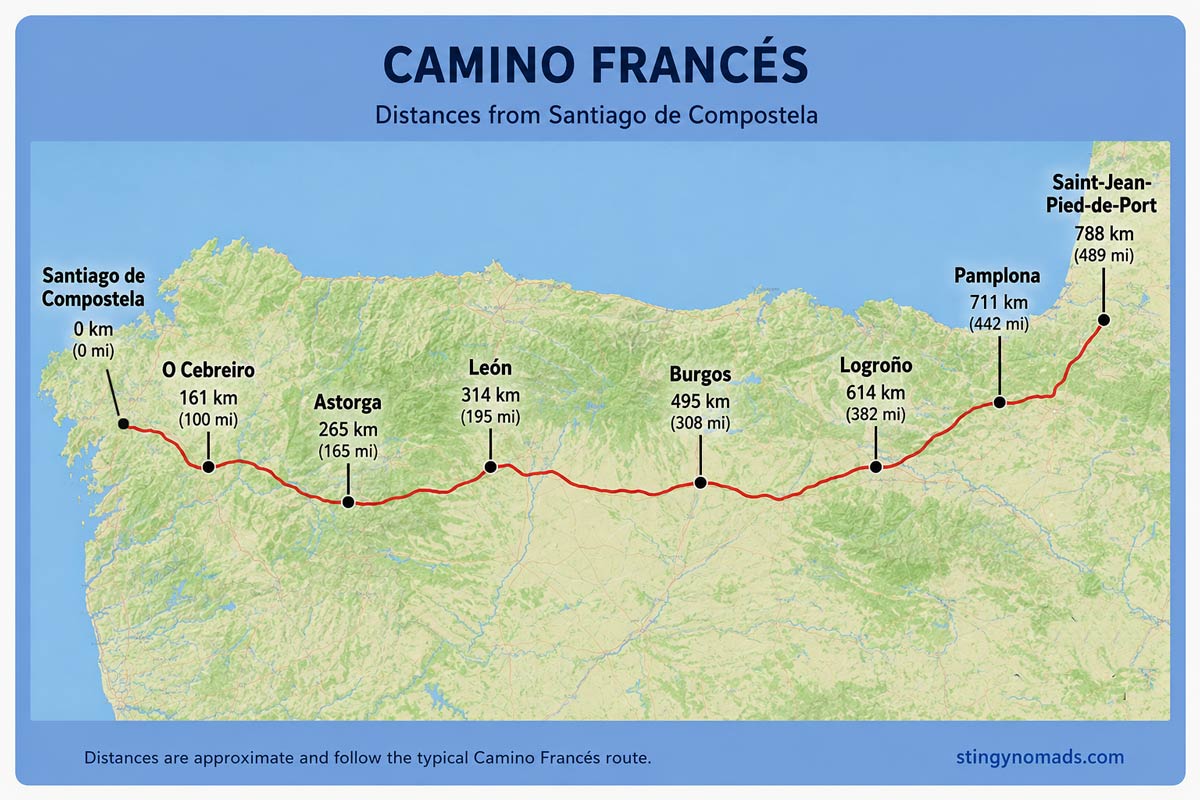
- Distance - 790 km/490 mi
- Number of days (stages) - 28-35
- Starting point - Saint-Jean-Pied-de-Port (France)
- Regions - Navarra, La Rioja, Castilla y León, Galicia.
- It can be combined with - Camino Primitivo (from León following the Camino del Salvador), Camino Finisterre-Muxia (from Santiago de Compostela)
Best guidebook for the Camino Frances route - A Pilgrim’s Guide to the Camino de Santiago (Camino Francés): St. Jean Pied de Port • Santiago de Compostela, John Brierley, 2023

The Camino Francés is the busiest Camino route. For many people the Camino de Santiago = Camino Francés. The popularity of this route was the main reason we didn't want to walk it but in the end, I decided to do the French Way to be able to compare it with other Camino routes. I walked it in September and there were many people. For 90% of all pilgrims I met, it was their first Camino de Santiago.
The French Camino out of all routes has the best infrastructure and the most albergues. Some of the albergues are open all year round which means this route can be completed off-season, in winter months.
Main towns on the route
There are many historical cities and towns on this route;
- Pamplona
- Logroño
- Burgos
- León
- Astorga
- Ponferrada
- Melide
- Santiago de Compostela.
Read more about the beautiful towns on the French Camino.
Best walking months
This route can be walked all year round, some albergues stay open all year. A good thing about walking the Camino Francés offseason is that there will be not many people. As for the weather, May-June and September-October are probably the best walking months. It gets very hot and very busy in July and August. In the last years, September (especially the beginning of the month) has become a very popular month for walking the French Way.

What we liked about the route
- It's cheap to walk the French Camino. There are many public albergues and albergues for donation, you can find one for every night.
- This route goes through some amazing Spanish cities such as Pamplona, Logroño, Burgos, León, and Astorga.
- It's a very social Camino every day you meet new people.
What we didn't like
It's a very busy route in the peak season people start racing for beds in public albergues. It's not a big problem if you end your day in a big city with many hostels and hotels or if you book your accommodation in advance.
The scenery, the part of walking through the famous Meseta (plains and fields with nothing) was not my favorite. It's just not my kind of scenery, I prefer mountains, forests, or the coast.
Difficulty level
Knowing that for many people it'll be their first Camino de Santiago I'd say 4 out of 5. It's a long route, and the distance of 790 km/490 mi is already a big challenge. If you walk in summer it gets very hot in the Meseta you have to start your day early at 5.30-6.00 am. Add to that a couple of long ascents and descents over the mountain passes.
Scenery overview
The middle section of the Camino from Burgos to Leon is through the Meseta with wheat fields dominating the landscape. For days you walk through plains with occasional trees and villages. There are very few rivers, lakes, or big water bodies on this route.
My favorite parts are the beginning of the Camino from St.Jean Pied de Port to Pamplona (over the Pyrenees) with beautiful mountain views and lush green forest. And the part from Astorga to O Cebreiro for the same reason; mountains, forest, small villages.

Camino Portuguese (the Portuguese Way)
- Distance - from Lisbon between 613 km/381 mi and 650 km/403 mi. Central Route (from Porto) - 243,5 km/151 mi; Coastal Route (from Porto) - 274 km/170 mi; Litoral Way (from Porto) - 280 km/173 mi.
- Number of days (stages) - from Lisbon - 25-27; Central Route (from Porto) - 10-13; Coastal and Litoral Route (from Porto) - 12-15
- Starting point - Lisbon or Porto.
- Regions - Portugal: Estremadura, Ribatejo, Beira, Douro Litoral and Minho. Spain: Galicia.
- It can be combined with - Camino Finisterre-Muxia (from Santiago).
The best guidebook - A Pilgrim’s Guide to the Camino Portugués Lisbon – Porto – Santiago: including Camino Central, Variente Espiritual, Camino da Costa, & Senda Litoral, John Brierley, 2023

The Camino Portuguese starts at the Church of Santiago in Lisbon but most people start walking from Porto. The Lisbon to Porto part has less infrastructure for pilgrims. The route is marked but there are few albergues which means you end up paying more for accommodation. It’s possible to combine the Portuguese Camino from Lisbon with the Camino de Fátima.
The Portuguese Camino from Porto, there are 3 routes; the Central Route (inland), the Coastal Route (partly along the coast), and the Litoral Way (mostly along the coast). The routes merge in Redondela.
There is another route on the Portuguese Camino - the Spiritual Variant (Variante Espiritual). It splits from the main route past Pontevedra and merges again in Pontecesures.
Find more information in our post on the different routes of the Portuguese Camino.
Main towns on the route
- Lisbon
- Santarém
- Coimbra
- Porto
- Barcelos (Central Route)
- Ponte de Lima (Central Route)
- Viana do Castelo (Coastal and Litoral Route)
- Caminha (Coastal and Litoral Route)
- Vigo (Coastal and Litoral Route)
- Tui (Central Route)
- Pontevedra
- Santiago de Compostela

Best walking months
The best time for walking this Camino route is between May and July and September-October. In July and September, it can be quite hot on the Lisbon-Porto stretch. August is fine if you start walking from Porto. If you walk from Lisbon it’ll be very hot, the route goes through the plains with no shade. We walked the Portuguese Camino from Lisbon in May and had very good weather; warm, even hot some days, with no rain, the scenery was beautiful with many wildflowers and trees in blossom.
What we liked about the route
- We walked in spring the fields were covered in flowers
- Beautiful sea scenery on the Coastal and Litoral Route
- Interesting historical towns on the Central Route
- Possibility to combine different routes and sceneries
What we didn't like
- Our main dislike is for the Lisbon-Porto part; not enough albergues on the route, and long distances between towns.
Difficulty level
4 out of 5 for the Camino route from Lisbon to Porto due to long stretches through nothing and long distances between towns.
3 out of 5 for the Central Route from Porto to Santiago. It has many hills and involves a lot of walking on cobbled stones. The infrastructure is good, many albergues, restaurants, etc.
2 out of 5 for the Coastal and Litoral Way from Porto to Santiago. Not many hills, diverse waking surfaces, enough albergues, restaurants, etc.
Scenery overview
Countryside with many fields and vineyards and a couple of historical towns on the part between Lisbon and Porto.
Forest and fields with historical towns in between on the Central Route from Porto.
Beaches, coast, forest, and towns on the Coastal Route.
Mostly beaches and coast on the Litoral Way.

Camino del Norte (the Northern Way)
- Distance - 825 km/512 mi
- Number of days (stages) - 30-35
- Starting point - Irún
- Regions; the Basque Country, Cantabria, Asturias, Galicia
- It can be combined with - Camino Primitivo (from Gijon) and Camino Finisterre-Muxia from Santiago.
The best guidebook for the route - Camino del Norte: Irún to Santiago along Spain's Northern Coast, 2025

The Camino del Norte is one of the oldest Camino routes. It is one of the longest Camino de Santiago routes in Spain and one of our favorites. We're big fans of the ocean and liked the walk, especially the first half of it through the Basque Country and Cantabria.
The Northern Way offers spectacular coastal scenery, and I think it is a good alternative to the French Way; the distance is about the same, the route is less crowded, and it goes the coast. It has beautiful towns with interesting sights.
Camino del Norte is considered to be tougher than Camino Frances because of multiple ascents and descents on the way but it doesn’t have any mountain passes like the French route.
It merges with the French Route in Arzua, 40 km/24.8 mi before Santiago de Compostela.
Main cities and towns on the route
- San Sebastián
- Guernica
- Bilbao
- Portugalete
- Castro Urdiales
- Santander
- Santillana del Mar
- Llanes
- Gijón
- Avilés
- Ribadeo (Coastal Route)
- Santiago de Compostela

Best walking months
June to September is a good time for this route, July and August are the busiest months, with many tourists in beach towns, and most pilgrims on the Camino. The end of May and beginning of October are good border months with fewer people and possibly good weather.
What we like about the route
- Beautiful sea scenery
- Great food (especially in the Basque Country)
- Several interesting historical towns
- Not too many pilgrims
What we didn't like
- Prices are higher in the Basque Country and Cantabria compared to other Spanish regions.
- Very few public albergues on the route which makes it more expensive.
- Parts of the route along the road (e.g. the entire stage from Gijon to Aviles).
Difficulty level
4 out of 5, it is a long route, many ascends and descends on the way, a couple of stages with long distances between towns, albergues, places to stop for food, etc.
Scenery overview
About 50% of the walk is along the coast; beautiful sea scenery, beaches, green hills, picturesque towns, and a little bit of forest. Walking this route we often regretted not having enough time to explore some parts of it. We'd like to stay longer than just one night in several places along the way.

Camino Primitivo (the Original Way)
- Distance - 321 km/200 mi
- Number of days (stages) - 12-15
- Starting point - Oviedo
- Regions - Asturias, Galicia
- It can be combined with - Camino Finisterre-Muxia (from Santiago)

The history of the Camino de Santiago dates back to the 9th century when the first pilgrims walked to Santiago de Compostela to commemorate the discovery of the tomb of the Apostle St.James. The Camino Primitivo or the Original Way is believed to be the first Camino ever walked. According to the historical manuscripts Spanish King Alfonso II walked from Oviedo to Santiago de Compostela in the 9th century.
The Primitive Way is probably the closest to the real hike route. You walk on a footpath through the forest and over the mountains. You get towns but not as many as on the other routes. There is not much walking on or next to the road. If you have a knee problem it is difficult route due to many steep hills.
The route merges with the Camino Frances in Melide, 52 km/32.3 mi before Santiago.
Main towns on the route
There are very few cities and big towns on this Camino
- Oviedo
- Lugo
- Melide
- Santiago de Compostela

Best walking months
June - August are the warmest months with the least rainfalls. Second half of May and September are good border months. The weather in the mountains is quite unpredictable we walked this Camino in June and got a lot of rain. Be prepared for it.
What we liked about the route
- “Wild Camino” with a lot of walking on the footpath, trails, through remote areas, very few cities, no industrial areas, or busy roads.
- Public albergues can be found at the end of every walking stage, you can easily complete the whole route staying only in public albergues, which makes the walk cheaper.
- The Camino goes through off-the-beaten-track areas.
- Locals are very friendly and helpful.
What we didn't like
- We were very unlucky with the weather even though we walked the Camino in summer (June), we had a lot of rain and mud on the trail. Otherwise, it's a great Camino to walk with good facilities and stunning scenery.
Difficulty level
4 out of 5, many steep ascends and descends pretty much every day between Oviedo and Lugo.
Scenery overview
Beautiful mountain, lush-green forest, waterfalls, water reservoirs, etc. The trail goes through some remote areas of Asturias, with no cities or big towns on the way.

Camino Inglés (the English Way)
- Distance - 116 km/72 mi from Ferrol, 74 km/46 mi from A Coruña
- Number of days (stages) - 4-6
- Starting point - Ferrol or A Coruña
- Regions - Galicia
- It can be combined with - Camino Finisterre-Muxia (from Santiago)
The best guidebook - A Pilgrim's Guide to the Camino Inglés: The English Way also known as the Celtic Camino: Ferrol & Coruña - Santiago, John Brierley, 2024

The Camino Inglés is probably the best Camino for those who want to get a taste of the walk. It’s easy to combine this route with a holiday in Spain. You can decide whether the Camino is your cup of tea or not, after completing this route. The Camino from Ferrol has proper marking and good infrastructure.
We haven't walked from A Coruña but some sources say that route is not well-marked. If you start walking from A Coruña you won't be able to get the Compostela unless you live there or you start walking in England and then continue from A Coruña and your total distance is 100 km/62 mi or more.
Main towns on the route
A Coruña or Ferrol (depending on where you start) and Santiago de Compostela.
Best walking months
June - September, the beginning of October, and the second half of May, though in our experience it can rain any time in Galicia.
What we liked about the route
- A short Camino de Santiago route that can be done over a long weekend.
- The English Way is a perfect option for first-time pilgrims, it gives a good idea about walking the Camino. After completing it you can decide whether you like it or not before planning to walk one of the longer routes.
- It's a quiet route with not many people.
- There are no big cities or industrial areas.
What we didn't like
- My main dislike was the walking surface on this route, a lot of walking on sidewalks and tar roads.
Difficulty level
Though the Camino Inglés is a short route I'd give it 2 out of 5 due to multiple ascents and descents on the way.
Scenery overview
A typical Galician scenery, a mixture of pasture fields and lush green forest with a little bit of sea scenery and a couple of beaches in the beginning. Some parts e.g. on the last day to Santiago were truly beautiful.

Via de la Plata (the Silver Route)
- Distance - 1000 km/621 mi
- Number of days (stages) - 40-50 days
- Starting point - Seville
- Regions - Andalucía, Extremadura, Castilla y León, Galicia
- It can be combined with - the Camino Frances (from Astorga)
The best guidebook - Walking La Via de la Plata and Camino Sanabres: The Camino de Santiago from Seville to Santiago de Compostela and Astorga, 2024
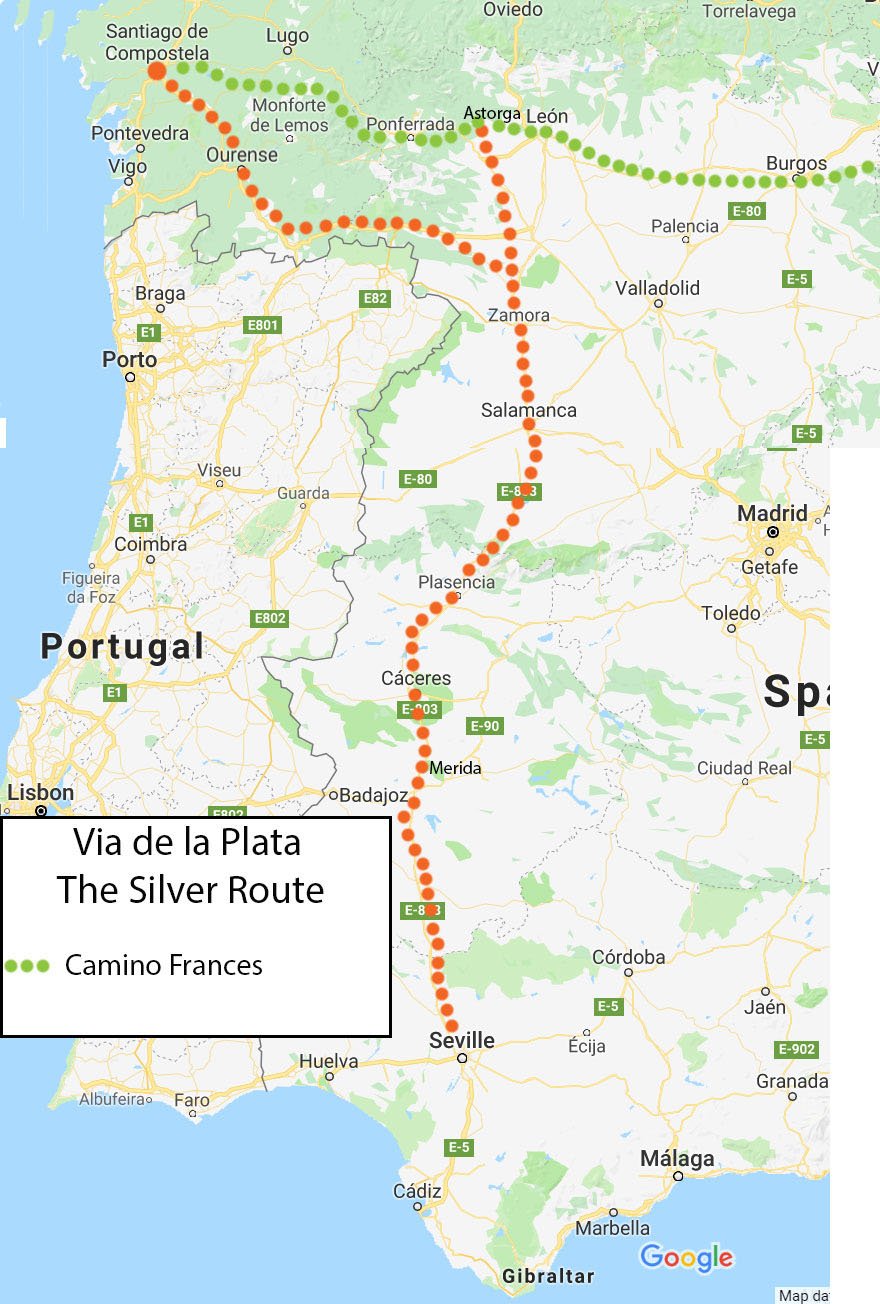
The Via de la Plata or the Silver Way follows an old Roman road to the mines in Northern Spain. Later the route was used for many other purposes e.g. moving stock from south to north in summer, trading, migratory, etc. It was used as a pilgrimage route to Santiago between the 10th and the 12th centuries. Nowadays the route has some infrastructure for pilgrims. It’s the least popular of the 7 routes, only 1,8% of pilgrims walk it.
This route is not recommended to walk as the first Camino due to the distance, fewer facilities, and long stages through nothing. For planning this walk it’s important to keep in mind the seasons.
The route splits after Zamora; one goes to Astorga where it merges with the French Camino another continues to Santiago through Ourense (this part is also known as Camino Sanabrés).
Main cities and towns on the route
Despite the length, there are not many big cities and towns on this route
- Seville
- Itálica
- Mérida
- Cáceres
- Salamanca
- Zamora
- Ourense
- Santiago de Compostela

Best walking months
April and May, when it’s warm but not too hot yet. In autumn it cools down only in October. Walking Via de la Plata between July and September is not a good idea, the temperature in Andalucía and Extremadura in August reaches 40C°, it’s very dry and hot.
What we liked about the route
- Walking surface, compared to some other routes, on the Via de la Plata there is not much tar or road walking.
- Some impressive Roman ruins, e.g. Italica, Mérida, etc.
- Every town along the route has an ATM, restaurants, and a shop/supermarket.
- No walking through industrial or urban areas, most of the time very peaceful countryside and fields.
What we didn't like
- Long stages with nothing in between, no towns or villages, no places to refill water.
- Not as many public albergues as on more popular Camino routes.
Difficulty level
I'd say 5 out of 5, a very long route combined with long stages and long distances in between. Plus tough weather conditions if you walk this Camino in summer or winter.
Scenery overview
A lot of walking through the fields, vineyards, and olive tree plantations with some interesting Roman ruins in between. In spring the area is covered in wildflowers.

Camino Finisterre-Muxía
- Distance - Santiago-Finisterre - 89 km/55 mi, Santiago-Muxía - 86 km/53 mi, Santiago-Muxía-Finisterre - 115 km/71 mi.
- Number of days (stages) - 3-5
- Starting point - Santiago de Compostela.
- Finishing point - Finisterre or Muxía
- Regions - Galicia
- It can be walked as an extension of any Camino route
The best guidebook - A Pilgrim’s Guide to the Camino Finisterre: Including Muxía Circuit: Santiago ― Finisterre ― Muxía ― Santiago, John Brierley, 2022

The name Finisterre comes from the Latin “finis terrae” which means “end of the earth”. The origin of the pilgrimage to Cape Finisterre goes back to pre-Christian times when people believed it was the edge of the world.
People usually walk the Camino Finisterre after completing one of the other routes but it can be walked as a separate Camino. It is a good option for those who are not sure if they want/will be able to walk a longer route of the Camino de Santiago. The Camino Finisterre-Muxía is the only Camino de Santiago route that starts (not ends) in Santiago de Compostela.
There are two finishing points; Finisterre and Muxía, both capes with small towns. It’s possible to walk to both of them. The route connecting the capes is the most scenic part of the Camino. After completing it you can get the Finisterrana and/or Muxiana certificates. There are plenty albergues, restaurants, and cafes on the route.
Main towns on the route
- Santiago de Compostela
- Negreira
- Cee
- Dumbria
- Finisterre
- Muxía

Best walking months
June to September. We walked this Camino in November and got a lot of rain and stormy wind.
What we liked about the route
- Beautiful sea scenery at Finisterre and Muxía
- Relaxed vibe maybe it feels that way because most people who walk this route have just finished one Camino route and are pretty chilled.
What we disliked
- Our main dislike was too much rain and strong wind we got on the route but we walked it in November, not the best time of the year.
- Very few supermarkets and shops on the way which makes it difficult to buy food.
Difficulty level
2 out of 5 - short route, many places to stop for food, many albergues. It has some hills, and a steep and long ascent on the first day (if it wasn't for that I'd give it 1 out of 5).
Scenery overview
Forest and fields most of the way, beautiful sea views on the stretch between Finisterre and Muxía.

Camino de Santiago planning resources
- How much does it cost to walk the Camino? | The cost of the Camino de Santiago - a detailed breakdown |
- What to pack for the Camino? | Packing list for the Camino de Santiago |
- Use our tips for planning your Camino | The best Camino de Santiago tips |
- How did it all start? | The history of the pilgrimage to Santiago |
- The Old Town of Santiago de Compostela | UNESCO World Heritage site |
Questions or Comments?
Got any questions or comments? We would love to help! All questions and comments will be answered by us personally in Buy Me a Coffee. Click below and ask away.
Feel free to support our site by buying us a coffee!

The pretty half of Stingy Nomads, responsible for all our land adventures (hiking, climbing, walking the Camino) and following them write-ups. Alya loves walking since she was a child, she prefers to walk 1000 km with a backpack rather than to do a 10 000 km road trip (actually any road trip). Alya is a big fan of Latin America, the Spanish language, and dancing. Every time we go away she desperately misses our dog Chile.

Hi, just could your blog and am inspired to do the Camino de Santiago. Would you be able to offer some advice on the following?
- which are the off-peak drier months with temperatures between 10 to 18 degrees?
- is it safe to walk alone as a single Asian woman?
- am considering any of the following routes: del Norte, Portuguese or French. Where are the starting points and how to get to there from the international airport?
- how to record the walk? Are there midway check points and a passbook to collect stamps? If yes, can I purchase the passbook at the starting points?
- is there a single guidebook for all routes detailing the checkpoints, places of interests, accommodation along the routes and places to eat?
- any advice on how to train for the Camino?
Hello Aby. Thank you for the comment.
The end of September - beginning of October is probably the best off-peak month when it's warm and not much rain.
- Yes, it's safe to walk the Camino as a single woman. I met many girls from Korea walking along on different Camino route and nobody complaint.
- We have detailed posts on the 3 routes you mention where you can find information on how to get there; https://stingynomads.com/st-jean-pied-de-port-how-go-get/ (Camino Frances) and https://stingynomads.com/northern-way-camino-de-santiago/ (Camino del Norte). The easiest is the Portuguese Camino because it starts in Porto. It's a big city with an international airport.
- You can buy a Credential (pilgrim's passport) at the start of the Camino route. There are no check points on the Camino. You can get a stamp at Albergues (hostels for pilgrims), hotels, restaurants, and cafes along the route.
- There is not one guidebook for all Camino routes but you can find all that information in our posts.
- We have over 50 posts on the Camino de Santiago including how to train for the Camino. You can find all the Camino posts here https://stingynomads.com/camino-de-santiago/
Buen Camino
Having just completed the first several stages of Camino del Norte ( to Deba) and abandoning it I’d like to warn people of something that’s not talked about for those in the planning stages, the Camino del Norte is not like the other Camino routes, the municipal albergues are normally closed and I believe this may be to give more business opportunities to the basque hoteliers, you will pay most nights minimum upwards of 30 euro for the same service, leave out of the hostel by 9 am etc that you pay 6 euros or donation for municipal on other Camino routes, I came all the way from New Zealand and had budgeted according to the general information on the Camino, understand this the Camino del Norte will cost you ten times the other Camino routes and it’s orchestrated by the bodies that run the Camino accomodation authorization, I will never do another Camino again because I’ve been ripped off, there are nice long coastal walks in Portugal and Turkey. dead to me now it’s a purely and cynically commercial operation in the north, the basques are normally sensible in business, they’re taking too much and they deserve to fail for robbing the pilgrims if it’s gods will, don’t do the Camino del Norte is my advice from someone that with good intent that believed it was a fair operation lost a substantial amount of money from being misinformed because we aren’t allowed to say negative things about the Camino so we don’t get the message, it’s only said in whispers, the Camino del Norte is a moneymaking Mickey Mouse operation.
Hello Guy. Thank you for your comment. I understand your frustration. When we walked the Camino del Norte we almost quit it after the first 3 days because accommodation was very expensive and there were basically no albergues. I don't know where you researched in preparation for your walk. We share our opinion about the prices on the route in this post https://stingynomads.com/northern-way-camino-de-santiago/#How_much_does_the_walk_cost. It clearly says that the Basque country is a lot more expensive and that there are very few albergues. In the comment section of that post you can see my replies to other pilgrims asking about the cost of the walk. You walked the route in the peak touristy season when hotels and hostels are a lot more expensive. Overall July and August are the peak holiday months in this part of the world.
Here is another post about the cost of different Camino routes where it clearly says that the Northern Camino is the most expensive route https://stingynomads.com/camino-de-santiago-cost/#Comparing_the_cost_of_different_routes.
All the best
Hi there!
I'm looking at a Sept/Oct Camino and have around 22-25 days for the journey. It will be my third (first solo) as I have previously walked the Portuguese Coastal route from Porto and the French Way from Ponferrada.
Candidate routes include:
1. Portuguese Interior from Viseu. This one intrigues me as I hear it's beautiful and I like less crowded ways. However, I'm concerned about lack of infrastructure and that it might be too uncrowded.
2. Portuguese Central/Spiritual Variant from Coimbra.
3. Sanabres starting in Salamanca.
I would love to hear your comments and suggestions.
All the best!
Hello Jim. Thank you for the comment. We've never walked the Camino through Viseu as the official route doesn't go there. I don't know if there will be any other people walking the route. As for infrastructure I don't think there will be much beside normal hotels/guesthouse.
Since you've already walked the Coastal Route of the Portuguese Camino from Porto maybe it's better to choose a different route. The part from Coimbra to Porto has very few pilgrims, from Porto to Santiago there will be many, the Central Route is more popular than the Coastal.
As for the Camino Sanabres I know people who walked it and they seem to like it. You might be completely along on the route some days as this route is not popular.
You can look into other Camino routes with fewer pilgrims than the Portuguese route and better infrastructure e.g. Camino Primitivo (the mountain scenery), Camino del Norte (the coastal scenery).
Buen Camino
Hello! Thank you for your informative site :). There seem to be many options on the routes. I would love your advice : I want to finish with the spiritual variant, however, from Porto to Redondela : If I have 3 days and would like to go more coastal... Baiona, Vigo and go to Santa Trega, what route would you suggest? Catching a bus or train inbetween is also fine. Thank you, Terri
Hello Terri. Thank you for the comment. I don't know where Santa Trega is. I just walk that part of the Coastal Route it don't remember seeing a town with such name. If you have 3 days to walk a part of the route from Porto and want to walk along the Coast I'd suggest considering the stretch from Caminha (includes a short boat ride) to Baiona/A Ramallosa. It's exactly 3 days. From A Ramallosa you can take a bus to Redondela. I'm not sure if there is a direct bus or you'll have to switch in Vigo. The Spiritual Variant starts in Pontevedra.
Buen Camino
@Stingy Nomads, Hello, I just in April walked the Portuguese Coastal Camino, and just after crossing from Portugal into Spain at the town called O Guarda (Spain) is a mountain in town with a historic site atop, called Santa Trega. Perhaps that is where Terri is referring to.
Thanks too for all of the information you shared here! Wonderful!
Joe from San Francisco
Hello Joe. Thank you for your input. I just came back from walking the Coastal Route for the second time and saw that site on the map but I'm not sure it's a major attraction to base the itinerary on especially if you have only 3 days for the Porto to Redondela part. I think there might be some confusion.
Cheers
Greetings from Northern Nevada! I'm going to walk the Camino Inglés this summer starting in Bedfordshire England 🏴 While this route, at least from A Coruña isn't sufficient to earn a Compostela, starting in England does. The Pilgrims of St James have an agreement to add kms in England to those in Galicia! I've just learned that the waymarked and "official" route from Reading Abbey (110 km) is extended as far as Oxford later this month. I will let you know how it goes. I'll be blazing a trail from Bedfordshire to Oxford and taking the newly waymarked trail from there to the coast.
I am from Seattle, Washington, US. I'm planning to take the Porto to Santiago route in April-May next year. What airport should I fly to Porto? Which airport is best to fly back to US from Santiago? Thanks
Hello Raymond. Thank you for the comment. It' usually cheaper to buy a return ticket than two one way tickets. If you're planning to walk the Portuguese Camino from Porto the best is to fly to and from Porto. There is a big international airport in the city. You can buy a return ticket. After finishing the Camino in Santiago you can take a bus back to Porto to catch your flight.
Buen Camino
feeling more ambitious than i should be, i would like to walk to whole del norte, but not during peak season, maybe in the spring. is that a good choice? but my main question is, how much do the private albergues cost per night, and is there any kind of current guide to lodgings?
Hello Steve. Thank you for the comment. I would suggest May then because in April it might still be a bit cold and rainy. We have a detailed post on the Camino del Norte where you can find downloadable PDF files with walking stages and a list of places to stay along the route https://stingynomads.com/camino-del-norte-stages/. When checking for prices make sure to choose the right month as they vary greatly depending on the season. The first part of the Camino dell Norte through the Basque Country and Cantabria is more expensive that the second part through Asturias and Galicia. Outside of season accommodation including private rooms is quite affordable.
Buen Camino
Hello! Thank you so much for the info! I am flying into Santiago on Sept. 3rd and arrive in the late afternoon. I was thinking about doing the 1st 6 days of the Camino Primitivo and then taking a taxi or bus to Fisterra to enjoy for a few days before flying on to my next destination. I was also thinking about doing a part of the Del Norte but really wanted the mountains. I've done the Camino Frances already and didn't want t repeat a path. Would you have a recommendation for which part of the Camino Primitivo to complete in 6 days, or would you recommend Del Norte? I'm ok not getting a certificate and want more nature but am getting stuck on how to get to a starting point and then back to Santiago. I wish I had more time, but I fly out early on the 12th. Thank you for your input!
Hello Becky. Thank you for the comment. If you want the mountains then the Camino Primitivo is the best one to walk. I'd suggest the first half of it from Oviedo, it's the most mountainous part. You can get to Oviedo by bus from Santiago de Compostela. If you walk 6 days from Oviedo you'll probably finish in Grandes de Salime (if you follow the suggested itinerary https://stingynomads.com/camino-primitivo-stages/). From Grandas de Salime you can get a bus to Oviedo or to Lugo. There are direct buses to Santiago from both cities.
Buen Camino
Hi,
I was wondering if you combined the Del Norte Route with the Camino Primitiva, would that take same time as doing the Del Norte Route in its entirety? Thanks!
Hello Brigid. Thank you for the comment. We walked both routes separately. It takes more or less the same time to walk del Norte if you walk it all the way to Santiago or if you switch to the Primitivo. You can expect to spend 30-35 days walking depending on your daily distances, number of rest days, etc.
Buen Camino
Hello,
I would like to know how you get to a starting point on the Camino Frances that is around 120KM away from Santiago? Also once in Santiago how does one get to major airport to move on?
Hello Chris. Do you mean the town of Sarria (the one that is 120 km away)? We have a detailed post on the Camino de Santiago from Sarria where you can find information on how to get there https://stingynomads.com/camino-frances-sarria-santiago-walk/
There is an airport is Santiago from where you can fly to many Spanish cities and some other places in Europe. Otherwise the best will be to take a train or a bus from Santiago to Madrid and fly from there. There are direct trains and buses including buses that go directly to Madrid Airport. I'd suggest check RENFE website for trains and ALSA for buses.
Buen Camino
What route would you recommend for someone doing it the first time? I’m deciding between Camino Frances or Camino Del Norte.
Hello Renee. Out of the two Camino routes for a first-timer I'd recommend Camino Frances. It has a lot more infrastructure for pilgrims including albergues and budget accommodation options than del Norte. Many people walk the French or the Portuguese route as their first Camino. Just keep in mind that the Frances is the most popular route if you walk it between May and September there will be many pilgrims. The Portuguese Camino from Porto is a good alternative to the Camino Frances it has several route options so you don't see hundreds of people on the route every days. If you like walking along the coast I can definitely recommend the Coastal Route of the Portuguese Camino. It's quite a bit shorter than the French route as well which might be a good thing if you have never done long-distance walking.
Buen Camino
Thank you for your detailed information. Very helpful! What is your most favorite route?
Hello Scott. Thank you for the comment. It's difficult to choose the favorite route they all are very different. We like hiking and really enjoyed the Camino Primitivo as it's the closest you can get to hiking in the mountains on any Camino route. For the coastal scenery the Camino del Norte is the best route. Out of the shorter routes we really liked the Camino de Gran Canaria, it's a 3-day trail on Gran Canaria Island.
Buen Camino
This is excellent page. Thank yiu for sharing your experiences. I came to your web by accident figuring out some forest walks .... I wonder if you could share which part/route is the most foresty. I love walking in forests and consider Camino Finisterre-Muxía route. I would be grateful if you could let me know your views. Thank you.Gloria from Cambridge
Hello Gloria. Thank you for the comment. I'd say the Camino Primitivo has the most forest and overall reminds more of a hiking trail. It takes 12-14 days to complete it. If you're looking for a shorter route then the Camino Finisterre would be a good option. It takes 5 days on average to complete.
Buen Camino
Hello,
Thank you so much for your site - it's incredibly comprehensive and helpful! I'm thinking of doing the second half of the Camino del Norte in late July/early August this year. Do you think I'm ok to rely on public albergues during that busy time of year? This is my first camino, I'm travelling solo and I don't want to have to rush to get a bed, like you say is common on the Camino Francés, so I'm hoping there would be plenty of beds available on this route instead. What do you think?
Thanks again for all your information - it's very inspiring!
Emma
Hello Emma. Thank you for the comment. There are not that many public albergues on the Camino del Norte it's impossible to stay only in public albergues. As far as I remember public albergues on del Norte are not as big as on the Camino Frances they have fewer beds. Some nights you'll have to stay in private albergues or hostels. July and August are the peak season for the area mainly for the beach towns you can expect higher accommodation prices and fully-booked places. We have a detailed post on the stages of the Camino del Norte where you can find a PDF with a list of places to stay along the route https://stingynomads.com/camino-del-norte-stages/. I'd suggest you plan your walk and more or less decide on the towns you're going to stop in and check if there is a public albergue or a private one and how many places to stay are in each town. After that, you can see if you have to book some places in advance or if it's unnecessary.
Buen Camino
Hello.Chathol here. I plan to walk the Frances Camino starting around the first week of July in Pamplona. My main question is how do I book a bed in advance? I do not want to camp outdoors. I am open to almost all kinds of residences. Do I book by email, as I usually do for Bed and Breakfasts when in Europe/UK? Is there a list of hotels and private/public albergues? If not how do I go about it? I know my routes and distances pretty well at this point. Thank you! Chathol Linn
Hello Chathol. Thank you for the comment. I'm not sure if you have seen our detailed post on the walking stages of the Camino Frances. Here it is https://stingynomads.com/camino-frances-walking-itinerary/. In the second paragraph of that post, you can find free downloadable PDFs that contain walking stages and a list of places to stay along the Camino route. Most private albergues and hotels can be booked online through booking.com. I find it's the easiest way to book accommodation on the Camino.
Buen Camino
Firstly, I would like to say how much I appreciate your blog. It has provided me a lot of helpful information. I am planning my first Camino trip for late September to October 2023. Based on your blog questions and responses, I am thinking about the Camino del Norte, due to the length, vistas and food. A few questions:
1) will there be enough small hotels available and open along the Camino at that time, or do I have to reserve in advance?
2) will I be able to send my pack to the next hotel?
3) I will be travelling solo, but very social. Do I need to stay at the aubergues to meet other hikers, or will that just happen along on the trail?
4) is it easiest to fly to Madrid and get to the Camino from there, or go to San Sebastián or Bilbao?
Thank you, Rob
Hello Rob. Thank you for the comment.
1. Yes, in n September - October most hotels and private albergues will be open.
2. Yes, there is a backpack delivery service on the Camino del Norte.
3. You can meet people on the route and go out together for lunch or dinner. If at any stage you feel lonely you can always stay for a night or two in an Albergue to meet other pilgrims.
4. I don't know what country you're coming from. If you come from overseas it's easier to fly to Madrid and from there get to the Camino del Norte.
We have 2 detailed posts on the Camino del Norte. Camino del Norte walking stages https://stingynomads.com/camino-del-norte-stages/ where you can find a complete list of places to stay along the route. And a detailed guide to the Northern Camino https://stingynomads.com/northern-way-camino-de-santiago/ where you can find detailed answers to your questions #2 and 3.
Buen Camino
Hello! I am so delighted I found your website. Thank you! I have learned so much already.
Based on what you've shared, I believe I'll be taking the Norte route as the thought of walking near water sounds amazing.
I am a VERY light sleeper so I wasn't planning on staying in any public or private albergues. However, after reading and your encouragement, I'll be sure to stay a couple days to get a feel for the experience. You mentioned for a solo traveler to expect around 30-35 euros/night if you stay in a hotel. Would you say that is pretty typical on the Norte route? Is there a 'best' time of year to walk this route - combining weather AND costs?
Or - is there a different route (other than the busy Frances) that offers nightly hotel accommodation at a reasonable price? I'm interested in at least 2-3 weeks of walking, which is why I initially looked at Norte. (I can take as much time as I need.)
Thank you so much for the help!!! I'll be sure to head over and buy a couple cups of coffee, too!
Hello Jen. Thank you for the comment. Out of 9 Camino routes, we've walked the Camino del Norte worked out the most expensive. Everything in that part of Spain is quite pricey especially accommodation. In some places, you'll be very lucky to find a room for 35 euros, especially during the summer months. Camino del Norte has some spectacular scenery but it is quite expensive to walk especially if you are a solo traveler and want to stay in private (to share a double room usually works out cheaper per person).
If you want to walk along the coast have good weather and reasonable accommodation prices I'd say the Coastal Route of the Portuguese Camino is your best option. It's not as popular as the Camino Frances and it has enough places to stay. Overall Portugal is cheaper than Spain especially the Basque Country and Cantabria. To walk the Coastal Route takes around 12-14 days. If you want to walk more from Santiago you can continue walking on the Camino Finisterre-Muxia which will add 5-6 more days. In total, your walk will be around 3 weeks.
Buen Camino
Really loved how you organized your data and facts for the el Camino. Just right to get a group to gain consensus on which route we can try as first timers.
Hello Vaishali. Thank you for the comment. I hope you'll find the best Camino route for you and your friends. If you have any questions we'll be happy to help.
Buen Camino
Hi - love your site! Followed a lot of the information for my first Camino (Camino Frances - SJPP to Santiago) and loved it! I was looking to get a similar distance with a good mixture and was thinking Portuguese Central from Lisbon switching to the Spirtual Route then back on Central to Santiago. What would the total kms be and would this give a good mixture of quaint villages with coastal too? Was thinking of doing Via Francigena but have heard that it is a lot quieter and much less pilgrim community.....
Hello Rosie. Thank you for the comment. The total distance of the walk from Lisbon to Santiago will be roughly 640 km. We have a detailed post on the Portuguese route from Lisbon where you can find more information on the route https://stingynomads.com/camino-fatima-walk-lisbon-porto/. If you walk the Central route and the Spiritual Way you'll get barely any coastal scenery (just one day on the Spiritual Way). If you want a combination of the coastal scenery and the villages I would suggest taking the Coastal Route from Porto. This way you see rural scenery and villages on the Lisbon to Porto part and the coastal scenery and beach towns on the Porto to Santiago part.
Buen Camino
@Stingy Nomads,
thank you for your reply...that does sound like a good combination, then possibly finishing with Finisterre to get close to the 800 km like the CF. Would you say that from Lisbon to Porto is Camino friendly? I have hear and read that there are many cobblestone paths and highways...we are deciding on this route versus Camino del Norte. Thanks again!
To he honest for the scenery we definitely prefer the Camino del Norte over the Camino Portuguese from Lisbon. I can't recall walking next to highways a lot. Cobblestones were mainly in the second half of the Camino route from Porto on. The main challenge on the Lisbon to Porto part is a lack of infrastructure not only for pilgrims but overall. Distances between towns are quite long, there are few hotels and albergues, etc. Which route to choose depends on what scenery you want to have. If you want to walk along the coast and historical towns then the Camino del Norte is the best. If you want to see rural areas then the Portuguese Camino from Lisbon. You do see historical towns on the Portuguese Camino as well but not as many as on the Camino Frances or del Norte. The only drawback of walking del Norte is that it works out more expensive at least the first half of it through the Basque Country and Cantabria.
Buen Camino
Hello,
Wonderful advice. I've walked the Camino Frances in May of 2019 from SJPDP to Santiago. Am planning another Camino this spring and was considering walking from Lisbon to Santiago or doing the Camino del Norte. I am quite fit, a 60 year old woman walking alone. Which route would you recommend? Thank you.
Warm regards,
Julie
Hello Julie. Thank you for the comment. We've walked both Camino routes the Portuguese from Lisbon and del Norte. From the scenery point of view the Camino del Norte is by far more impressive. You get to walk a lot along the coast of Northern Spain and it's spectacular. The part of the Portuguese Camino from Lisbon to Porto is mostly countryside. Walking the Camino del Norte is more expensive than the Camino Frances. There are fewer public albergues and overall prices in that part of Spain are higher especially during the holiday season (July and August). It's a more challenging route as well as it has many ascents and descents but nothing like the two passes on the Camino Frances. I think if you're fit and enjoy walking the Camino del Norte a good route to take.
Buen Camino
@Stingy Nomads, Thank you very much for replying. Reading you is most helpful.