
Portuguese Camino routes - explained
Figuring out the many routes of the Portuguese Camino de Santiago might be confusing for first-time pilgrims. Over the recent years I've walked all the routes many of them more than once and have a lot of knowledge about them. In this post I explain the main routes of the Portuguese Camino, compare them, and give my opinion on each of them.

Stingy Nomads participates in the Amazon Services LLC Associates Program and other affiliate programs. If you click on the link and purchase the item or make a booking, we will receive an affiliate commission at no extra cost. Thank You for supporting us and assisting us to produce quality, free content.
Portuguese Camino planning tool
We've created a free planning tool. Using it you can choose any route of the Portuguese Camino, add the Spiritual Variant, choose the daily distance, a starting point and get a customized itinerary with places to stay for every stage.
How many routes does the Portuguese Camino have?
The Lisbon to Porto part of the Camino has one route. It goes inland from Lisbon through Santarem and Coimbra to Porto.
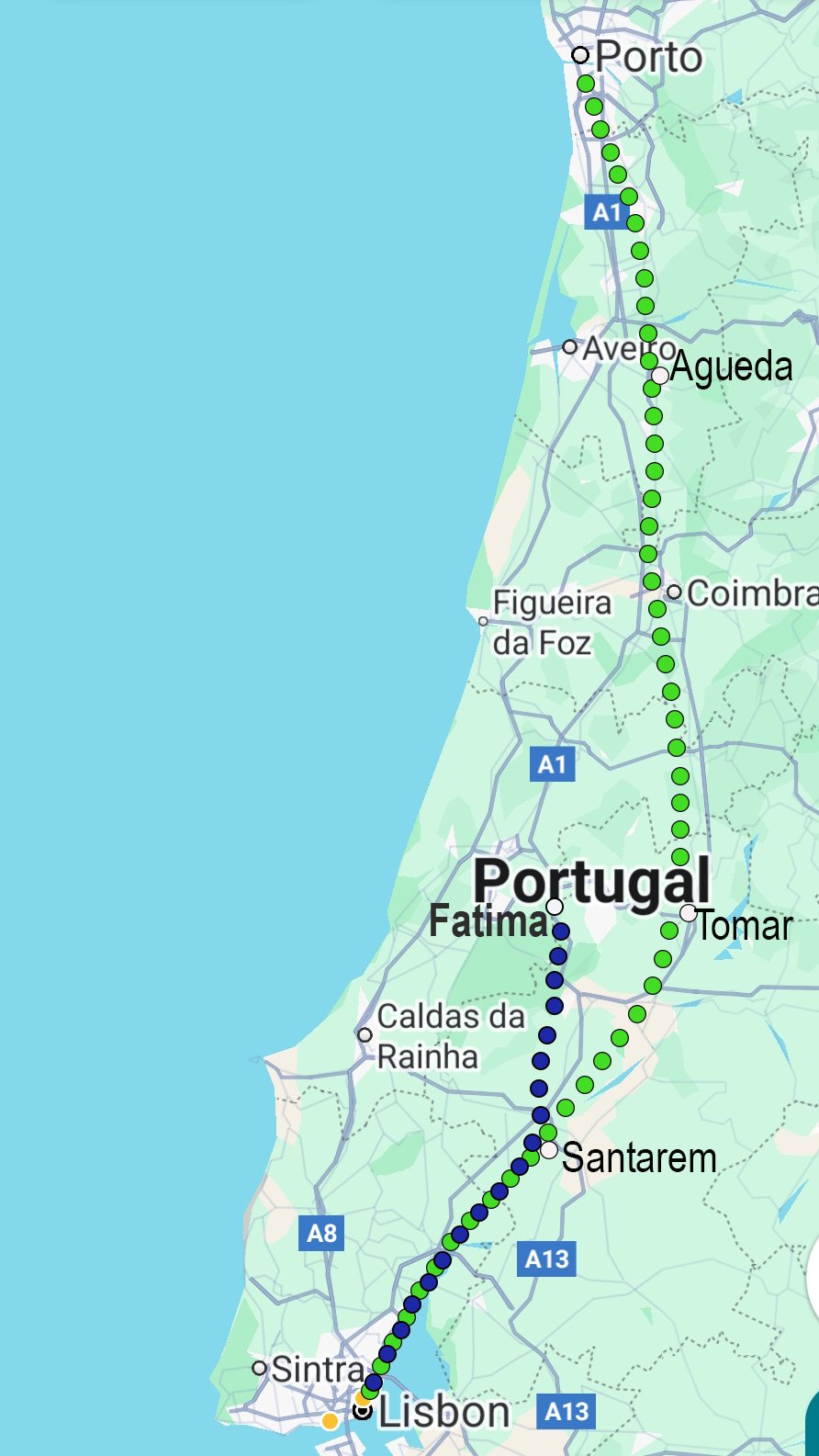
The Camino from Porto has 3 routes; Central, Coastal, and Litoral.
There is an alternative route on the Portuguese Camino from Pontevedra to Padron, it’s called the Spiritual Variant.
As you can see, the part of the Camino from Porto to Santiago has many route options.
If you still deciding where to start the walk we have a detailed post comparing the pros and cons of starting the Portuguese route in Lisbon, Porto, and Tui.

We have detailed posts with PDF and GPX files of the main and combined routes of the Portuguese Camino.
- The Central Route of the Portuguese Camino
- The Coastal Route of the Portuguese Camino
- The Litoral Way of the Portuguese Camino
- Coastal and Central routes combined
- Litoral and Central routes combiend
- The Spiritual Variant of the Camino Portugues
See our detailed Packing List for the Camino Portuguese.
What is the best route of the Portuguese Camino?
It depends on your preferences. For me, the Litoral Way is the best route because I enjoy walking along the coast. Another bonus of this route is that it’s flat. It has barely any hills. If you don’t like ups and downs, the Litoral Way is definitely the best route. 80% of the route is next to the sea. Another good thing about the Senda Litoral is that it doesn't go along busy roads or through industrial areas.
For historical towns I’d say the Central Route is the winner. I liked the towns on this route the most. The forest part is nice too. You get to see rural areas, forests, and fields. This route offers the best cultural experience. Many sources refer to it as to the original route of the Portuguese Camino.

I have mixed feelings about the Coastal Route. Despite the name most of it is inland. Only 30% of the route is next to the coast. Which is not what you expect when you decide to walk the coastal route. This route is something between the Central Route and Litoral Way. It goes along the coast but at the same time you walk through forest and over the hills.
You can combine all routes of the Portuguese Camino in one walk to see for yourself which one you like the most.
As for the Lisbon to Porto part of the Camino it's more challenging than the Porto to Santiago part. Because it has few albergues, longer distances between the towns, and goes through more isolated areas. The scenery on the Lisbon route is beautiful especially in spring time but it's 100% rural (mostly fields), no coast or mountains.

Pros and cons of each route
Central Route
Pros
- It has a good infrastructure for pilgrims.
- If you like history you'll enjoy the Central Route more it has interesting historical towns.
- It’s shorter compared to the other two routes.
- It’s a better option to walk in bad weather conditions e.g. strong wind or heavy rain.
- There are more pilgrims if you walk alone and want a company it is a good route.
Cons
- It is the busiest route, 56% of pilgrims on the Camino Portuguese walk the Central Route.
- It has many hills.
- It's 100% inland.
Coastal Route
Pros
- 30% of the route is along the coast.
- Fewer pilgrims. In 2024 44% of pilgrims on the Portuguese Camino walked the Coastal Route.
- A good combination of the coastal scenery, countryside, and forest.
Cons
- If it’s very windy and rainy it’ll be an unpleasant route to walk.
- It has hills (a little bit less than the Central Route).
- Less infrastructure, I mainly refer to public albergues but it never was a problem for us.
- Confusing route marking on the part of the route near Vigo.
Litoral Way (Senda Litoral)
Pros
- 80% of it is along the coast.
- It is very flat with barely any hills.
- It's the least popular route, a small percentage of pilgrims from the Coastal Route walk the Litoral Way.
Cons
- The lack of route marking.
- The worst route to walk in bed weather.
- It might feel a bit lonely outside of the season.
Comparing the Portuguese Camino routes
Distance from Porto to Santiago
- Central Route - 243.5 km/151 mi
- Coastal Route - 274 km/170 mi
- Litoral Way - 280 km/173 mi
Number of days (stages)
- Central Route - 10-13 days
- Coastal Route - 12-15 days
- Litoral Way - 12-15 days
Total ascent/descent
- Central Route - 4045 m/3820 m
- Coastal Route - 3990 m/3716 m
- Litoral Way - 2975 m/2705 m

Number of pilgrims
- Central Route - 63% of pilgrims on the Portuguese Camino
- Coastal Route - 37% of pilgrims
- Litoral Way - there is no data for the Litoral Way because it coincides with the Coastal Route. A smaller part of 37% from the Coastal Route walks the Litoral Way.
Walking surface
- Central Route - 42 km/26 mi - cobbled; 143 km/89 mi - tar road/asphalt; 57 km/35.4 mi - footpath/gravel road.
- Coastal Route - 29 km/18 mi - cobbled; 155 km/96 mi - tar road/asphalt; 65 km/40.3 mi - footpath/gravel road; 24 km/15 mi - boardwalks; 1 km/0.6 mi - beach.
- Litoral Way - 19 km/11.8 mi - cobbled; 167 km/103 mi - tar road/asphalt; 53.5 km/33.2 mi - footpath/gravel road; 35 km/21.7 mi - boardwalks; 5.5 km/3.4 mi - beach.
Route marking
- Central Route - well-marked from the start to the end
- Coastal Route - well-marked except for the part of it through Vigo
- Litoral Way - some parts are marked some not
We have two detailed posts comparing the Central Route and Coastal Route and the Litoral Way and Coastal Route.

How to combine the Camino routes?
You can combine all 4 routes of the Portuguese Camino.
- The easiest way is to start on the Litoral Way from Porto to Vila do Conde.
- Then continue combining the Litoral Way and Coastal Route (both routes merge and split all the time) to Caminha.
- From Caminha walk to Valença and from there continue on the Central Route to Pontevedra.
- From Pontevedra you follow the Spiritual Variant to Padron. And from Padron continue again on the Central Route to Santiago.
As an option you can combine the Litoral and Central routes or the Coastal and Central routes.
What is the most scenic route?
In my opinion (which might be different from yours) the Litoral Way is the most scenic route. You get to see many spectacular unspoiled beaches, the picturesque coast with old windmills, small fishermen villages, and lighthouses.
The Coastal Route has similar scenery but you walk next to the sea a lot less than on the Litoral Way.
The Central Route is beautiful too. In my opinion it has the most interesting historical towns.
Here I want to mention the Spiritual Variant too. A walk through the beautiful forest around Armenteira and a boat ride from Vilanova de Arousa to Pontecesures is a unique and very special experience.
The route from Lisbon to Porto is mostly through the countryside but it does have interesting towns such as Santarem, Tomar, Coimbra, and Agueda.

What is the shortest route?
The Central Route of the Portuguese Camino is the shortest one. The total distance from Porto to Santiago is 243.5 km/151 mi. It takes between 10 and 13 days on average to complete it.
If you want to walk a shorter route and still get your Compostela certificate you can walk the last 100 km on the Central Route from Tui (Central Route) or on the Coastal/Litoral Route from Vigo.
The distance of the Portuguese Camino from Lisbon to Porto is 370 km/230 mi. The total distance from Lisbon to Santiago depends on which route from Porto you choose. It is 613 km/381 mi on the Central Route; 644 km/400 mi on the Coastal Route; and 650 km/403 mi on the Litoral Way.

Which Portuguese route has less cobblestones?
The Litoral Way has the least walking on cobblestones (calçada portuguesa). 19 km out of 280 km are on cobblestones. You get cobbled streets in the Portuguese part of the route. In Spain you sometimes get them in historical centers.
The route with the most historical towns
The Central Route has the most interesting historical towns. Some of the best towns on the route are Barcelos, Ponte de Lima, Valenca, Tui, Caldas de Reis, Redondela, Pontevedra, Padron.
You do get beautiful towns on the Coastal and Litoral Way. Some of my favorites are Viana do Castelo, Caminha, Baiona, and Vigo. The last one is a big city with a busy port but the historical center is beautiful.

Which Camino is the best for first-time pilgrims?
I’d say the Central Route is the most straightforward and easy to follow. It’s well-marked from the start to the end. It has the most pilgrims and best infrastructure.
The Coastal Route is marked too and has enough places to stay. Some parts of the route might be a bit confusing. I mostly refer to the walk to and from Vigo. It has many albergues though a bit fewer than the Central Route.
As for the Litoral Way it might be more challenging for first-time pilgrims who are not used to walk using GPS navigation. A big part of the route is not well-marked. It’s easy to follow as it goes along the coast but in some places you have to use navigation e.g. to get across the river.

The Spiritual route of the Portuguese Camino
The Spiritual Variant is another route of the Portuguese Camino from Pontevedra to Pontecesures. This route is unique because it includes a boat ride. The boat trip (Traslatio) from Vila Nova de Arousa to Pontecesures is believed to repeat the route that was used to bring the remains of St.James (Santiago) from Jerusalem to Santiago de Compostela.
The route is spectacular and the boat ride adds a special touch to the Camino experience. The Spiritual Variant has fewer pilgrims than the main Portuguese route so if you walk in the peak season and want to skip the crowds it’s a good alternative.
The distance from Pontevedra to Padron
- on the Spiritual Variant - 74 km/46 mi (46 km/28.5 mi walking and 28 km/17.3 mi by boat), 3 stages
- on the main Camino route - 39.5 km/24.5 mi, 2 stages
Questions or Comments?
Got any questions or comments? We would love to help! All questions and comments will be answered by us personally in Buy Me a Coffee. Click below and ask away.
Feel free to support our site by buying us a coffee!

The pretty half of Stingy Nomads, responsible for all our land adventures (hiking, climbing, walking the Camino) and following them write-ups. Alya loves walking since she was a child, she prefers to walk 1000 km with a backpack rather than to do a 10 000 km road trip (actually any road trip). Alya is a big fan of Latin America, the Spanish language, and dancing. Every time we go away she desperately misses our dog Chile.

Hi! Thank you so much for sharing your knowledge and beautiful work here to help others.
I want to combine the routes and I read about your suggested options how to do that. However I would like to go to the Islas Cies and planning to take the boat from Baiona, therefore the option to switch from Coastal to Central Route in Caminha doesn't work for me. I'd like to ask for your advice regarding below alternatives where to switch route:
* Central Route between Porto - Barcelos (walk or take a buss from Barcelos till Fao) and continue on Coastal/Litoral Route from there
* Central Route between Porto - Valenca do Minho/Tui and from there walk or take transport to Caminha and continue on Coastal/Litoral Route
* Central Route between Porto - Ponte de Lima and walk/transport between Viana do Castelo and continue Coastal/Litoral Route
I would love your advice if there's any of these parts of the routes that you think is especially incredible that I shouldn't miss when I switch routes. And the second question is if there are any good connecting routes on the other options than Caminha - Valenca/Tui.
Thank you so much!
Hello Sofia. Thank you for the comment.
Do you want to see anything specific on the Central Route or you just want to combine 2 routes? To be honest the first couple of stages from Porto are nicer on the Litoral Way. I'm not sure it makes sense to walk out of Porto on the Central Route and then to switch to the Litoral/Coastal.
There is a connecting route after the first stage from Vila do Conde (Litoral/Coastal) to Sao Pedro de Rates (Central Route) which I guess can be walked in the opposite direction. But again I'm not sure it makes sense to walk 1 day on the Central route and then switching to the Litoral/Coastal. Many people who walked the Central route prefer to walk out of Porto following the Litoral Way and then switching to the Central route in Vila do Conde. Because the most scenic first stage with least roads is on the Litoral Way.
If you really want to start walking on the Central Route the best in my opinion is to walk to Valenca, from there walk or take a train to Caminha and continue on the Litoral//Coastal route.
Buen Camino
I've seen a number of pilgrims recommend taking a bus out of Porto to avoid the first day of walking through the city. What is your thoughts on that? I did the Camino Frances 3 years ago and this year I am doing Camino Portuguese with my 22 year old grandson. He could only get two weeks off and so has to be back in Porto to catch his flight out. I am 72 years old and I managed to do Camino Francis in a little over 5 weeks. I was thinking bussing out of Porto might help us to not be rushed. I also thought that if we see we are getting pushed for time we could go to Tui by taxi to skip a day's hike and keep us on schedule. That way he would still get his Compostela. Any recommendations. We are hoping to start on the literal route out of Porto and switch over to the central route at some point. Any recommendations about how to do that? Thanks for all your great info!
Hello Mary. Thank you for the comment. The Litoral Way out of Porto is nice even the city part is along the river first and then by the sea. If you want you can skip it and take a train to Vila do Conde from Porto. You can switch from The Litoral Way to the Central Route in Caminha. The stage from Caminha to Tui is very long since you don't have much time you can take a train from Caminha to Valenca to skip that part.
According to the new rules for getting the Compostela you should walk at least 100 km, 70 km of which should be in Spain and it should include the last stage on the route to Santiago de Compostela, for the Portuguese Camino it is the stage from Padron to Santiago. If you have to skip some parts rather do so in Portugal to make sure you walk 70 km through Spain.
Buen Camino
Awesome information! Thank you for your time and effort in putting all this information in one place.
I have a question. Eight of us are planning to bike ride the exact combination of the Litoral, Coastal, Inland and Spiritual routes you described above. Would you advise this or a different route? We are also looking for a company to help plan the stages of our ride. Thanks!!
Hello Lisa. Thank you for your comment. The Litoral route is the best for cycling as it's flat with no hills and a lot of it is on boardwalks or cycling routes (in Spain but if you switch to the Central route you will miss that part). The only section of the Litoral Way that is not great for cycling is the one from Esposende to Viana do Castelo, it is on the rocks and dunes.
As for the Spiritual Variant, the first stage of it from Pontevedra to Armenteira has a very steep hill, check the elevation profile in this post https://stingynomads.com/spiritual-variant-portuguese-camino/#Stage_1_Pontevedra_to_Armenteira_21_km13_mi. I'm not sure how nice it's for cycling. I checked the boats that do the on the Spiritual Variant do take bicycles on board, you pay 5 euros per bicycle.
We have a free Portuguese Camino planner which you can use to plan your route. Of course for cycling the distances will be longer you can combined two stages in one to get the desired distance. Here is the link https://stingynomads.com/portuguese-camino-planner/
Buen Camino
Hi,
Planning our Camino Portuguese we found you!
Worth full and inspiring!
Thank you for your generosity!
Best,
Nina & Thomas
Hello Nina and Thomas. Thank you for the comment. It's great to know that our site is helpful for fellow pilgrims. Buen Camino!