The French Camino de Santiago - a 2026 guide
The French Camino is one of the routes of the Camino de Santiago, a pilgrimage to the tomb of the Apostle St.James in Santiago de Compostela. It is the most popular Camino route. According to the Pilgrims’ Reception Office in 2024, 236 381 people walked the French route. Pilgrims start their walk from different towns along the Camino. 64% of the pilgrims walk the last 100 km on the French route from Sarria.
You can find more information on walking stages, distances, elevations, stops along the route, and albergues in our post Camino Frances walking stages.
Stingy Nomads participates in the Amazon Services LLC Associates Program and other affiliate programs. If you click on the link and purchase the item or make a booking, we will receive an affiliate commission at no extra cost. Thank You for supporting us and assisting us to produce quality, free content.
French Camino planning tool
You can use our free Camino Frances planning tool. Choose your daily distance and a starting point and get a customized itinerary with recommended places to stay.
The route overview
- Total distance - 770 km/478 mi
- Number of days required – 30-33 days
- Walking surface - 290 km/180 mi - tar/asphalt; 480 km/298 mi - gravel road/footpath
- Walking on the road - 70 km/43.3 mi mostly quiet roads with almost no cars
- Average cost - 35-40 Euros per person per day
- Accommodation - private and public albergues, hotels, guesthouses
- Route marking - yellow shells and arrows, distance poles (in Galicia)
Insurance for the walk
You can read more information on travel insurance for the Camino Frances in our dedicated post on Camino travel insurance or get an instant quote right now.
Things can and do go wrong when you travel. World Nomads offers coverage for more than 150 activities as well as emergency medical, lost luggage, trip cancellation and more.
French Camino PDFs
To make your planning easier we've created free downloadable PDF files that contain detailed walking stages and places to stay on the French Way of St.James.
- The French Camino walking stages. Part 1. SJPDP to Leon. PDF
- The French Camino places to stay. Part 1. SJPDP to Leon. PDF
- The French Camino walking stages. Part 2. Leon to Santiago. PDF
- The French Camino places to stay. Part 2. Leon to Santiago. PDF
What is the French Way of St.James?
The French Way is the most popular Camino de Santiago long-distance pilgrimage route. The history of the Camino dates many centuries back. Since the 12th century, the French Camino has been used by hundreds of thousands of pilgrims from all over Europe as the main route to the tomb of St.James in Santiago de Compostela. Due to its popularity, the French Camino has the best infrastructure and the most albergues compared to the other routes. Many pilgrims walk it as their first Camino.
How long is the route?
The distance of the French Way of St.James from St.Jean-Pied-de-Port to Santiago de Compostela is 770 km/478 mi. One needs 30-35 days to complete the route. There are plenty of beautiful towns on the French Camino if you need to take a rest day.

Where does it start?
The French route starts in the small town of Saint-Jean-Pied-de-Port in France, near the border with Spain. St.Jean is the official start of the Camino but you can start walking from anywhere along the route. Many people don't walk the entire Camino and do only a part of it depending on how much time they have and how far they want to walk.
Popular starting points of the French Camino
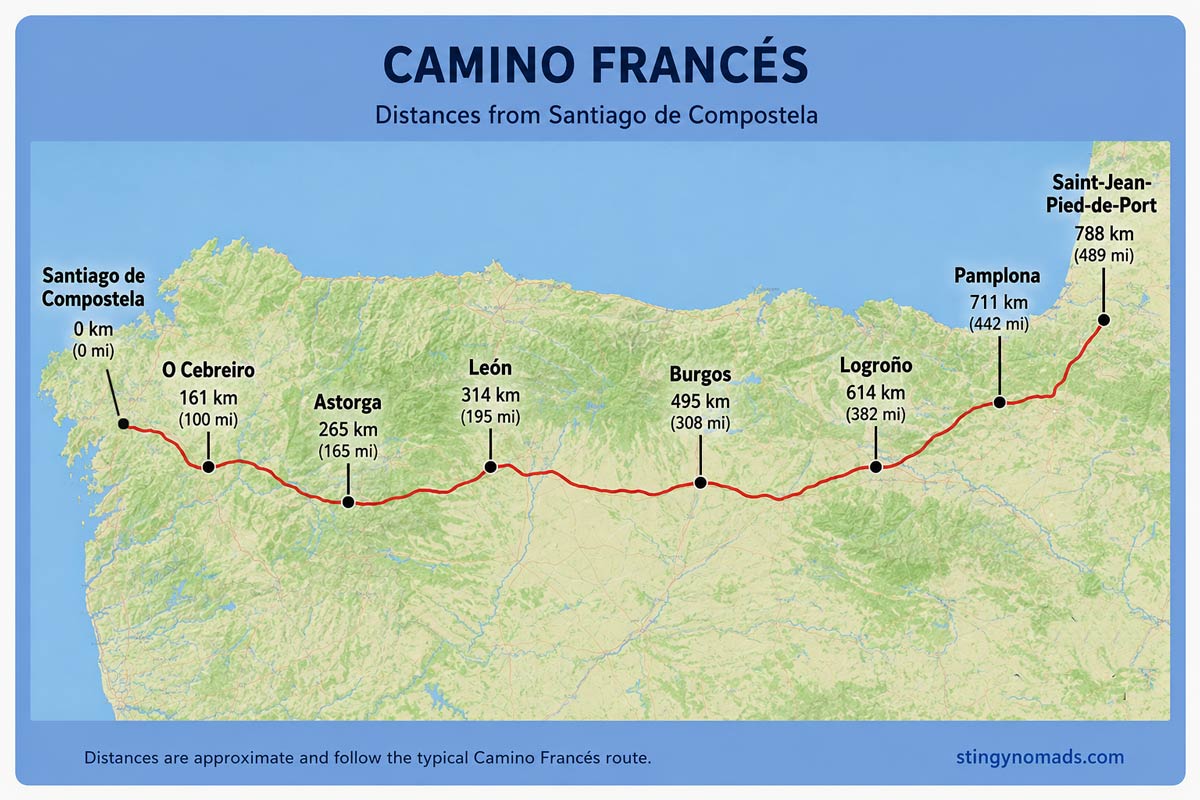
| Name of the town | Distance to Santiago |
|---|---|
| Le Puy (France) | 1490 km/925 mi |
| Saint-Jean-Pied-de-Port | 770 km/478 mi |
| Roncesvalles | 746 km/463 mi |
| Pamplona | 702 km/436 mi |
| Logroño | 606 km/376 mi |
| Burgos | 483 km/300 mi |
| León | 319 km/198 mi |
| Astorga | 267 km/166 mi |
| O Cebreiro | 162 km/100 mi |
| Sarria | 116 km/72 mi |
Le Puy is 1500 km/932 mi from Santiago, St.Jean-Pied-de-Port is about halfway. I haven’t walked the French part yet. From what I’ve heard the French part of the Camino is quite different. First of all, because there are very few people which might be great if you’re seeking solitude. Second, there are fewer albergues which means your accommodation expenses will be higher.
Many people start the French Camino in Roncesvalles (746 km/463 mi from Santiago) skipping the challenging stage from Saint-Jean-Pied-de-Port. My advice is if you start in Roncesvalles and get there by bus book your accommodation ahead, there is one big public albergue for 200 people, and two hotels. You can book it online.

Starting in one of the big cities like Pamplona, Logroño, Burgos, Leon, or Astorga is a popular option. You can choose any of these cities depending on how much time you have and how far you want to walk. It's quite easy to get to any of the cities from anywhere in Spain or Europe.
Many people start walking the Camino from Sarria, a town that is 116 km/72 mi from Santiago. It’s an option if you don’t have much time and want to walk the required 100 km/62 mi for getting the Compostela certificate.
Is it easy to find the route?
Yes, the route is well-marked from start to end. The French route is one of the best marked Camino routes. You can follow yellow shells and arrows painted on the ground, walls, stones, and Camino signs. You don't need GPS to find the route.

The best guidebook
If you want to buy a guidebook I can recommend A Pilgrim's Guide to the Camino de Santiago; Camino Frances by John Brierley. We used his guides for several Camino routes including this one. They're easy to use, very detailed, and helpful.
How hard is the walk?
The French Camino is a tough walk like any long-distance route. It has some challenging parts with steep ascents and descents and long walking stages. It's especially hard for first-time pilgrims who have never done a multi-day walk before. So training for the Camino de Santiago is important.
How to get to the French Camino?
St.Jean-Pied-de-Port is the official start of the French Way of St.James. It's a small French town on the border with Spain. Getting there might look a little bit complicated. I tried to put together the best transportation options.

Either way via France or Spain you'll have to make at least one switch to get to St.Jean. There are no direct transport options from the capital cities. Departure times and ticket prices can change at any time, you can confirm the information on the companies' websites. We have a detailed post explaining how to get to St.Jean Pied de Port from different cities in France and Spain.

Backpack delivery on the Camino
It’s possible to walk the French Camino with a day pack. Several luggage transfer offer luggage delivery on the route. You can carry only valuables and water with you and your luggage will be delivered to your hotel/albergue. The service costs 7€ per backpack per stage on average. The backpacks are picked up in the morning at the reception and delivered by lunchtime. Correos, Pilbeo, and Xacotrans (from O Cebreiro to Santiago) are the main companies offering luggage transfers.
My favorite parts of the route
I enjoy mountainous scenery and don't mind steep ascents and descents. For me the beginning of the French Camino from Saint-Jean-Pied-de-Port to Pamplona and the middle section to and from O Cebreiro are the best parts of the route.
If you prefer walking on flat ground then the part of the French route between Burgos and Leon, the famous Meseta is the best section for you. It's probably the most famous scenery on the French Camino. To be honest, it's my least favorite part of the route but I know some pilgrims really enjoy it.
If you want to do a shorter walk and get your Compostela certificate for completing the Camino then the French Camino from Sarria is the best section for you to walk.
Best months for walking
If you want to have the best weather not too rainy and cold and not too hot May, June, and September are the best months for walking the French Camino. Temperatures are comfortable around 25°C and not many rainfalls. Spring in general and May, in particular, in my opinion, is the best time for walking the Camino. In addition to the good weather and long days, you get to see fields covered in flowers.
The good weather attracts many people. May, June, and September are the busiest months on the French route. You might have to book accommodation in some places in advance and deal with many people on the route but on the bright side, it’s very social - good for those who walk alone.
In August and July, it is hot and dry, especially in the part of the Meseta. You have to start walking early to be done by lunchtime. There are not that many people walking the Camino in August. Everybody knows it’s hot, and people don't want to walk in the heat.
In the second half of October, March, and April you can be lucky and get nice weather or unlucky and get a lot of rain and low temperatures. There will be some pilgrims but significantly fewer than in the summer months.
As for walking completely off-season from November to February, it’ll be cold and wet, many albergues are closed. Some parts of the Camino, from St.Jean to Roncesvalles and through O Cebreiro are closed too. You have to take the alternative winter routes or skip the stages. The only advantage of walking the French Way in winter is that there will be no people on the route.

How much does it cost?
The Camino can be done on a tight budget spending 25€ daily. If you don't mind paying more and want more comfort your spendings can be between 40 and 50+€ per person per day. We have a detailed post on the cost of walking the Camino Frances.

What to pack for the walk?
My main tip is don't overpack! Unless you're planning to use a backpack delivery service. Two essential things that you want to be good quality and comfortable are shoes and a backpack. Make sure you wear your shoes before starting the Camino so your feet are used to them. If you walk in a new pair of shoes your chances of getting blisters are pretty high.
Find out more about the best backpacks and best shoes for the Camino de Santiago.
We have a detailed Camino packing post where you can find what to pack for different seasons for men and women.

What is the accommodation like?
Finding places to stay on the French Camino is easy. There are many albergues, hotels, and guesthouses along the route. Albergues are the cheapest accommodation on the Camino.
Albergues can be municipal and private. Municipal albergues are cheaper and bigger than the private ones.
Most albergues have a couple of dormitories with bunk beds (sometimes one big room with many beds) and shared facilities like a kitchen, toilets, and showers. In municipal albergues, you often get disposable bedding (a bed sheet and a pillow casing).
Challenges you may encounter in albergues, especially in municipal as they’re bigger and accommodate more people:
- Snorers, make sure to pack earplugs; you often have people snoring in your dorms.
- Lining up to use showers, washing machines, cooking facilities, checking in, etc.
- Being woken up at 4.30 am because some people want to start walking at 5 am and even if they try to be quiet they still make noise.
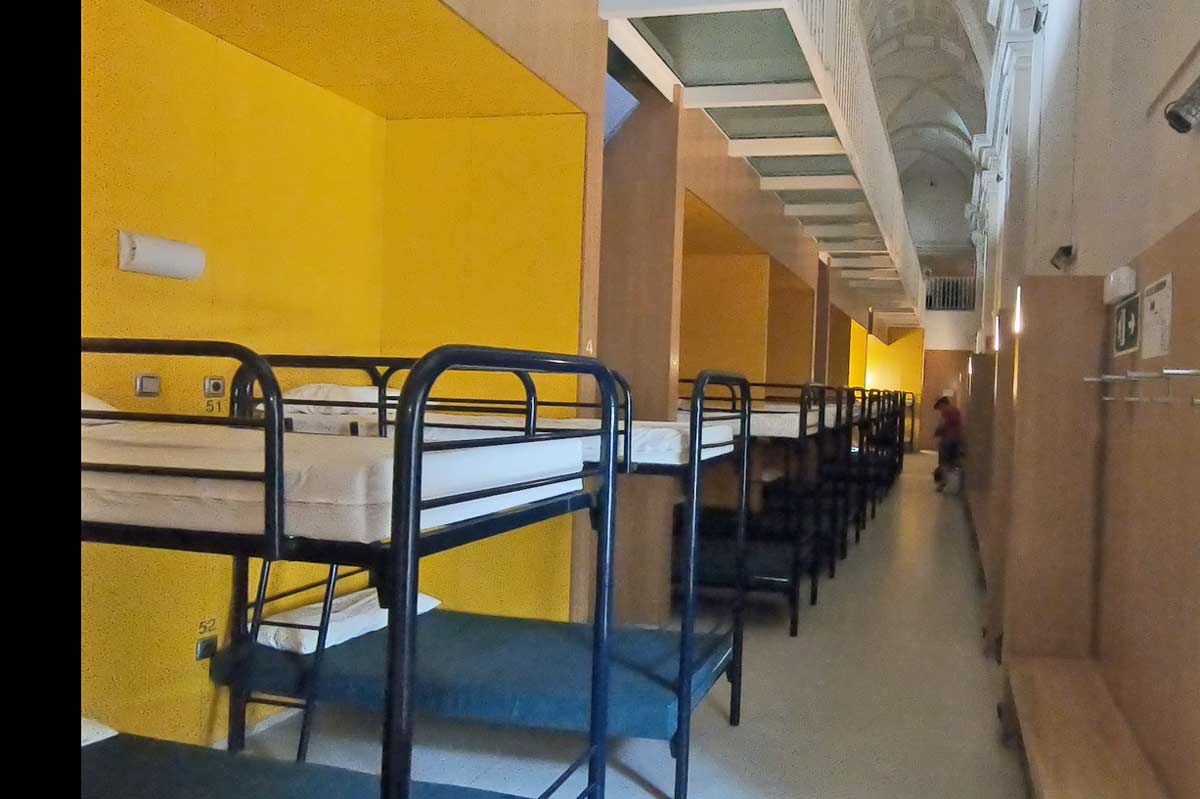
If staying in dormitories doesn’t sound very appealing and you rather pay extra money to have more comfort and privacy you can stay in hotels and guesthouses.
Comparing public and private albergues and hotels
| Facilities | Municipal albergues | Private albergues | Hotels |
|---|---|---|---|
| Only for pilgrims | yes | no | no |
| Need a Credential to stay | yes | no | no |
| Hot shower | yes | yes | yes |
| Kitchen | usually | usually | no |
| Wi-fi | usually | yes | yes |
| Blankets | sometimes | usually | yes |
| Washing machine | usually | usually | sometimes |
| Restaurant | no | usually | usually |
| Advanced booking | rarely | yes | yes |
| Luggage delivery | sometimes | yes | yes |
As for booking in advance, I recommend doing it in the peak season, particularly in some places. First of all in Roncesvalles (there is only one albergue for 200 people and two expensive hotels). Zubiri is a small town and a popular stop on the second day. O Cebreiro is another small town with one municipal albergue and a couple of small guesthouses. I walked the French Way in September and well-priced private rooms were often unavailable.

French Way planning resources
- Plan your walk on the French Camino with our itinerary | The Camino Francés walking stages - detailed guide |
- Find out more about alternative Camino routes | Different routes of the Camino de Santiago |
- Get useful tips for planning the pilgrimage | Tips for planning & walking the Camino de Santiago |
- Learn how to get the Compostela after finishing the Camino | Getting the Compostela in Santiago |
Questions or Comments?
Got any questions or comments? We would love to help! All questions and comments will be answered by us personally in Buy Me a Coffee. Click below and ask away.
Feel free to support our site by buying us a coffee!
Liked this post? Pin it!


The pretty half of Stingy Nomads, responsible for all our land adventures (hiking, climbing, walking the Camino) and following them write-ups. Alya loves walking since she was a child, she prefers to walk 1000 km with a backpack rather than to do a 10 000 km road trip (actually any road trip). Alya is a big fan of Latin America, the Spanish language, and dancing. Every time we go away she desperately misses our dog Chile.

Oops I found the gpx files I think there was a glitch on the site.
Thanks Frank
I want to do the French. Camino but not spend 30 days. Is there a way to skip less desirable sections? If so, which sections?
Hello Perry. You can walk the last 100 km or 200 km to Santiago. You don't have to start the French Camino from St.Jean. If you do want to start there you can take a bus or a train (depending on where you are) and skip parts of the route. Many people do so in the Meseta part (the middle section of the French Camino between Burgos and Leon). If you want to get the Compostela certificate you have to walk at least the last 100 km to Santiago de Compostela. Besides that there are no other rules you can skip any stages or walk as far as you want.
Buen Camino
Wanted to know, if we can get by without carrying cash. Is a credit card good enough?
Hello. I would recommend having some cash, 50 euros or so. Not all places especially in smaller towns accept cards. Most public albergues don't if you want to stay there you'll need cash.
Buen Camino
Thank you for all of this wonderful information. You mentioned roughly 20 km in between towns (I appreciate that this will vary). Is there a town route/ accommodation guide available in anywhere or in any of the books you recommend?
Hello Aingie. Thank you for the comment. In the third paragraph of this post you can find downloadable PDFs one contains walking stages for the French Way with distances and all towns along the route and the second one contains a list of places to stay on the French Camino. Using these 2 files you can f=plan your walk and book accommodation if you wish so.
Buen Camino
Would like to walk the Camino, French Way, sometime during the Spring of 2023. Would like to acquire a walking partner for the journey. I am an American male and enjoy good health and vigor. I would like to do it mainly as a Spiritual pilgrimage, but would also like to gain all the cultural benefits that are offered along the way. I only speak English and a few words in Spanish. Please e-mail me if you or others might be interested in talking about this. I did live in Europe for 18 months during 1984-86.
Very insightful info. You mentioned about the asphalt road, etc. I prefer nature trails, do you have a list where those roads are so I can avoid them? I understand there are buses and trains along or near the French way, but I can’t find any info if someone has used them here and there. I’d like to know the availability of various transportation as a backup plan, do you have any info to share? Thanks.
Hello Shouee. Thank you for the comment. I don't have a list of roads on the French Camino it's pretty impossible to compile a list like that. Every day you walk, say 3 km on asphalt then 2 km on a footpath, 1 km on the road, then back on asphalt etc. Different surfaces alter all the time. We have a detailed post on the stages of the French Way where you can find information on how much asphalt and road you get every day https://stingynomads.com/camino-frances-walking-itinerary/. You can eliminate days with the most asphalt and road and walk. There are buses and trains between different towns and cities on the Camino. Before finding information on transportation it's better to decide which stages you want to skip.
The Fench Way is not a hike most of the time the route goes through towns, cities, and populated areas. I'm not sure if it's the right route for you if you enjoy nature trails. It's not a hike in nature. As an alternative, there is the Camino Primitivo https://stingynomads.com/camino-primitivo-stages/. It's a different Camino de Santiago route that starts in Oviedo and finishes in Santiago de Compostela. Out of all Camino routes that one is the closest to a hike in nature. There you walk through the forest and over the mountains mainly on a footpath with little asphalt and road. I hope it helps.
Buen Camino
Hi Alya, thanks for all your great articles. I am currently thinking about walking one of the caminos starting at the beginning of October. I would like to walk one that is not too busy, have enough accommodation options still open in October and not too quiet for a single female hiker. It sounds to me based on your blog that you really enjoyed the Primitivo, I am just wondering if there will be enough albergue still open at that time? Appreciate your feedback!
Hello Susan. Thank you very much for the comment. Based on your description I would suggest walking the Portuguese Camino from Porto. In October none of the Camino routes even the French Way won't be very busy it's outside of the season. I'm sure there will still be pilgrims on the Portuguese Route. It has plenty of accommodation options most albergues will still be open in October. As for Primitivo October is a bit late in the season for that route. It's very likely you'll get a lot of rain the route goes over the mountains and the climate there is very unpredictable. Plus, there will be fewer pilgrims in October walking that Camino.
Buen Camino
What about tenting? I was thinking this might be nice for sone nights.
Hello Bridget. In many places in Spain, unauthorized camping is not allowed. If you get caught you might get a fine. The French Camino goes through towns and cities it might be challenging to find a spot suitable for camping. I'm not sure it's worth carrying camping gear on the Camino. There are some campsites on the route but not many and most of them are away from the Camino so you have to walk a couple of kilometers extra.
Buen Camino
Congratulations on your new baby. Thank you for the videos and all the priceless information. I especially enjoyed your candid descriptions and recommendations. The pie chart/cost breakdown is so valuable. I wish you and your family much happiness. I do not know what camino I will walk this year, however, my flight from USA is booked and I'll start May 1.
Hello, Mitzy. Thank you very much for the comment. If you have any questions regarding the Camino we'll be happy to answer them. We're hoping to do the Portuguese Camino with our daughter in May. Fingers crossed everything works out.
Buen Camino
Thanks for doing all the leg work, brilliant
Hello, Denis. Thank you for the feedback!
Buen Camino
great article!
I’m trying to find transport options from Ages area to Biarritz airport
Any information you can provide would be greatly appreciated.
I need to get there wthin 4 hours or less. Private car service ~$300 plus ... too expensive for me. Possibly other options ?
Thank you for any information you could provide.
Mary Jon
Hello, Mary. Sorry, but I don't know where Ages is. All I can advise is to try to use Uber it's usually quite a bit cheaper than taxis. We use it a lot in Portugal and sometimes in Spain.
Good luck
Gosh, this helped me decide which route and when. Thanks.
Wendy in Seattle
Excellent Article! Thank you so much, this has me longing for adventure.
Do you know if the Camino is open in 2021?
Or the status of the entry to the countries?
Hello, Tina! Thank you very much for the comment! As far as I know, Spain is planning to open for tourism in the second half of the year, around September if the situation gets better. We all hope we'll be able to be back on the Camino this year.
Cheers
HI, can I know how if bank atm is easy to find along the French way? Do you carry money or credit card right bank card?
Hello, Gale! There are many ATMs on the way we used to draw 200 Euro to have some cash with to pay for albergues, most shops and restaurants accept cards. If you want to know where you can find ATMs along the route, please, check our Camino Frances walking stages post, at the end of every day there is a list of towns and facilities.
Cheers!
Hi I have appreciated the info provide. We will be travelling the French Way Camino in early April 2020. Are you able to tell me how busy it will be at that time of year.
Hello, Jeff! Thank you for the comment! It won't be very busy in April, the season starts in mid-May, there will be people I'm sure but not too many.
Buen Camino!
Thank you so much for your detailed website. I have been taking lots of notes as I prepare for my family - my husband, myself and 4 older kids to walk the Camino in May, 2020. I have gained a lot of information with your charts on how to best get to St. Jean Pied de Port from either Paris or Madrid. We are leaning towards flying from the US into Paris b/c of the cost savings. I haven't seen any information on how to best arrange the return leg from Santiago to Paris. Do you have any tips?
Hello, DeAnne! Thank you for the comment! The best way of getting back to Paris from Santiago is to fly, if you buy a couple of months in advance you can get a direct flight for 40-50 Euro per person, just make sure about luggage allowance usually with budget airlines you have only hand luggage included in the fare. Another thing is it's better to buy a flight that arrives one day before your international flight that you have enough time in case of any delay that happens sometimes with budget airlines. Check skyscanner(don)net to find best-priced flights.
Buen Camino!
I just love your website. It is so informative. I am leaving for my Camino next April. I will be starting in Astorga and walking to Santiago. From there I am walking to Muxia and then to Finisterre. Your website has given me information I found difficult to find in other sites, and you- tube videos. I will be using this website as a resource. I have my flights booked. I am trying to book my train/bus to Astorga from Madrid and from Santiago back to Madrid, but having a little trouble. Any suggestions?
Hello, Jeffrey! Thank you for the comment! I think it's a bit too early to book tickets for local trains and buses. April is no peak season, you can book your tickets just one or two weeks in advance. We always buy our train tickets to Madrid from Santiago just a couple of days before on the RENFE website. I can see there are tickets available for April from Madrid to Astorga on the ALSA website, it's about 15 Euro, takes 4 hours, you can buy it right now if you want. As for the train ticket, I think it's just too early those tickets are not available yet. In a couple of days, we're going to publish a new post The Camino Frances stages that might be helpful for your planning.
Buen Camino!