
The Camino Finisterre-Muxia - a 2026 guide
The Camino Finisterre-Muxia is a pilgrimage route in Galicia, Northern Spain. It's a part of the Camino de Santiago network. This short route offers diverse scenery from beautiful Galicia forest and peaceful countryside to the stunning Atlantic coast. It can be walked as a separate Camino or as a part of another route.
Camino Finisterre-Muxia PDFs
Download our PDF files with walking stages and places to stay on the Camino Finisterre-Muxia.
What is the Camino Finisterre-Muxia?
The Camino Finisterre is a pilgrimage route from Santiago de Compostela to Cape Finisterre, a place that’s believed to be the end of the earth in Roman time. It’s the only Camino route that starts and does not end in Santiago de Compostela. Many pilgrims walk to Finisterre after completing one of the other Camino de Santiago routes.
How long is the route?
The route from Santiago de Compostela to Cape Finisterre is 90 km/56 mi. From Santiago to Cape Muxia is 87 km/54 mi. If you walk to both capes the total distance is 117 km/71 mi (through Finisterre) and 114 km/70.8 mi (through Muxia). You'll need 4-6 days on average to complete the Camino.
Where to get a pilgrim’s passport (Credential)?
If you continue walking to Finisterre after completing another Camino route you can keep using the same Credential (if there is space). Otherwise you can get a new one at the pilgrim’s reception office in Santiago de Compostela. It costs 2 euros. You might be able to buy one at the kiosk inside the Cathedral too.

Two routes of the Camino Finisterre
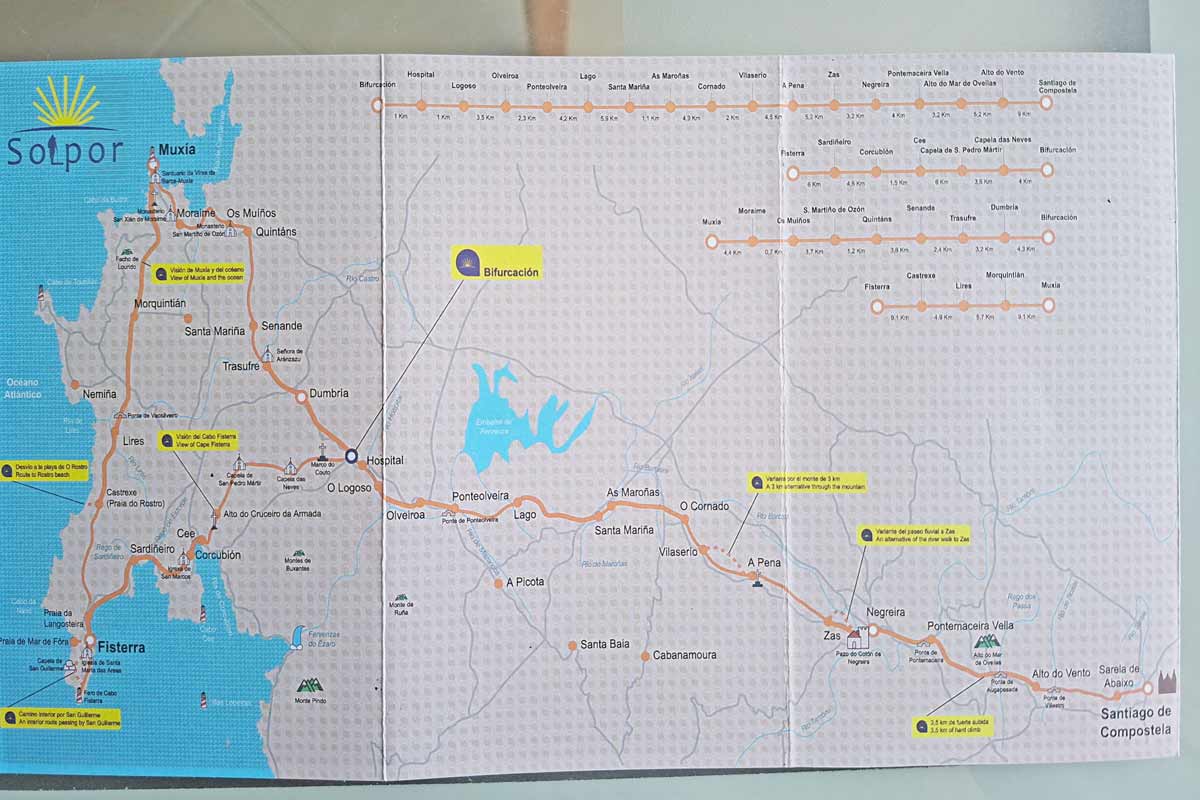
The Camino Finisterre-Muxia has two routes; one from Santiago to Finisterre and the other one is from Santiago to Muxia, another cape about 30 km/18.6 mi north of Finisterre. The first 60 km/37.2 mi from Santiago are the same for both routes. The route split after Hospital, on the third day.
The distance of both routes is more or less the same; 90 km/56 mi from Santiago to Finisterre and 87 km/54 mi from Santiago to Muxia.
The two capes are connected - after arriving at one of them you can walk to the other one. The connecting route is 27 km/16.7 mi.
If you don’t want to walk you can take a bus. There is a daily bus from Finisterre to Muxia at 11.45 am and from Muxia to Finisterre at 5 pm. The journey takes 30 minutes. The price - 2.64€.
Finisterre vs Muxia - which one to choose?
It's difficult to compare places and sights and say which one is better. If you have enough time I suggest visiting both. If you have to choose, go to Cape Finisterre, not because it’s more beautiful but because historically it was the end of the Camino route.
Both capes have KM0 Camino signs. Both points have lighthouses though the Muxia one is quite small.
Pros of walking to Finisterre
If you have to choose one I suggest walking to Finisterre because it was the original end of the Camino route.
The route to Finisterre (the last stage of it) in my opinion is more interesting than the route to Muxia (the last stage). On the Finisterre route you get to walk through two beautiful coastal towns of Cee and Corcubion, plus you get spectacular coastal views in the last part of the route.
Pros of walking to Muxia
Cape Muxia is less touristy than Finisterre. Fewer day visitors and tour buses stop here so it’s less crowded.
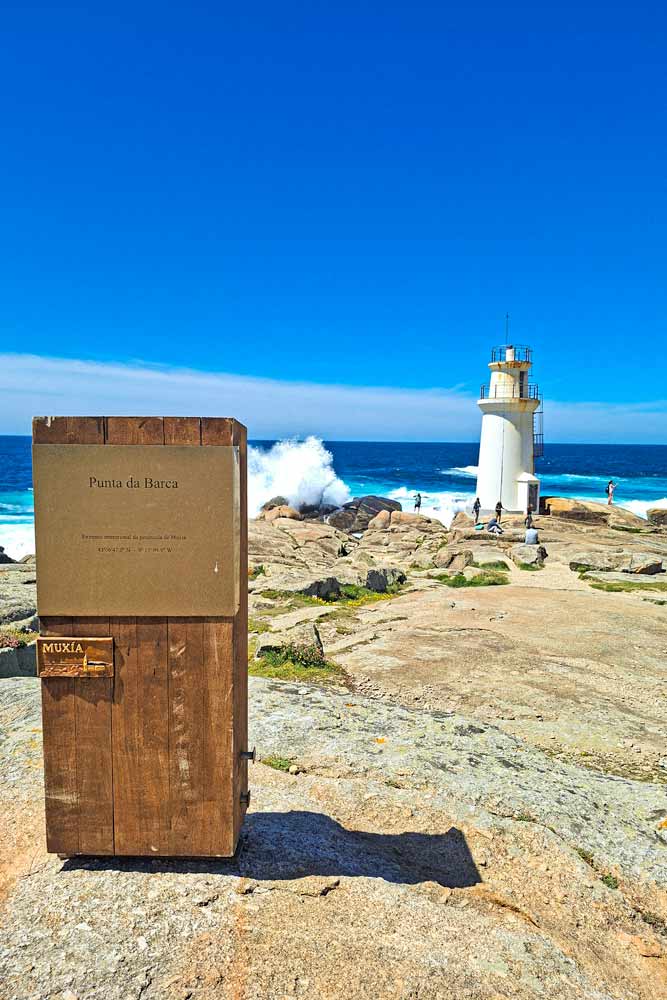
The cape is more spacious with several interesting landmarks; everybody doesn’t just concentrate at a narrow point like at Finisterre.
Muxia cape is less than 1 km/0.6 mi from the town; it's a short walk unlike Cape Finisterre.
Cape Finisterre attractions
- KM0 Camino sign
- Finisterre lighthouse
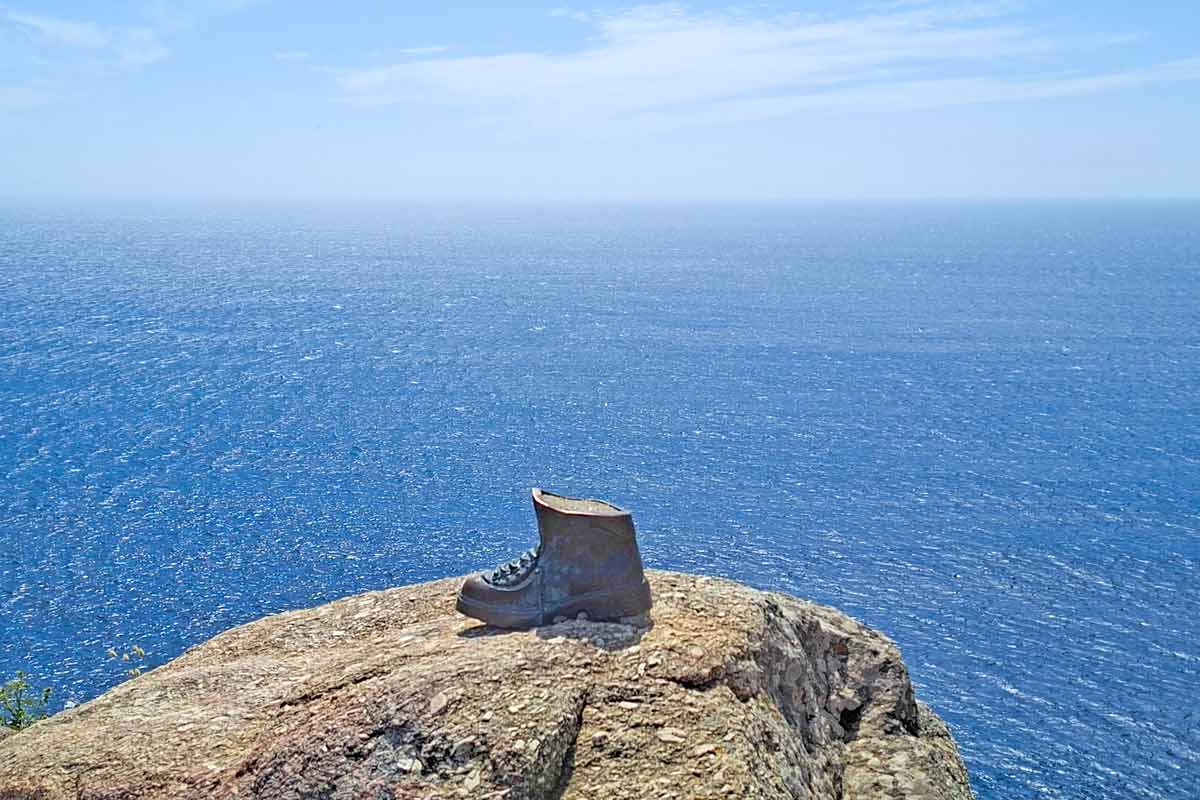
- A metal shoe on the rocks
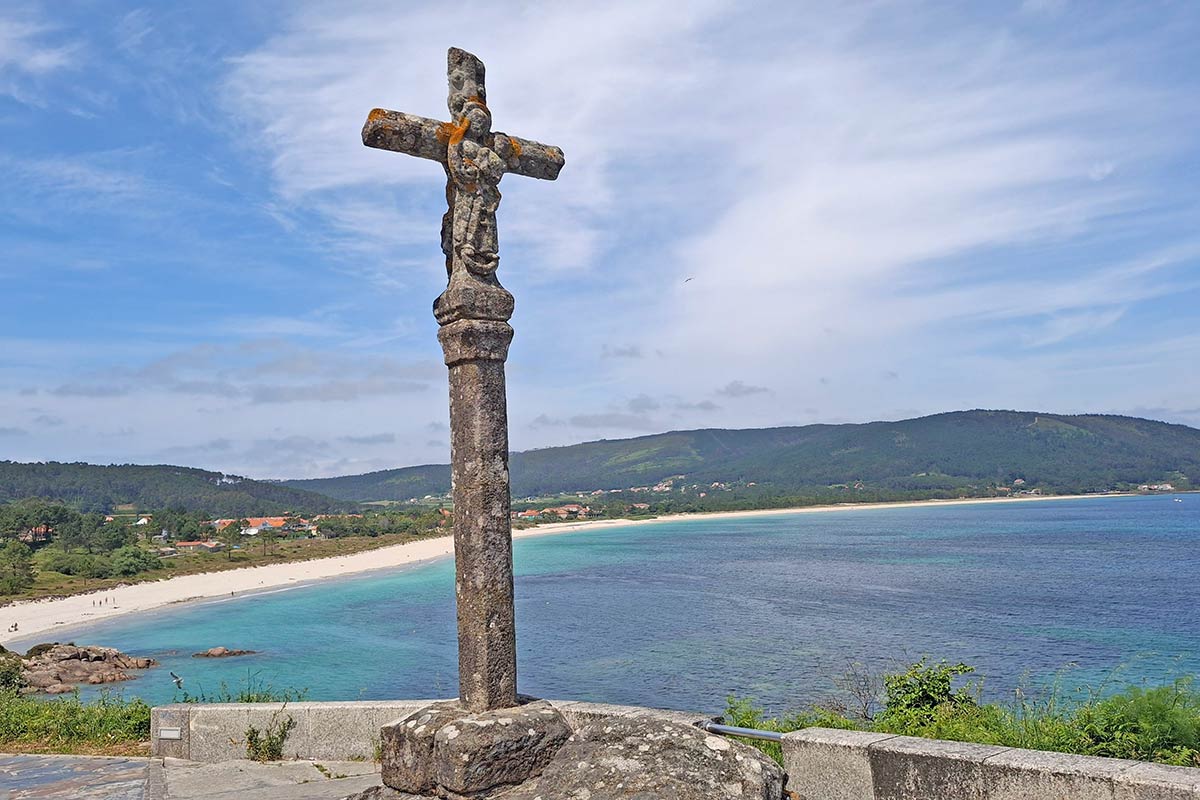
- A stone cross
Cape Muxia attractions
- KM0 Camino sign
- The Sanctuary of Nossa Señora da Barca
- A Ferida monument (a stone monument split in the middle)
- Muxia lighthouse
- Piedra dos Cadrís
Can I get the Compostela certificate for this Camino?
No, you don't get the Compostela certificate for this route from Santiago. You can get two other certificates; the Finisterrana and the Muxiana. The Finisterrana you get at the Tourism Information office and Municipal Albergue in Finisterre. The Muxiana you can get at the Tourism Information office and municipal albergue in Muxía.
The cost of walking the Camino
The cost of the Camino varies depending greatly on the type of accommodation you choose. If you stay only in public albergues (which is possible if you walk the standard stages) your Camino Finisterre budget can be around 30€ per person per day. Staying in private albergues will increase it to 40-45€ per person per day. If you prefer private rooms then expect to spend 60+€ per person per day.
Accommodation
All municipal albergues on the route cost 10€ pp., private albergues are between 17€ and 20€ , and hotels are from 50€ for a private room.

Eating out
- Menu del Dia (a set menu with a starter, main, drinks, and dessert) - 13-15€.
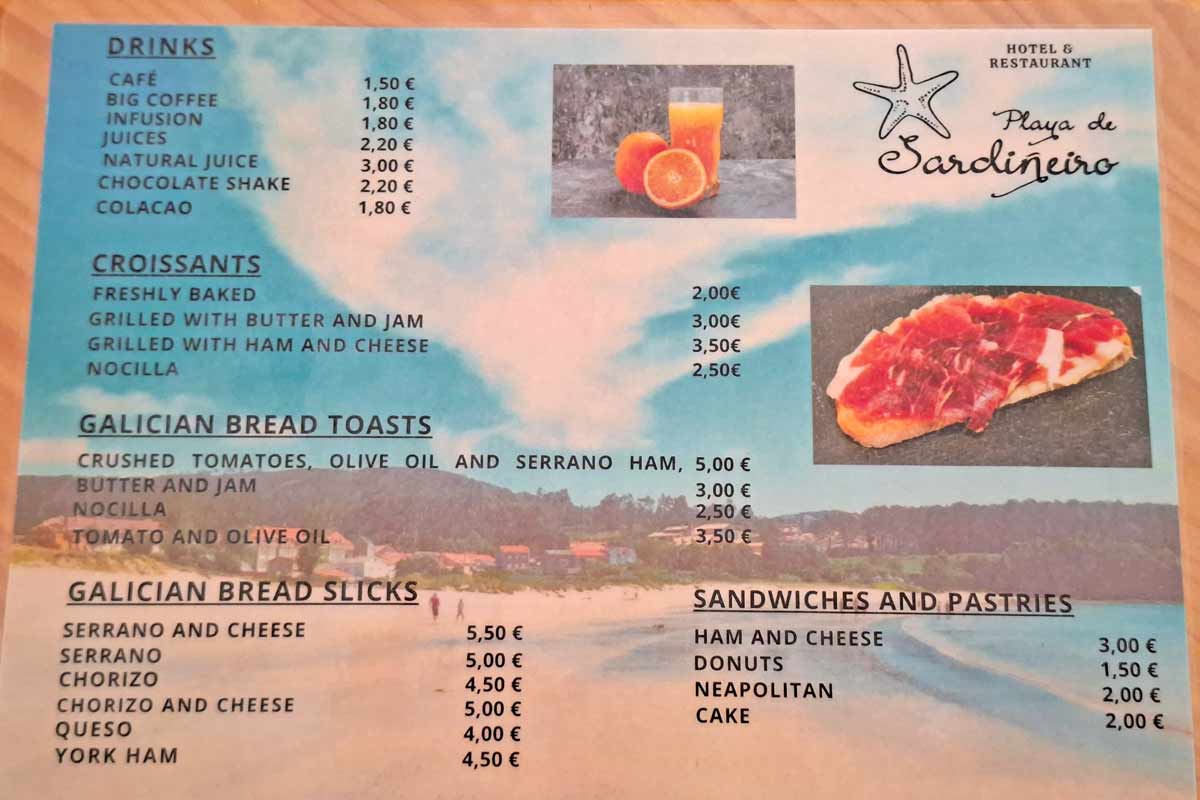
- Breakfast (coffee with croissant or toast with butter and jam) - 5-7€.
- Continental breakfast (eggs, toast, coffee, etc.) with coffee - 8-10€.
- Dinner - from 20€ per person.
- A cup of coffee between 1.5-2.5€.
Shopping
If you want to save money buy food at the supermarket and cooking is the way to go. Most albergues have a kitchen so you can prepare your own meal. To buy food for 3 meals (breakfast, lunch, and dinner) expect to spend 10-15€ per person per day on average.
Make sure you end your stages in bigger towns where you can find shops otherwise you will have to buy food at cafes or restaurants.
Extras
- Bus Finisterre - Santiago - 11€; bus Muxía - Santiago - 8€.
- Washing - 4€; drying - 4€.
- Luggage transfer - 6-7€ per day.

What is the accommodation like?
Like any other Camino de Santiago route the Camino Finisterre-Muxia has albergues (special hostels for pilgrims). There are two types of albergues: municipal (public) and private albergues. Municipal albergues are exclusively for pilgrims. To stay there, you have to show your Credential (pilgrim’s passport) with stamps.
Municipal (public) albergues
Municipal albergues are run by the municipality, they cost 10 Euro per person per bed. These albergues are exclusively for pilgrims with a Credential.
- You can check-in between 1 pm and 2 pm.
- The doors are locked after 10 pm if you go out make sure to come back in time.
- You have to leave municipal albergues by 8 am.
- You can usually stay in a municipal albergue for only one night.
On the Camino Finisterre municipal albergues are relatively new and in good condition; clean, big, and spacious.
Public (municipal) albergues on the Camino Finisterre-Muxia can be found in
- Negreira - 21 km/13 mi from Santiago
- Olveiroa - 54 km/33.5 mi from Santiago
- Dumbria (Muxia route) - 65 km/40 mi from Santiago
- Corcubión (Finisterre route) - 75 km/46.6 mi from Santiago
- Muxía town - 86 km/53.4 mi from Santiago
- Finisterre town - 87 km/54 mi from Santiago
Private albergues
Private albergues are more like hostels where anybody can stay. Most guests are usually pilgrims. The average price of a bed is 15-20 Euro pp. Private albergues are more flexible:
- They might let you check in earlier and check out later.
- They're usually smaller and have better facilities though, on the Camino Finisterre-Muxia, public albergues are very good.
- You can stay at a public albergue for more than 1 night.
Private albergues on the Camino Finisterre-Muxia can be found pretty much at every town or village along the route.
Public vs private albergues
| Features | Public albergues | Private albergues |
| Price | 10€ | 17-20€ |
| Only for pilgrims | Yes | No |
| Need the Credential | Yes | No |
| Can be booked | No | Yes |
| Accept luggage delivery | No | Yes |
| Can stay for more than 1 night | No | Yes |
Comparing public and private albergues on the Camino Finisterre
When is the best time for walking?
I walked the Camino Finisterre twice in November and in May (the end of it). It was a completely different experience. In November the weather was very bad; it rained all the time, sometimes with hail and strong wind. At the end of May it was very warm and sunny without a drop of rain.
From our Camino experience May, June, September, and the first half of October are the best months to walk the Camino. It's warm but not too hot with little rain.
July and August are the hottest and busiest months. Many tourists come to the area for beach holidays, the prices are higher and many places are full. I suggest booking accommodation in advance.
Between November and March the weather is not the best for walking; it's quite cold and rainy. Many places are closed for the off-season.
The end of April is a shoulder month so you can still get rain and cool temperatures in Galicia.
What to pack for the walk?
The Camino Finisterre-Muxia is a short route (4-5 days) so you don't need to bring a lot of stuff. I’d say 2 sets of clothes for hiking, a set of clothes to change into, a couple of pairs of underwear, a pair of flipflops, and some toiletries. Many places have washing and drying machines.
Some pilgrims leave their big backpacks/suitcases in their hotel in Santiago and walk to Finisterre with a day pack.
As an option, you can use a backpack transfer service and bring as much stuff as you want. You can find the complete packing list for different seasons for men and women in our Camino de Santiago packing list post.
Luggage transfer on the Camino
It's possible to arrange luggage delivery service on the Finisterre route. If you have never used it here how it works. In the morning you leave your backpack or suitcase at the reception, a car picks it up and drives to your next accommodation place. By the time you arrive, your luggage is already there.
The average price is 6-7 Euros per backpack per stage. The weight limit per item is usually between 15 kg and 20 kg depending on the company.
Several companies offer luggage delivery services on the Camino Finisterre - Correos, Pilbeo, Camino Comodo are some of them.
Camino Finisterre-Muxia guidebooks
The main guidebook for the Camino is A Pilgrim's Guide to the Camino Finisterre; Santiago, Finisterre, Muxia by John Brierly.
If you like reading it might be worth joining the Amazon Kindle Unlimited program and getting free access to hundreds of thousands of Ebooks and audiobooks.

The pretty half of Stingy Nomads, responsible for all our land adventures (hiking, climbing, walking the Camino) and following them write-ups. Alya loves walking since she was a child, she prefers to walk 1000 km with a backpack rather than to do a 10 000 km road trip (actually any road trip). Alya is a big fan of Latin America, the Spanish language, and dancing. Every time we go away she desperately misses our dog Chile.


If you walk Santiago to Muxia, then Finisterre (or in reverse) and back to Santiago can you get a certificate of completion in Santiago when you return? Will it be 100 K?
Hello Julie. Thank you for the comment. If you start in Muxia, walk to Finisterre, and then to Santiago the distance is more than 100 km, around 120 km. Technically it qualifies for the Compostela. I saw people walking in the opposite direction probably for that same reason https://oficinadelperegrino.com/en/contact-us/. I would suggest contacting the Pilgrim's Office in Santiago to clarify before you start walking.
Buen Camino
@Julie C, I'd be interested to know the answer of the Pilgrim Office if you would share. Thank you