
The Portuguese Camino - your 2026 guide
The Portuguese Camino is one of the spiritual routes to Santiago de Compostela. It is the second most popular Camino de Santiago route after the Camino Frances. According to the Pilgrim's Reception Office in 2025 more than 34% of all pilgrims who arrived in Santiago de Compostela walked it. Every year more and more people choose the Portuguese Camino. It's my favorite Camino route.
You can find a complete list of our posts dedicated to the Portuguese Camino on our Portuguese Camino de Santiago resource page.

This post contains affiliate links. If you make a purchase, I may receive a small commission at no extra cost to you.
Portuguese Camino planning tool
You can use our free Portuguese Camino planning tool to get a customized itinerary with recommended places to stay.
The Portuguese Camino - downloadable PDF files
To make your Portuguese Camino planning easier we created free downloadable PDF files. Two files for each route; one contains walking stages and one places to stay along the route including public albergues with contact details and booking information.
Central Route
- Central Route Portuguese Camino - walking stages PDF
- Central Route Portuguese Camino places to stay PDF
Coastal Route
- Coastal Route Portuguese Camino - walking stages PDF
- Coastal Route Portuguese Camino - places to stay PDF
Litoral Way
- Litoral Way Portuguese Camino - walking stages PDF
- Litoral Way Portuguese Camino - places to stay PDF
Portuguese Camino overview
- Distance - from Lisbon: between 613 km/381 mi and 650 km/403 mi depending on the route from Porto. From Porto: 243.5 km/151 mi - Central Route; 274 km/170 mi - Coastal Route; 280 km/173 mi - Litoral Way. From Tui - 117 km/72.7 mi.
- Number of days – 25-30 days from Lisbon; 12-15 days from Porto; 5-7 days from Tui.
- Starting points - the Church of Santiago in Lisbon; Sé Cathedral in Porto; Cathedral de Santa Maria in Tui (for the last 100 km to Santiago).
- Finishing point - Obradoiro Square in Santiago de Compostela, Spain.
- Walking surface - asphalt, cobblestone, footpath, gravel road, boardwalks (on the coastal routes).
- Average cost - 35-55 Euro per person per day
- Accommodation - public and private Albergues, hostels, hotels, guesthouses, and campsites.
- Route marking - yellow shells and arrows, metal shells and arrows on the ground, stone distance poles.

Travel insurance for the Camino
Walking like any other outdoor activity involves a risk of getting an injury or losing some of the gear. Camino travel insurance can offer you coverage. The Portuguese Camino de Santiago is not a high-altitude wild hike through remote areas but it's still a physically challenging experience that involves a long walking distance with a heavy backpack. It's not rare for pilgrims to get injuries from small blister problems to knee or shin splint issues. It makes the walk less stressful when you know you're covered in case of any unpredictable emergencies.
World Nomads offers simple and flexible travel insurance. Buy at home or while traveling and claim online from anywhere in the world.
Where does the Portuguese Camino start?
The Portuguese Camino like other Camino de Santiago routes has several starting points. In fact one can start walking from any place on the route. The most popular starting points are Lisbon (the actual start of the Portuguese Camino), Porto (where most pilgrims start), and Tui (the last 100 km to Santiago).
In Lisbon the Camino starts at the Church of Santiago, a small church 400 m away from Se Cathedral. Many people think the route starts at the Cathedral but it doesn't. The church is closed most of the time. If you need a pilgrim's passport (Credential) you can buy it at Se Cathedral in Lisbon (from the church the Camino goes to the Cathedral).
In Porto the Portuguese Camino (all 3 routes) start at the Se Cathedral in the historical center.
In Tui (Spain) the route starts at Cathedral de Santa Maria de Tui. The reason many people start walking the last 100 km from Tui is to get the Compostela, a pilgrimage certificate. It's granted only to pilgrims who have walked at least the last 100 km to Santiago de Compostela on any Camino route.
Vigo is another starting point to walk the last 100 km on the Coastal/Litoral route of the Portuguese Camino. You can start the walk at the Church of Santa Maria de Vigo in the historical center.

How long is the route?
The distance of the Camino Portugues depends on where you start walking. As you can see in the above section there are several starting points.
If you start the Portuguese Camino in Lisbon your total distance will be between 613 km/381 mi and 650 km/403 mi depending on the route from Porto. It takes 25-30 days to complete it.
If you start in Porto and walk the Central Route it's 243.5 km/151 mi. It takes on average 10 to 12 days to complete.
The Coastal Route from Porto is 274 km/170 mi. It takes 12 to 14 days to complete.
The Litoral Way from Porto is 280 km/173 mi. It takes 12 to 14 days.
The combination of the Litoral and Central routes from Porto is 262 km/163 mi. It takes 12-14 days.
The Portuguese Camino from Tui is 119 km/74 mi. It takes 5 to 7 days to complete on average.

How difficult is the walk?
The Portuguese Camino is a challenging multi-day walk. It requires preparation and training especially if you're not an experienced hiker and have never done a long-distance walk. You walk 20-25 km a day on average with a backpack for weeks. You can imagine that by the end of the Camino, you'll be quite tired. You can always take rest days and stay in one of the beautiful towns on the Portuguese Camino.
The difficulty level depends on the chosen route and starting point. If you start in Lisbon and walk to Santiago de Compostela it's a demanding walk, especially the part from Lisbon to Porto. The distances between towns are greater and there are fewer places to stop in between.

If you walk the Central Route from Porto you can expect steep ascents and descents. Some people might find it challenging. The route is well-marked and has good infrastructure for pilgrims. There are plenty of places to stay along the route so you can walk shorter distances.
The Coastal Route from Porto is well-marked and has fewer hills than the Central Route but it's a bit longer. During winter months it gets very windy, cold, and wet. It's not the best route to walk outside the spring/summer months.
The Litoral Way is my favorite route of the Portuguese Camino. Most of the time it goes next to the sea. It has no hills, the distance is the same as on the Coastal Route. The lack of route marking is the main challenging part of it. You'll need some sort of navigation to stay on the track.
If you decide to take the Spiritual Variant (the optional route of the Portuguese Camino from Pontevedra to Pontecesures/Padrón) be prepared for a challenge as the route has a very steep ascent and descent.

Camino with a company
We often get questions from our readers about using a company to plan their Camino walk. We have never done it so I can't recommend it from my personal experience.
It's easier to plan the Camino through a company because they do all the booking and planning for you. The main drawbacks (in my opinion) are that it's more expensive and it doesn't give you much flexibility as your accommodation and luggage delivery are booked in advance.

Download the Camino Portuguese Walking Routes map
Different routes of the Portuguese Camino
The Portuguese Camino de Santiago has different routes. You can combine the routes from Porto in one walk.
The Lisbon to Porto part has only one route. The Porto to Santiago part has three routes: Central, Coastal, and Litoral. The last two are similar they merge and split every day.
The Central Route is a 243.5 km/151 mi inland route from Porto to Santiago de Compostela. There are several interesting historical towns along the way. The scenery is countryside, forest, and fields.
The Coastal Route is a 274 km/170 mi partially coastal partially inland route from Porto to Santiago. It goes close to the coast till Vigo. From there is goes inland to Redondela where it merges with the Central Route. If you are choosing between the two above routes read my post where I compare the Central and Coastal Route. As an option you can combine the Coastal and Central routes in one walk.

The Litoral Way (Senda Litoral) is a 280 km/173 mi coastal route. From Porto, it goes along the Douro River and the Atlantic Coast. The main difference of the Litoral Way compared to the Coastal Route is that the first is 80% next to the sea. Like the Coastal Route, it merges with the Central Route in Redondela.
There are two connecting routes that you can use to switch from the Coastal/Litoral Way to the Central Route. First is from Vila do Conde to Rates (after the first stage) and second from Caminha to Valença/Tui.
The Spiritual Variant (Variante Espiritual) is an optional route from Pontevedra to Padron (Pontecesures). It includes 2 walking days and 1 day on the boat. It's a scenic and quite challenging route due to a steep ascent on the first day and a long descent on the second day.

The best time for walking
September and May are the most popular months for the Portuguese Camino. Good weather for walking is one of the reasons. It's warm and sunny but not too hot. It's not the peak holiday season so flights and hotels are usually cheaper. Expect to see a lot of pilgrims on the route. It's better to book accommodation and luggage transfer in advance.
If you want to have good weather and fewer people, the end of April and the first half of October are the best months to walk the Camino.
June is the beginning of the summer season; the weather is good and there are fewer people on the route compared to May and September.
July and August are the hottest months and the peak holiday season. Finding private accommodation on the coastal routes might be difficult without booking in advance and prices are a higher.
Winter months are not the best for walking in Northern Portugal and Spain it gets cold, rainy, and windy, and some albergues are closed.

What is the accommodation like?
Albergue is a special hostel for pilgrims with dormitories and shared facilities don’t expect any luxury.
There are two types of albergues on the Camino; municipal (public) and private albergues.
Municipal albergues are cheaper (10-12 euros pp.), they can’t be booked in advance, and most of them don't accept luggage delivery. One requires a Credential (a pilgrim's passport) to stay there. Usually can be paid only cash.
Private albergues are more expensive (around 20 euros pp.). They have better facilities, can be booked in advance online or over the phone, and accept luggage delivery. Usually accept cards and cash.
Most Albergues (private and public) have dormitories with bunk beds, shared bathrooms/toilets, and a kitchen, some have washing machines. Most (if not all) private albergues and some public have wi-fi.
For more details on accommodation on the Camino, the pros and cons of staying at albergues, tips, etc. check our detailed post Albergues on the Camino de Santiago.

The best guidebook
For us, Camino de Santiago guidebooks by John Brierley are the best. We used his Pilgrim’s Guide to the Camino Portugués Lisbon – Porto – Santiago: including Camino Central, Variente Espiritual, Camino da Costa, & Senda Litoral on the Portuguese Camino.
Want to read a fun, entertaining book about the Camino? Some fun and informative novels take place on The Way. Campbell read a few of the most famous books written about the Camino. See our reviews of a couple of the Top Novels on the Camino de Santiago.
Best Camino apps
We don't use apps for walking the Camino but I know many people do. So we've tried different apps for the Portuguese Camino to see how they work. I used for a couple of days Wise Pilgrim and Buen Camino on the different stages and routes of the Portuguese Camino. I used Camino Ninja (I know many pilgrims like it) when I walked the Litoral Way and it was quite accurate most of the time.
Overall my experience with Camino apps was good. I didn't need apps for walking the Central and Coastal Routes as they are well-marked. For the Litoral Way I used it for a couple of stages. I didn't like walking attached to my phone so unless you walk a not-well-marked route I don't think having an app is crucial.

Luggage transfer on the Camino
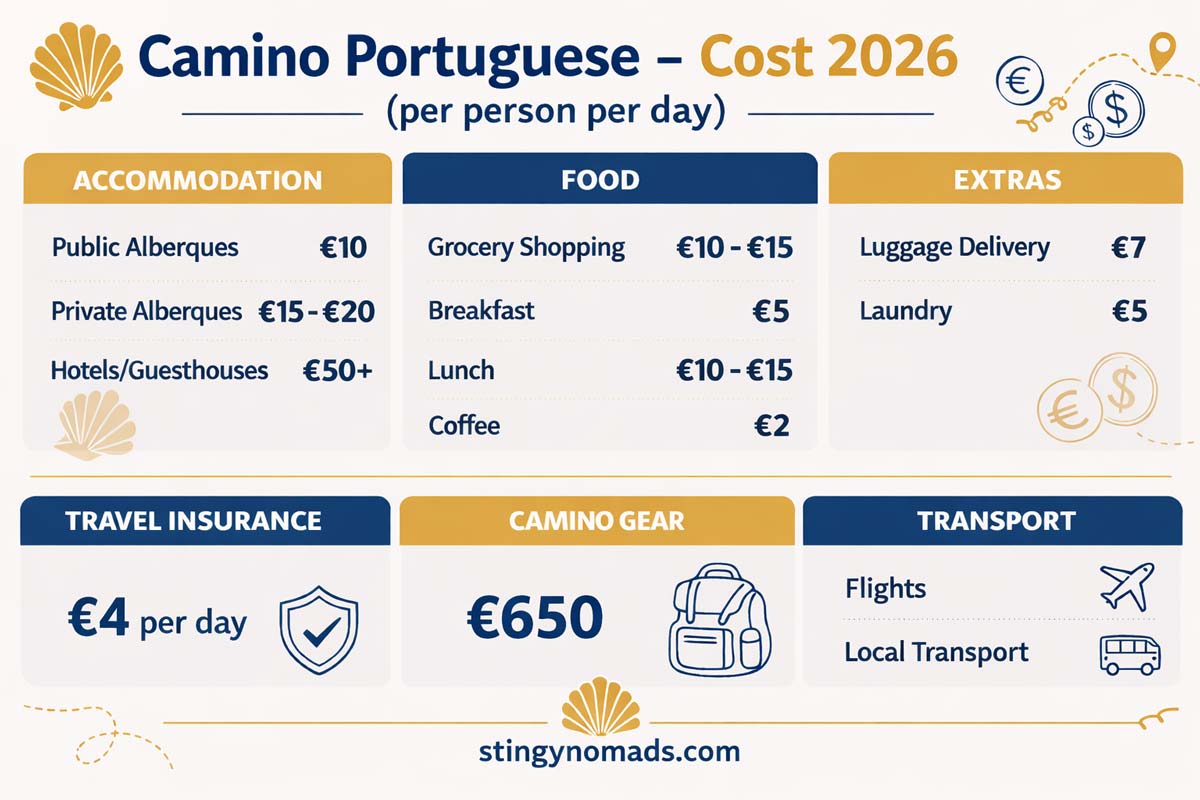
If you want to make your walk easier or have some back issues and can’t carry a heavy bag every day you can use a backpack delivery service. Several companies offer this service on the Portuguese route. Pilbeo (Central Route), Tui Trans (Coastal, Central, and Spiritual Routes) and Correos (Central, Coastal, and Spiritual Route). You can use it for the entire route or some stages. One stage costs 7 Euros per backpack.
It's important to remember that public albergues on the Camino usually don't allow luggage delivery. These albergues can't be booked in advance and they won't keep a bed for you even if your backpack is delivered there. Private albergues and hotels along the route have no problem with luggage delivery.

The cost of walking the Portuguese Camino
The cost of accommodation and food in Portugal and Spain is similar. Eating out and hotels are a bit cheaper in Portugal than in Spain.
If you stay in public albergues and buy food in supermarkets your average Camino cost will be around 25 Euros per person per day. If you stay in private albergues and eat in a restaurant at least once a day, go out for a beer, or stop a couple of times for coffee be ready to spend daily 35-40 Euros per person. If you stay in hotels, eat out twice a day, and use luggage transfer service be ready to spend 55+ euros per person per day. You can find a detailed breakdown with prices in our Portuguese Camino cost post.
Prices in Portugal
- Accommodation - municipal albergues - 10-12 Euro per person, private albergues - 20 Euro pp. Hotels from 30 Euros pp. (if sharing a budget double room), from 45 euros for a single budget room.
- Eating out - Menu do Dia, a set lunch that includes a starter, main dish with sides, drink and coffee or dessert - from 12 Euro pp.
- Food shopping - 10 Euro pp per day
- A cup of coffee (Americano) - 1.5-3 euros
- A beer in a bar - 2 Euro.
- Laundry - washing 4 Euro per load.
- Backpack delivery service (optional) - 7 euros per backpack per stage.
Prices in Spain
- Accommodation - municipal albergues - 10 euros per person, private albergues - 20-25 euros pp. Hotels from 35 Euro pp. (if sharing a double budget room), from 50 euros for a budget single room.
- Eating out - Menu del Dia; starter, main dish, drink (usually house wine), coffee or dessert - from 12 euros.
- Food shopping - 10 euros pp per day
- A cup of coffee (Americano) - 1.5-3.5 euros
- A beer in a bar - 2-3 euros
- Laundry - washing - 4 euros per load
- Backpack delivery service (optional) - 7 euros per stage
Food on the Camino is a part of the experience even if you're on a tight budget I'd suggest going out sometimes to try traditional Spanish and Portuguese dishes.

What to pack for the Camino?
Make sure not to pack too much and bring only the necessary stuff. We've met many people who had to reconsider their backpack content after the first day on the Camino. You don't need much and you always can buy anything you need way there are shops, supermarkets, and pharmacies along the way.
What you will need for the Camino are a pair of good walking shoes and a comfortable backpack. These two items will make a big difference to your walk.
If you're planning on using a luggage delivery service then it doesn't matter you can pack as much as you want.
We have a detailed Portuguese Camino packing list post where you can find our recommendations on what to pack for the Camino for men and women for different seasons.

Portuguese Camino planning resources
- The three routes of the Portuguese Camino from Porto
- The Central Route of the Portuguese Camino
- The Coastal Route of the Portuguese Camino
- The Litoral Way of the Portuguese Camino
- The last 100 km on the Portuguese Camino from Tui
- Portuguese Camino packing list
- The Spiritual Variant of the Portuguese Camino
- The Portuguese Camino from Lisbon
- Best towns on the Portuguese Camino de Santiago
Questions or Comments?
Got any questions or comments? We would love to help! All questions and comments will be answered by us personally in Buy Me a Coffee. Click below and ask away.
Feel free to support our site by buying us a coffee!

The pretty half of Stingy Nomads, responsible for all our land adventures (hiking, climbing, walking the Camino) and following them write-ups. Alya loves walking since she was a child, she prefers to walk 1000 km with a backpack rather than to do a 10 000 km road trip (actually any road trip). Alya is a big fan of Latin America, the Spanish language, and dancing. Every time we go away she desperately misses our dog Chile.

That is a perfect and amazing article guide! So many great advices and life-saver information, I am deeply grateful to You for this tremendous work🙏
Wish You stay well and all the best and beautiful adventures💛
Thank you very much for your comment, Diana! We're glad you've found our article useful! I hope in the nearest future we all will be able to walk the Camino!
Stay safe!
Hi Am planning to start walking from Porto On April 1st.
Given the near Pandemic virus, could you kindly advise as to whether to wait until next year or go in 4weeks In short, how safe is it to shRe accomodation?
I fly from Auckland NZ direct to Lisbon by Qatar airlines.
Many thanks
LLove your blog 😊😊💕
Hello, Bernadette! Thank you for the comment! As for now, there are no people infected with the virus in Portugal the country itself is safe for travelling. The main risk you run is the flight, Doha is a huge hub with thousands of people from all over the world I'd recommend using a mask all the time you're at the airport and washing hands/using hand sanitizer often. We flew to Nepal via Dubai about 2 weeks ago there were many people wearing masks at the airport. If you feel it's too dangerous to travel now then better postpone the trip. We had to change our plans we were planning to go to the North of Itlay in April but decided not to. We're staying in Nepal for an extra month instead but we're still going to Portugal in May to walk the Camino again.
Buen Camino!
Beautiful work- just want to say "Obrigada!" for sharing it all!!
Thank you so much. This is a fantastic resource! we have done 2 other parts of the Camino and loved both previous trips! (Sarria to Santiago and Pamplona to Logrono).
Hello, Rita! Thank you for the comment! I walked the Camino Frances from St.Jean in September and really enjoyed the route. The Portuguese Camino is a great route as well!
Cheers!
Thank you for the wonderful website and information. It has been a valuable resource as we plan our Portuguese Camino trip for May 2020. I would like to take the detailed daily trek guide with me, but I am not able to copy it or save i from the website. How can I get this information in a file I can save? Thank you again!
Hello, Elaine! Thank you for the comment! Sometime in February, we'll have to add downloadable PDF files to all our Camino posts.
Buen Camino!
Heya, your blog is super-useful, I love how it is full of the needed information. I was trying to find the printable version, is there already link anywhere? Many thanks, Monika
Hello, Monika! Thank you very much for the comment! We're planning to make PDFs for our Camino posts in a month or two. We don't have enough time to do it right now as we're busy trekking in Nepal.
Cheers!
Hey I am planning to walk the Camino Portuguese Central route in May 2020 too and starting a little out of LIsbon. What a great resource this website and information is. THANK YOU.
Marianne
Great information....Thanks. Is it difficult to book private accommodations ahead. Dorm life is not for my wife and I and we are willing to pay for the privacy. I wonder if that is realistic for the whole trip.
Tony....Very realistic. We found places on booking.com for our other Camino. Make sure the places are close to the trail to avoid unnecessary walking but there are always taxis. Only issue is if you book in advance, you need to keep to your itinerary. Luggage services are readily available to get pieces from one hotel to another.
Hi Nomads
Great blog. Going in mid June from Porto. Really looking forward to it after reading your no nonsense advice. Keep up the good work. Bom camino
Hello, Philip! Thank you very much for the feedback! I'm sure you'll enjoy the walk. We're planning to walk the Portuguese Camino in May again, we really like it!
Buen Camino!
Thanks for the great resource, it's very useful!
Somebody who is not a hardcore hiker, for us 260km from Porto will probably be too much? Or what do you think? Is there a good option to, for example, fly into Portom spend a couple of days there to acclimatize (northeners here) and then travel by train/bus to a closer point, to make the travel less by, say a 100km? Any advice on a good (interesting) starting point? Or should I consider the French Way instead? Thanks!
Hello, Yuri! Thank you for the comment! Many people walk the Portuguese Camino starting from Valenca/Tui, it's about 120km from Santiago. You can get to Valenca by bus from Porto, it takes 2h30min., price 11 Euro. Tickets can be bought online, check Rede Express website, there are several daily departures.
Buen Camino!
Thank you for the quick reply. You guys are an amazing asset. I think we'll fly to Porto and try to decide how much we want to walk based on our condition and the weather, etc.
Any opinions on how tough the whole journey from Porto would be on an averagely fit person, in july?
It might be quite hot in July we never walk the Camino July-August because of the heat. I'd recommend choosing the Coastal Route rather than the Central. You'll have to start walking early in order to be finished by midday to skip the heat. You can make your stages shorter as well if you feel like it.
Greetings. Do you think is it worth to go to walk the camino when you feel lost in daily life? Is it possible to find the answer when on the way? The most important thing is that is it worth to resign the job to walk the camino?
Hello, Knox! I don't think we can help you with this it's your personal decision. We met people on the Camino that were lost, between two jobs, didn't know what to do with their lives, people who lost beloved ones, etc. I believe it does help first of all because you have a lot of time to think, to talk to other people, you might meet someone who's been through the same struggle and can give you advice. As for quitting your job, I'd rather try to take a longer leave unless you really hate it and very sure you don't want to do it anymore. You always can quite after the Camino.
Good luck!
Hi, did you purchase any self-guide/ guided package online? As I searched through Internet, I could see there's number of packages offered at slightly different which includes accommodation, meals, luggage transfer etc. Is it a must to purchase one of those? Or actually just start the journey without any guided package?
Hello, Guinevere! We've never used any package tour on any Camino route. The route is very self-explanatory, it's marked all the way, there are many accommodations along the Camino and many people walking it we've never felt that we needed any assistance with booking accommodation, finding food etc. Most of the people walk it on their own and everybody manages it just fine. I don't think those packages include a guide you will be walking on your own anyway just everything will be booked ahead which is not always good it makes you less flexible and more dependant on the itinerary. I hope it'll help to make up your mind.
Buen Camino!
Hi This looks amazing We will be a group of 6 travelling in mid October. I would love any more info you could offer. We have decided the coastal route may be too windy in October so we will do Porto to Santiago the Central route unless you think otherwise.
Many thanks
Ana
Hello, Ana! The Coastal Route might be windy in October but you can decide on the way based on the weather, the first day to walk out of Porto it's better to take the Senda Litoral which goes along the coast. I'm sure you'll enjoy the walk!
Buen Camino!
Thank you so much for this site; it's an amazing resource! My dad and I are going to go from Porto to Santiago this coming March. I'm a public school teacher, so we have to fit it mostly into my spring break, so we're flying into Porto on a Friday and leaving Santiago 9 days later. We are hoping to bike much of the trail, so we can fit it all in easily, but it's been difficult to find resources for renting bicycles. Do you have any leads? Thank you!
Hello, Emily! Thank you for the comment! We've never rented bikes in Portugal or Spain not sure how it works it might be a bit difficult I guess you're supposed to return the bikes to the same place you rented them from (usually you leave a deposit) not sure if it works like with renting a car that you pick it up in one place and drop it off somewhere else. I can suggest you checking out Bicigrino website, they arrange cycling tours on the Camino they might have more insides.
Buen Camino!
Hi, great site guys. I didn't catch the information about the elevation gain on the routes from day to day. Is this in your guide written? thank you
Hello, Renata! Our guide doesn't have elevation gain for every day but from what I remember the route was pretty flat most of the days.
Buen Camino!
Renata, Google Maps shows the elevation. Just get directions between the two places, and then just look at the bottom, below the routes they offer. Hope that helps!
First of all, many many thanks for your website and the information you provide. I've completed el Camino Portugues last week, combining as you suggest all the different caminos from Porto. I/We started on the Litoral, then continued on the Costal to get back in on the interior before going back west on the Espiritual. I do a lot of long-distance walking and this was my 4th camino this year (after walking la Rota Vicentina/Fishermen Way in Portugal, el Camino dos faros in Galicia and the James Herriot's way in England). I go quite fast so it took me less than most people but I have found the information you kindly offer very helpful indeed. Please continue with the good work.
Giovanni Cirulli (Harrogate, UK)
Hello, Giovanni! Thank you for the comment! I'm currently busy with my fourth Camino this year Camino Frances, we walked the Rota Vicentina in May (both routes the Fishermen's Trail and the Historical Route) as well as the Via de la Plata and the Camino Ingles and really want to walk the Camino de los Faros next year.
Enjoy walking and safe travels!
Ha! I know the feeling...I've just booked to do Santiago - La Coruna in December! Unfortunately I can't go to Ferrol as I only have 3 days and I'll fly back from La Coruna to the UK. Still, I am sure it will be fun!
Your blog is so informative! I’m heading to Porto from Canada on Monday and I’m beyond excited! I’ve been reading and rereading your posts since I’ve decided to take this journey. My hope is not to use my phone or any apps (I’ll use it of course for pics and in case of an emergency). I have Brierley’s guide book. Will I have a problem finding an albergue if it’s not in the guide?
Thanks again for all the helpful info!
Hello, Kim! Thank you very much for the comment! Don't worry about albergues, most of them are in the guide book (we used it too). It's not difficult to find albergues, municipal albergues are usually right on the Camino there is always a sign pointing the way, private albergues always have banners or signs along the route too. I'm sure you'll enjoy the walk!
Buen Camino!
I woudl like to go to Satiago from Porto (the Senda Litoral along the coast) wity my daughter.(11years). You recommended the course for 12 Days. However I have 10days only. Could you please advise me what course would be good and where to stay? Your any comments would be great help for us. Many Thanks :))
Hello, Peter! I would recommend you, to take a bus to Rates (for example) and start walking from there this way you can follow the existing itinerary and your daughter won't have to walk 27-30km a day I'm not sure but such distances can be too long for an 11-year-old.
Buen Camino
I am hoping to do the Camino Portugues. I am living in Porto now. I have two questions: 1, how do you get you passport stamped if you stay in hotels? 2. How safe is this camino for single women? I would probably walk in November or May. Thank you! I'm glad I doscivered yuo blog.
Hello, NatBee! Thank you for the comment!
1. Many hotels on the route have stamps as well as many restaurants and cafes along the route and some tourist information offices so I'm sure even if you don't stay in albergues you'll be able to get a least one stamp a day. Just remember for the last 100km it's better to get two a day but again it won't be a problem.
2. We saw women and young girls walking alone, the route goes through nice areas nothing doggy so I'd say it's pretty safe. We walked the Portuguese Camino in May and it was wonderful; nice weather, not too hot, it was busy in a nice way not too many people. I think May is a good time. Not sure about November in Portugal but in Spain when we walked to Finisterre we got a lot of rain in November weatherwise May is better.
Cheers!
Thanks for your blog. I'am planning to do the camino Portugues next saturday, starting in Valencia.
Is my first experience (long hike) and i'm sure that all the information shared in your blog will be very useful.
Hello, Luis! Thank you for the comment! I'm sure you'll enjoy the walk on the Portuguese Camino. Just remember don't push yourself too hard, take you time and don't pack your backpack heavy.
Buen Camino!
thank you so much for the amazing info. it has really helped me make decisions on my porto route. I walked the last 100 on the Frances way but this time will be walking from porto. so excited. your blog is by far the best I have come across
Hello, Michelle! Thank you for the comment! I'm sure you'll enjoy the Coastal Route.
Buen Camino!
Great site. Thanks for sharing. We don’t have the time to do the complete trail but are planning to do the last 100km in March of 2020. Would you suggest starting from Tui or Baiuna? Also we will be coming from the states where do you suggest flying in to?
Thanks again for your site