
The Portuguese Camino - your 2026 guide
The Portuguese Camino is one of the spiritual routes to Santiago de Compostela. It is the second most popular Camino de Santiago route after the Camino Frances. According to the Pilgrim's Reception Office in 2025 more than 34% of all pilgrims who arrived in Santiago de Compostela walked it. Every year more and more people choose the Portuguese Camino. It's my favorite Camino route.
You can find a complete list of our posts dedicated to the Portuguese Camino on our Portuguese Camino de Santiago resource page.

This post contains affiliate links. If you make a purchase, I may receive a small commission at no extra cost to you.
Portuguese Camino planning tool
You can use our free Portuguese Camino planning tool to get a customized itinerary with recommended places to stay.
The Portuguese Camino - downloadable PDF files
To make your Portuguese Camino planning easier we created free downloadable PDF files. Two files for each route; one contains walking stages and one places to stay along the route including public albergues with contact details and booking information.
Central Route
- Central Route Portuguese Camino - walking stages PDF
- Central Route Portuguese Camino places to stay PDF
Coastal Route
- Coastal Route Portuguese Camino - walking stages PDF
- Coastal Route Portuguese Camino - places to stay PDF
Litoral Way
- Litoral Way Portuguese Camino - walking stages PDF
- Litoral Way Portuguese Camino - places to stay PDF
Portuguese Camino overview
- Distance - from Lisbon: between 613 km/381 mi and 650 km/403 mi depending on the route from Porto. From Porto: 243.5 km/151 mi - Central Route; 274 km/170 mi - Coastal Route; 280 km/173 mi - Litoral Way. From Tui - 117 km/72.7 mi.
- Number of days – 25-30 days from Lisbon; 12-15 days from Porto; 5-7 days from Tui.
- Starting points - the Church of Santiago in Lisbon; Sé Cathedral in Porto; Cathedral de Santa Maria in Tui (for the last 100 km to Santiago).
- Finishing point - Obradoiro Square in Santiago de Compostela, Spain.
- Walking surface - asphalt, cobblestone, footpath, gravel road, boardwalks (on the coastal routes).
- Average cost - 35-55 Euro per person per day
- Accommodation - public and private Albergues, hostels, hotels, guesthouses, and campsites.
- Route marking - yellow shells and arrows, metal shells and arrows on the ground, stone distance poles.

Travel insurance for the Camino
Walking like any other outdoor activity involves a risk of getting an injury or losing some of the gear. Camino travel insurance can offer you coverage. The Portuguese Camino de Santiago is not a high-altitude wild hike through remote areas but it's still a physically challenging experience that involves a long walking distance with a heavy backpack. It's not rare for pilgrims to get injuries from small blister problems to knee or shin splint issues. It makes the walk less stressful when you know you're covered in case of any unpredictable emergencies.
World Nomads offers simple and flexible travel insurance. Buy at home or while traveling and claim online from anywhere in the world.
Where does the Portuguese Camino start?
The Portuguese Camino like other Camino de Santiago routes has several starting points. In fact one can start walking from any place on the route. The most popular starting points are Lisbon (the actual start of the Portuguese Camino), Porto (where most pilgrims start), and Tui (the last 100 km to Santiago).
In Lisbon the Camino starts at the Church of Santiago, a small church 400 m away from Se Cathedral. Many people think the route starts at the Cathedral but it doesn't. The church is closed most of the time. If you need a pilgrim's passport (Credential) you can buy it at Se Cathedral in Lisbon (from the church the Camino goes to the Cathedral).
In Porto the Portuguese Camino (all 3 routes) start at the Se Cathedral in the historical center.
In Tui (Spain) the route starts at Cathedral de Santa Maria de Tui. The reason many people start walking the last 100 km from Tui is to get the Compostela, a pilgrimage certificate. It's granted only to pilgrims who have walked at least the last 100 km to Santiago de Compostela on any Camino route.
Vigo is another starting point to walk the last 100 km on the Coastal/Litoral route of the Portuguese Camino. You can start the walk at the Church of Santa Maria de Vigo in the historical center.

How long is the route?
The distance of the Camino Portugues depends on where you start walking. As you can see in the above section there are several starting points.
If you start the Portuguese Camino in Lisbon your total distance will be between 613 km/381 mi and 650 km/403 mi depending on the route from Porto. It takes 25-30 days to complete it.
If you start in Porto and walk the Central Route it's 243.5 km/151 mi. It takes on average 10 to 12 days to complete.
The Coastal Route from Porto is 274 km/170 mi. It takes 12 to 14 days to complete.
The Litoral Way from Porto is 280 km/173 mi. It takes 12 to 14 days.
The combination of the Litoral and Central routes from Porto is 262 km/163 mi. It takes 12-14 days.
The Portuguese Camino from Tui is 119 km/74 mi. It takes 5 to 7 days to complete on average.

How difficult is the walk?
The Portuguese Camino is a challenging multi-day walk. It requires preparation and training especially if you're not an experienced hiker and have never done a long-distance walk. You walk 20-25 km a day on average with a backpack for weeks. You can imagine that by the end of the Camino, you'll be quite tired. You can always take rest days and stay in one of the beautiful towns on the Portuguese Camino.
The difficulty level depends on the chosen route and starting point. If you start in Lisbon and walk to Santiago de Compostela it's a demanding walk, especially the part from Lisbon to Porto. The distances between towns are greater and there are fewer places to stop in between.

If you walk the Central Route from Porto you can expect steep ascents and descents. Some people might find it challenging. The route is well-marked and has good infrastructure for pilgrims. There are plenty of places to stay along the route so you can walk shorter distances.
The Coastal Route from Porto is well-marked and has fewer hills than the Central Route but it's a bit longer. During winter months it gets very windy, cold, and wet. It's not the best route to walk outside the spring/summer months.
The Litoral Way is my favorite route of the Portuguese Camino. Most of the time it goes next to the sea. It has no hills, the distance is the same as on the Coastal Route. The lack of route marking is the main challenging part of it. You'll need some sort of navigation to stay on the track.
If you decide to take the Spiritual Variant (the optional route of the Portuguese Camino from Pontevedra to Pontecesures/Padrón) be prepared for a challenge as the route has a very steep ascent and descent.

Camino with a company
We often get questions from our readers about using a company to plan their Camino walk. We have never done it so I can't recommend it from my personal experience.
It's easier to plan the Camino through a company because they do all the booking and planning for you. The main drawbacks (in my opinion) are that it's more expensive and it doesn't give you much flexibility as your accommodation and luggage delivery are booked in advance.

Download the Camino Portuguese Walking Routes map
Different routes of the Portuguese Camino
The Portuguese Camino de Santiago has different routes. You can combine the routes from Porto in one walk.
The Lisbon to Porto part has only one route. The Porto to Santiago part has three routes: Central, Coastal, and Litoral. The last two are similar they merge and split every day.
The Central Route is a 243.5 km/151 mi inland route from Porto to Santiago de Compostela. There are several interesting historical towns along the way. The scenery is countryside, forest, and fields.
The Coastal Route is a 274 km/170 mi partially coastal partially inland route from Porto to Santiago. It goes close to the coast till Vigo. From there is goes inland to Redondela where it merges with the Central Route. If you are choosing between the two above routes read my post where I compare the Central and Coastal Route. As an option you can combine the Coastal and Central routes in one walk.

The Litoral Way (Senda Litoral) is a 280 km/173 mi coastal route. From Porto, it goes along the Douro River and the Atlantic Coast. The main difference of the Litoral Way compared to the Coastal Route is that the first is 80% next to the sea. Like the Coastal Route, it merges with the Central Route in Redondela.
There are two connecting routes that you can use to switch from the Coastal/Litoral Way to the Central Route. First is from Vila do Conde to Rates (after the first stage) and second from Caminha to Valença/Tui.
The Spiritual Variant (Variante Espiritual) is an optional route from Pontevedra to Padron (Pontecesures). It includes 2 walking days and 1 day on the boat. It's a scenic and quite challenging route due to a steep ascent on the first day and a long descent on the second day.

The best time for walking
September and May are the most popular months for the Portuguese Camino. Good weather for walking is one of the reasons. It's warm and sunny but not too hot. It's not the peak holiday season so flights and hotels are usually cheaper. Expect to see a lot of pilgrims on the route. It's better to book accommodation and luggage transfer in advance.
If you want to have good weather and fewer people, the end of April and the first half of October are the best months to walk the Camino.
June is the beginning of the summer season; the weather is good and there are fewer people on the route compared to May and September.
July and August are the hottest months and the peak holiday season. Finding private accommodation on the coastal routes might be difficult without booking in advance and prices are a higher.
Winter months are not the best for walking in Northern Portugal and Spain it gets cold, rainy, and windy, and some albergues are closed.

What is the accommodation like?
Albergue is a special hostel for pilgrims with dormitories and shared facilities don’t expect any luxury.
There are two types of albergues on the Camino; municipal (public) and private albergues.
Municipal albergues are cheaper (10-12 euros pp.), they can’t be booked in advance, and most of them don't accept luggage delivery. One requires a Credential (a pilgrim's passport) to stay there. Usually can be paid only cash.
Private albergues are more expensive (around 20 euros pp.). They have better facilities, can be booked in advance online or over the phone, and accept luggage delivery. Usually accept cards and cash.
Most Albergues (private and public) have dormitories with bunk beds, shared bathrooms/toilets, and a kitchen, some have washing machines. Most (if not all) private albergues and some public have wi-fi.
For more details on accommodation on the Camino, the pros and cons of staying at albergues, tips, etc. check our detailed post Albergues on the Camino de Santiago.

The best guidebook
For us, Camino de Santiago guidebooks by John Brierley are the best. We used his Pilgrim’s Guide to the Camino Portugués Lisbon – Porto – Santiago: including Camino Central, Variente Espiritual, Camino da Costa, & Senda Litoral on the Portuguese Camino.
Want to read a fun, entertaining book about the Camino? Some fun and informative novels take place on The Way. Campbell read a few of the most famous books written about the Camino. See our reviews of a couple of the Top Novels on the Camino de Santiago.
Best Camino apps
We don't use apps for walking the Camino but I know many people do. So we've tried different apps for the Portuguese Camino to see how they work. I used for a couple of days Wise Pilgrim and Buen Camino on the different stages and routes of the Portuguese Camino. I used Camino Ninja (I know many pilgrims like it) when I walked the Litoral Way and it was quite accurate most of the time.
Overall my experience with Camino apps was good. I didn't need apps for walking the Central and Coastal Routes as they are well-marked. For the Litoral Way I used it for a couple of stages. I didn't like walking attached to my phone so unless you walk a not-well-marked route I don't think having an app is crucial.

Luggage transfer on the Camino
If you want to make your walk easier or have some back issues and can’t carry a heavy bag every day you can use a backpack delivery service. Several companies offer this service on the Portuguese route. Pilbeo (Central Route), Tui Trans (Coastal, Central, and Spiritual Routes) and Correos (Central, Coastal, and Spiritual Route). You can use it for the entire route or some stages. One stage costs 7 Euros per backpack.
It's important to remember that public albergues on the Camino usually don't allow luggage delivery. These albergues can't be booked in advance and they won't keep a bed for you even if your backpack is delivered there. Private albergues and hotels along the route have no problem with luggage delivery.

The cost of walking the Portuguese Camino
The cost of accommodation and food in Portugal and Spain is similar. Eating out and hotels are a bit cheaper in Portugal than in Spain.
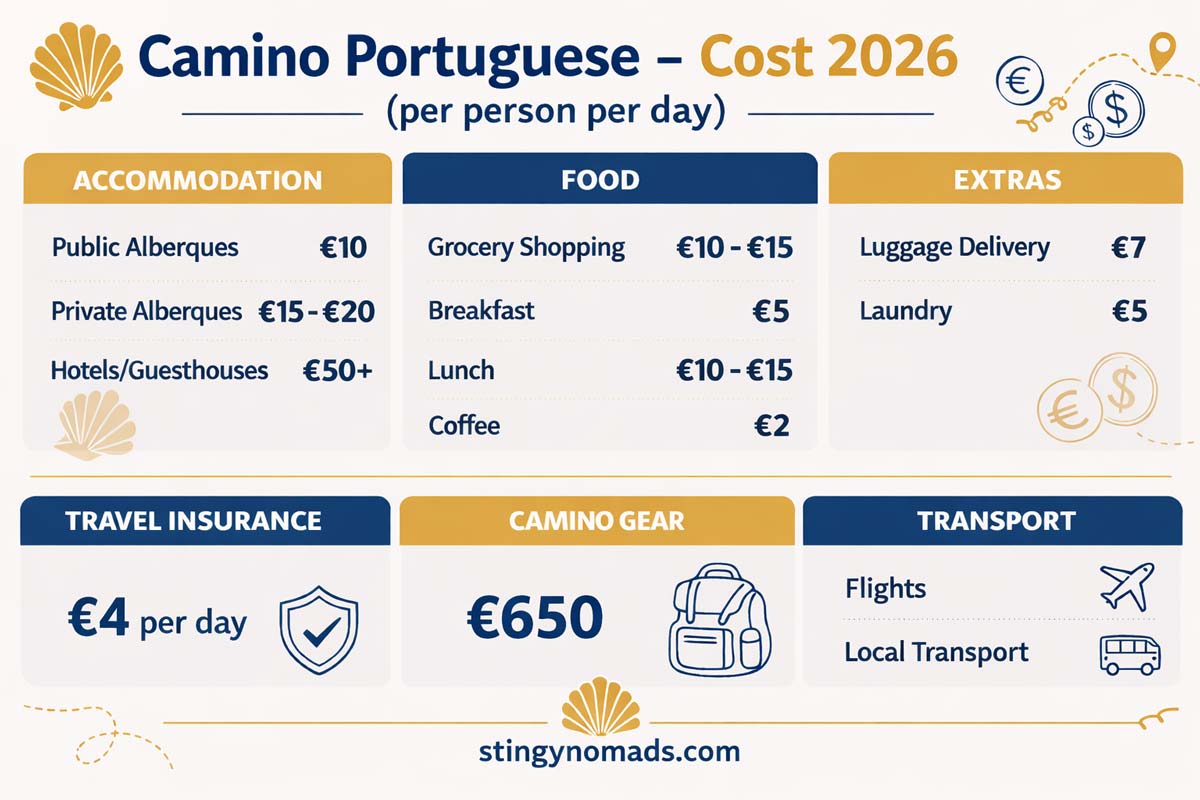
If you stay in public albergues and buy food in supermarkets your average Camino cost will be around 25 Euros per person per day. If you stay in private albergues and eat in a restaurant at least once a day, go out for a beer, or stop a couple of times for coffee be ready to spend daily 35-40 Euros per person. If you stay in hotels, eat out twice a day, and use luggage transfer service be ready to spend 55+ euros per person per day. You can find a detailed breakdown with prices in our Portuguese Camino cost post.
Prices in Portugal
- Accommodation - municipal albergues - 10-12 Euro per person, private albergues - 20 Euro pp. Hotels from 30 Euros pp. (if sharing a budget double room), from 45 euros for a single budget room.
- Eating out - Menu do Dia, a set lunch that includes a starter, main dish with sides, drink and coffee or dessert - from 12 Euro pp.
- Food shopping - 10 Euro pp per day
- A cup of coffee (Americano) - 1.5-3 euros
- A beer in a bar - 2 Euro.
- Laundry - washing 4 Euro per load.
- Backpack delivery service (optional) - 7 euros per backpack per stage.
Prices in Spain
- Accommodation - municipal albergues - 10 euros per person, private albergues - 20-25 euros pp. Hotels from 35 Euro pp. (if sharing a double budget room), from 50 euros for a budget single room.
- Eating out - Menu del Dia; starter, main dish, drink (usually house wine), coffee or dessert - from 12 euros.
- Food shopping - 10 euros pp per day
- A cup of coffee (Americano) - 1.5-3.5 euros
- A beer in a bar - 2-3 euros
- Laundry - washing - 4 euros per load
- Backpack delivery service (optional) - 7 euros per stage
Food on the Camino is a part of the experience even if you're on a tight budget I'd suggest going out sometimes to try traditional Spanish and Portuguese dishes.

What to pack for the Camino?
Make sure not to pack too much and bring only the necessary stuff. We've met many people who had to reconsider their backpack content after the first day on the Camino. You don't need much and you always can buy anything you need way there are shops, supermarkets, and pharmacies along the way.
What you will need for the Camino are a pair of good walking shoes and a comfortable backpack. These two items will make a big difference to your walk.
If you're planning on using a luggage delivery service then it doesn't matter you can pack as much as you want.
We have a detailed Portuguese Camino packing list post where you can find our recommendations on what to pack for the Camino for men and women for different seasons.

Portuguese Camino planning resources
- The three routes of the Portuguese Camino from Porto
- The Central Route of the Portuguese Camino
- The Coastal Route of the Portuguese Camino
- The Litoral Way of the Portuguese Camino
- The last 100 km on the Portuguese Camino from Tui
- Portuguese Camino packing list
- The Spiritual Variant of the Portuguese Camino
- The Portuguese Camino from Lisbon
- Best towns on the Portuguese Camino de Santiago
Questions or Comments?
Got any questions or comments? We would love to help! All questions and comments will be answered by us personally in Buy Me a Coffee. Click below and ask away.
Feel free to support our site by buying us a coffee!

The pretty half of Stingy Nomads, responsible for all our land adventures (hiking, climbing, walking the Camino) and following them write-ups. Alya loves walking since she was a child, she prefers to walk 1000 km with a backpack rather than to do a 10 000 km road trip (actually any road trip). Alya is a big fan of Latin America, the Spanish language, and dancing. Every time we go away she desperately misses our dog Chile.

Hello and thank you for all the great information you provide. I am devouring it all! 🙂
I am planning to walk from Porto to Santiago in late September and I having troubles planning my return flight. I am planning on doing a mix of the coastal and the central routes and I am giving myself 13 days altogether. I would fly out from Santiago on Day 14. Do you think that is enough or shall I add another day or two to keep things more relaxed? Or do you recommend staying an extra day at the end in Santiago? I live in the lower Alps and I am a good walker if that helps. Thank you for your input. All the best.
Hello, Valerie! Thank you very much for the comment! We always stay in Santiago for at least a day after we finish walking, usually the day you arrive there are many things to do like getting the Compostela, going to the mass, etc. and you don't really have time to see the city. The historical center is not very big but it's beautiful worth having a day to explore it. If you have time I'd suggest to have one or two extra days not because you won't make it in 13 days but in case you really like a place or a town and want to stay there longer. If you finish and still have a couple of days left in Santiago you can always do a trip to the coast and visit Finisterre and/or Muxia.
Buen Camino!
Very, very informative nomads. Easy to follow and extremely relevant. You're guessing our potential questions before we even ask them!
Thank you for all your effort here.
David (UK)
Hello, David! Thank you very much for the comment! We're glad you find our post helpful! Enjoy the walk and Buen Camino!
Hi guys. Thanks so much for all the great information regarding the camino's. We are looking to head over from Australia in May 2020 to do the Camino de Santiago. We were going to head into Portugal after that. Is there any problems with going from Santiago to Porto using the coastal route instead of the opposite? We will actually go all the way to Finisterre, but can come back to Santiago to continue on. Thanks for any feedback
Hello, Debbie! Thank you for the comment! We actually met several pilgrims walking from Santiago to Porto for some reason it's quite a popular thing to do, most of them kept walking after finishing another route in Santiago. I don't think there will be any problem with albergues you just can show them your Credential with stamps and explain that you're walking it the other way around. I'm not sure the route is marked everywhere both ways (we did see some arrows pointing the opposite direction) but I'm sure you won't get lost there will be plenty of other pilgrims on the route.
Buen Camino!
Thanks so much for this! Two questions: is it easy or well marked to get back on the Camino Central from Vila do Conde? I can’t see any connecting paths on my map. I hope to leave Porto along the river and then do the Central Route. Also, is it necessary to call ahead and reserve beds in albergues in advance? I leave on May 30th and want to be sure I have somewhere to sleep. Thanks so much.
Hello, Emily! Thank you for the comment! The Camino Portuguese is well-marked everywhere, the route from Vila do Conde to the Central Route goes past the aqueduct, if I'm not mistaking the split is at the cathedral. If you have any doubts you can ask locals they always help but I'm sure it won't be difficult to find the way. As for booking albergues you can book only private albergues or hotels, public albergues can't be booked ahead they work on principal first come first serve. We walked this route in May and always could find a place to sleep. If there are no spots in public albergues you always can find a private one, it's more expensive between 10 and 12 Euro. We're busy walking the Camino Ingles, on May 30th we're finishing in Santiago)
Buen Camino!
This is super helpful! Many thanks! Can’t wait to hit the road tomorrow.
Hello, Emily! Thank you very much for the comment! We're glad it was helpful! We're finishing the English Way tomorrow in Santiago de Compostela, very excited to be there again!
Buen Camino!
My wife and I want to do the Camino in early Sept and want to do 7 days. Trying to decide between the Portuguese or Spanish route for a week. Porto looks nice but can we get to Santiago in a week?
Hello, Ron! There are many different routes to Santiago you can choose any route and don't walk the entire Camino but the last 150-200 km or so to make it in 7 days. To get the Compotela certificate you have to walk at least 100 km so it's up to you where to start. If you want to walk a shorter route I can suggest the Camino Ingles it's 120 km will take you 4-5 days and after arriving in Santiago you can continue for 3 more days and do the Camino Finisterre.
You won't make it in 7 day to Santiago from Porto but you can start walking from Tui which is about 6-7 walking days from Santiago. Another option is to start in Porto (it's a nice walk along the coast), walk to Barcelos, 3 days then take a bus to Redondela and from there continue to Santiago, another 4 days which makes 7 days in total.
Buen Camino!
Thanks for an excellent blog. I would like to do a shorter walk (like 7 days instead of the 12 days (due to my limited walking capacity). What options do I have? Is it possible to do some middle sections by bus or train?
Hello, Aliya! Thank you for the comment! As I understand you'd like to walk by the sea in this case I'd suggest to start from Porto on the Litoral Way, in one week you'll probably reach A Ramallosa or Vigo where you can end the Camino. It's very easy to get from Vigo to Santiago there is regular bus and train service. After Vigo the route goes inland all the way till Santiago. If you want to actually walk into Santiago I'd suggest to do the first part from Porto to Castelo do Neiva or Carreco (3 or 4 days) then take a bus to Redondela and walk from there to Santiago, another 3-4 days. I'm not sure about buses and trains for the middle section you'll probably have to do one or two switches on the way.
Buen Camino!
I just came home from hiking Via de la Plata. I have been doing Camino Francais and Camino del Norte. Now I am looking for a shorter, not too crowded and not to hilly Camino. Thanks to your blog! Camino Portuguese seems to have just what I am looking for! I am 77 years, and that is the reason why I am looking for something more suitable for a 78 years old woman. The only thing I have had problems with is hard surfaces. That kills my feet. Is it possible to avoid that to a great extent? Hopefully! Kerstin
Hello, Kerstin! Thank you for the comment! Good job on Via de la Plata! How was the Via de la Plata? Did you walk the whole route from Seville in one go? We were busy with it a couple of days ago but after Merida decided to change the scenery a little bit. Now we're in Portugal starting the Fisherman's trail of the Rota Vicentina tomorrow, it's a 10-day hike along the coast in the south of Portugal.
The Portuguese Camino does involve a lot of walking on the asphalt though on the Coastal route in the beginning there are some stretches on the boardwalks which is much nicer than cobblestones or asphalt. Hope it helps!
Buen Camino!
Thanks for the comments! Yes, this time I walked all in one go. Have been walking it in sections some years ago. I took bus twice due to too long distances ( 33+47km). Otherwise I hadn't any problems. The whole Via del la Plata is wonderful. Many different landscapes. Can you suggest some other Camino with little asphalt? I hope to be able to walk next year... Nobody knows.... Regards Kerstin
The only Camino we've done that didn't have much asphalt was the Camino Primitivo but it goes through the mountains there are many ascend and descend on the route sometimes quite steep and long. We're two day into the Fisherman's Trail of the Rota Vicentina in the south of Portugal and absolutely love it there is no walking on the asphalt at all most of the time you walk on the beach or on the footpath, the scenery here is breathtaking. From what we've seen in the first two days it might become our favorite walking route in this part of Europe. This route has nothing to do with the Camino de Santiago but for walking it's an amazing route. Walking distances are quite short as well average 20-22 km per day so it's a really good alternative to the Camino de Santiago.
Cheers!
Excellent blog and website — highly informative.
I’m looking for advice. I’ve enjoyed a fair number of long hikes including caminos in France, Switzerland, Italy, Spain and — the reason for this message — lastly the Camino Portugues.
But I’ve developed untreatable arthritis in my feet. I walked from Lisbon to Porto last year, intending to get as far as Santiago de Compostela, but the pain made that last 250 km impossible.
But I’d really like to finish one more hike before I get on a bike (nowhere near as enjoyable for me!). From last year’s experience I think there may be days when I have to reduce my distance from my standard 20-25 km down to maybe 10 km. Do you think I’ll be able to find enough accommodation if I’m forced to walk only around 10 km a day?
Thanks for any advice you can give.
Hello, Mike! Thank you for the comment! On the Portuguese Camino from Porto there are quite a lot of accommodation options, I'm not sure if you'll be able to find an albergue at every 10km but there will be hotels and guesthouses, there are definitely more accommodation options on this part of the Portuguese Camino then on the part from Lisbon to Porto. We have a PDF file with stops on the route, distances and facilities for the Portuguese Camino you can get it through our pop-up subscription form.
Buen Camino!
Great -- thank you.
Thank you for all the information...I am planning to arrive in Porto at the begining of May. You think its duable to make the trip to santiago in half the time that you describe?!
Regards from Malta
Hello, George! I don't know how far you can walk a day, the total distance is 260km we suggest 12 days for the route if you do it in 6 days instead you'll have to walk about 45km a day. If you're fine with walking that distance daily it's doable but you'll miss out quite a bit on the way.
Buen Camino!
Hi - I want to thank you so much, this is the best blog I have copied ALL of your advice and I can't wait to walk my first Camino starting early September. I really appreciate all of the thought you have put into this, including tips like how to leave Porto by going along the beach and even tips like if there is wifi at the Albergue! One question about day 9 where you say a "couple of kilometers before Redondela...sign for River Trail" did you mean a couple of KM before Pontevedra because Redondela is the starting point of the day.
Hello, Madeleine! Thank you very much for the feedback! We're glad our post was helpful! On day 9 it should be Pontevedra of course, it was a typo, I changed it, should be right now.
Buen Camino!
Hello, what are the best options for traveling from santiago back to porto/lisboa?
Hello, Lynette!
We took a direct bus from Santiago to Lisbon it was quite a long bus ride basically the whole day with several stops. As I know there is not a direct train from Santiago to Porto or Lisbon you can catch a train to Vigo and switch there for another train to Porto, it will be faster, from Vigo to Porto it's about 2h20min. and from Santiago to Vigo between 1h and 1h30min. (depending on the train). If you buy train tickets online beforehand it might be relatively cheap (35-40 Euro), you can do it on RENFE site (the official Spanish railway site). Note! When buy train tickets make sure that you arrive and depart in Vigo from the same train station, there are two, trains to Porto usually depart from VIGO GUIXAR.
Buen Camino!
Hi,
Thx for the amazing advice on the Camino, specially the stages. Walking the Portuguese way next year! Was a one-man show, that grew into 5 pax, after I shared your info. It's the best!!
Hello, Charmaine! Thank you very much for the feedback! I'm sure you and your friends will enjoy the Portuguese Camino! If you have any questions later we'll be happy to answer!
Buen Camino!
Hello! I plan to go on the Portuguese Camino next May following your itinerary. How easy/difficult is it to cross from the coastal route to the central route (Labruge to Rates). Are the signs easy to follow? Most apps that I have downloaded only show strictly the central or coastal route with no options of mixing the two up. TIA for the advice!
Hello, Stacia! The route from Labruge to Rates is marked, there are many people walking that part, in fact, most people who walk the Central route walk along the coast from Porto to Labuge and from there turn inland, I'm sure in May there will be quite a few people going that way.
Buen Camino!
Hello
Looking to do this from Porto mid March. Will accomodation be a problem with places still closed?
Hello, Liezl! Most albergues on the Camino de Santiago open in mid March but even if some public albergues will still be closed you'll be able to find private albergues to stay.
Buen Camino!
Hi
We’re planning on walking the Portuguese Coastal Camino route in mid April beginning in Porto . Understand this time of the year will be shoulder season , any further detail on weather much appreciated.
Hello, Chris! Thank you for your question! We walked the Coastal Route in the beginning of May and had very nice weather; warm and no rain at all. In April you have more chances of rain, temperatures will be lower around 15°C average though nights will be quite chilly around 9°C.
Buen Camino!
Thank you! Your blog is just what I was looking for... hoping to head off in September.
Hello, Kim! Thank you very much for your comment! We're glad our blog was helpful!
Buen Camino!
Thank you for posting this invaluable information. Planning a Pilgrimage next June and I am printing your daily itinerary. Loved the packing list.
Hello, Michelle! Thank you for your comment! We just finished the Camino Finisterre-Muxia and really enjoyed it though the weather wasn't always great. Hope you'll enjoy the Portuguese Camino, June is a great month to walk it.
Buen Camino!
Hello-
I found your information very good.
Would you possibly have a day by day suggested itinerary for following the Senda Litoral Coastal route the entire way to Santiago?
It would be very much appreciated;)
Cheryl
Dear, Cheryl! We have a whole post about the Coastal Route of Camino Portuguese with a day by day itinerary and many details. Please, check "related posts" at the end of this article or go to the home page there is a section Camino de Santiago where you can find all posts.
Good luck!
Swedish pilgrim that is leaving tomorrow for the Senda Litoral on Camino Potogues. Found your blog and really like the information. Will use your daily stages a guide. Thank you for sharing!
Hello, Caroline! Thank you very much for your comment! We're happy that you found our blog helpful. Enjoy the walk!
Buen Camino!
So happy to discover your blog...walking the portugese way next year! Thanks for all the info!
Hello, Helena! Thank you for the comment! We're glad you enjoyed our post! Hopefully it will help you in planning.
Buen Camino!
Fantastic resource!