
The Portuguese Camino - your 2026 guide
The Portuguese Camino is one of the spiritual routes to Santiago de Compostela. It is the second most popular Camino de Santiago route after the Camino Frances. According to the Pilgrim's Reception Office in 2025 more than 34% of all pilgrims who arrived in Santiago de Compostela walked it. Every year more and more people choose the Portuguese Camino. It's my favorite Camino route.
You can find a complete list of our posts dedicated to the Portuguese Camino on our Portuguese Camino de Santiago resource page.

This post contains affiliate links. If you make a purchase, I may receive a small commission at no extra cost to you.
Portuguese Camino planning tool
You can use our free Portuguese Camino planning tool to get a customized itinerary with recommended places to stay.
The Portuguese Camino - downloadable PDF files
To make your Portuguese Camino planning easier we created free downloadable PDF files. Two files for each route; one contains walking stages and one places to stay along the route including public albergues with contact details and booking information.
Central Route
- Central Route Portuguese Camino - walking stages PDF
- Central Route Portuguese Camino places to stay PDF
Coastal Route
- Coastal Route Portuguese Camino - walking stages PDF
- Coastal Route Portuguese Camino - places to stay PDF
Litoral Way
- Litoral Way Portuguese Camino - walking stages PDF
- Litoral Way Portuguese Camino - places to stay PDF
Portuguese Camino overview
- Distance - from Lisbon: between 613 km/381 mi and 650 km/403 mi depending on the route from Porto. From Porto: 243.5 km/151 mi - Central Route; 274 km/170 mi - Coastal Route; 280 km/173 mi - Litoral Way. From Tui - 117 km/72.7 mi.
- Number of days – 25-30 days from Lisbon; 12-15 days from Porto; 5-7 days from Tui.
- Starting points - the Church of Santiago in Lisbon; Sé Cathedral in Porto; Cathedral de Santa Maria in Tui (for the last 100 km to Santiago).
- Finishing point - Obradoiro Square in Santiago de Compostela, Spain.
- Walking surface - asphalt, cobblestone, footpath, gravel road, boardwalks (on the coastal routes).
- Average cost - 35-55 Euro per person per day
- Accommodation - public and private Albergues, hostels, hotels, guesthouses, and campsites.
- Route marking - yellow shells and arrows, metal shells and arrows on the ground, stone distance poles.

Travel insurance for the Camino
Walking like any other outdoor activity involves a risk of getting an injury or losing some of the gear. Camino travel insurance can offer you coverage. The Portuguese Camino de Santiago is not a high-altitude wild hike through remote areas but it's still a physically challenging experience that involves a long walking distance with a heavy backpack. It's not rare for pilgrims to get injuries from small blister problems to knee or shin splint issues. It makes the walk less stressful when you know you're covered in case of any unpredictable emergencies.
World Nomads offers simple and flexible travel insurance. Buy at home or while traveling and claim online from anywhere in the world.
Where does the Portuguese Camino start?
The Portuguese Camino like other Camino de Santiago routes has several starting points. In fact one can start walking from any place on the route. The most popular starting points are Lisbon (the actual start of the Portuguese Camino), Porto (where most pilgrims start), and Tui (the last 100 km to Santiago).
In Lisbon the Camino starts at the Church of Santiago, a small church 400 m away from Se Cathedral. Many people think the route starts at the Cathedral but it doesn't. The church is closed most of the time. If you need a pilgrim's passport (Credential) you can buy it at Se Cathedral in Lisbon (from the church the Camino goes to the Cathedral).
In Porto the Portuguese Camino (all 3 routes) start at the Se Cathedral in the historical center.
In Tui (Spain) the route starts at Cathedral de Santa Maria de Tui. The reason many people start walking the last 100 km from Tui is to get the Compostela, a pilgrimage certificate. It's granted only to pilgrims who have walked at least the last 100 km to Santiago de Compostela on any Camino route.
Vigo is another starting point to walk the last 100 km on the Coastal/Litoral route of the Portuguese Camino. You can start the walk at the Church of Santa Maria de Vigo in the historical center.

How long is the route?
The distance of the Camino Portugues depends on where you start walking. As you can see in the above section there are several starting points.
If you start the Portuguese Camino in Lisbon your total distance will be between 613 km/381 mi and 650 km/403 mi depending on the route from Porto. It takes 25-30 days to complete it.
If you start in Porto and walk the Central Route it's 243.5 km/151 mi. It takes on average 10 to 12 days to complete.
The Coastal Route from Porto is 274 km/170 mi. It takes 12 to 14 days to complete.
The Litoral Way from Porto is 280 km/173 mi. It takes 12 to 14 days.
The combination of the Litoral and Central routes from Porto is 262 km/163 mi. It takes 12-14 days.
The Portuguese Camino from Tui is 119 km/74 mi. It takes 5 to 7 days to complete on average.

How difficult is the walk?
The Portuguese Camino is a challenging multi-day walk. It requires preparation and training especially if you're not an experienced hiker and have never done a long-distance walk. You walk 20-25 km a day on average with a backpack for weeks. You can imagine that by the end of the Camino, you'll be quite tired. You can always take rest days and stay in one of the beautiful towns on the Portuguese Camino.
The difficulty level depends on the chosen route and starting point. If you start in Lisbon and walk to Santiago de Compostela it's a demanding walk, especially the part from Lisbon to Porto. The distances between towns are greater and there are fewer places to stop in between.

If you walk the Central Route from Porto you can expect steep ascents and descents. Some people might find it challenging. The route is well-marked and has good infrastructure for pilgrims. There are plenty of places to stay along the route so you can walk shorter distances.
The Coastal Route from Porto is well-marked and has fewer hills than the Central Route but it's a bit longer. During winter months it gets very windy, cold, and wet. It's not the best route to walk outside the spring/summer months.
The Litoral Way is my favorite route of the Portuguese Camino. Most of the time it goes next to the sea. It has no hills, the distance is the same as on the Coastal Route. The lack of route marking is the main challenging part of it. You'll need some sort of navigation to stay on the track.
If you decide to take the Spiritual Variant (the optional route of the Portuguese Camino from Pontevedra to Pontecesures/Padrón) be prepared for a challenge as the route has a very steep ascent and descent.

Camino with a company
We often get questions from our readers about using a company to plan their Camino walk. We have never done it so I can't recommend it from my personal experience.
It's easier to plan the Camino through a company because they do all the booking and planning for you. The main drawbacks (in my opinion) are that it's more expensive and it doesn't give you much flexibility as your accommodation and luggage delivery are booked in advance.

Download the Camino Portuguese Walking Routes map
Different routes of the Portuguese Camino
The Portuguese Camino de Santiago has different routes. You can combine the routes from Porto in one walk.
The Lisbon to Porto part has only one route. The Porto to Santiago part has three routes: Central, Coastal, and Litoral. The last two are similar they merge and split every day.
The Central Route is a 243.5 km/151 mi inland route from Porto to Santiago de Compostela. There are several interesting historical towns along the way. The scenery is countryside, forest, and fields.
The Coastal Route is a 274 km/170 mi partially coastal partially inland route from Porto to Santiago. It goes close to the coast till Vigo. From there is goes inland to Redondela where it merges with the Central Route. If you are choosing between the two above routes read my post where I compare the Central and Coastal Route. As an option you can combine the Coastal and Central routes in one walk.

The Litoral Way (Senda Litoral) is a 280 km/173 mi coastal route. From Porto, it goes along the Douro River and the Atlantic Coast. The main difference of the Litoral Way compared to the Coastal Route is that the first is 80% next to the sea. Like the Coastal Route, it merges with the Central Route in Redondela.
There are two connecting routes that you can use to switch from the Coastal/Litoral Way to the Central Route. First is from Vila do Conde to Rates (after the first stage) and second from Caminha to Valença/Tui.
The Spiritual Variant (Variante Espiritual) is an optional route from Pontevedra to Padron (Pontecesures). It includes 2 walking days and 1 day on the boat. It's a scenic and quite challenging route due to a steep ascent on the first day and a long descent on the second day.

The best time for walking
September and May are the most popular months for the Portuguese Camino. Good weather for walking is one of the reasons. It's warm and sunny but not too hot. It's not the peak holiday season so flights and hotels are usually cheaper. Expect to see a lot of pilgrims on the route. It's better to book accommodation and luggage transfer in advance.
If you want to have good weather and fewer people, the end of April and the first half of October are the best months to walk the Camino.
June is the beginning of the summer season; the weather is good and there are fewer people on the route compared to May and September.
July and August are the hottest months and the peak holiday season. Finding private accommodation on the coastal routes might be difficult without booking in advance and prices are a higher.
Winter months are not the best for walking in Northern Portugal and Spain it gets cold, rainy, and windy, and some albergues are closed.

What is the accommodation like?
Albergue is a special hostel for pilgrims with dormitories and shared facilities don’t expect any luxury.
There are two types of albergues on the Camino; municipal (public) and private albergues.
Municipal albergues are cheaper (10-12 euros pp.), they can’t be booked in advance, and most of them don't accept luggage delivery. One requires a Credential (a pilgrim's passport) to stay there. Usually can be paid only cash.
Private albergues are more expensive (around 20 euros pp.). They have better facilities, can be booked in advance online or over the phone, and accept luggage delivery. Usually accept cards and cash.
Most Albergues (private and public) have dormitories with bunk beds, shared bathrooms/toilets, and a kitchen, some have washing machines. Most (if not all) private albergues and some public have wi-fi.
For more details on accommodation on the Camino, the pros and cons of staying at albergues, tips, etc. check our detailed post Albergues on the Camino de Santiago.

The best guidebook
For us, Camino de Santiago guidebooks by John Brierley are the best. We used his Pilgrim’s Guide to the Camino Portugués Lisbon – Porto – Santiago: including Camino Central, Variente Espiritual, Camino da Costa, & Senda Litoral on the Portuguese Camino.
Want to read a fun, entertaining book about the Camino? Some fun and informative novels take place on The Way. Campbell read a few of the most famous books written about the Camino. See our reviews of a couple of the Top Novels on the Camino de Santiago.
Best Camino apps
We don't use apps for walking the Camino but I know many people do. So we've tried different apps for the Portuguese Camino to see how they work. I used for a couple of days Wise Pilgrim and Buen Camino on the different stages and routes of the Portuguese Camino. I used Camino Ninja (I know many pilgrims like it) when I walked the Litoral Way and it was quite accurate most of the time.
Overall my experience with Camino apps was good. I didn't need apps for walking the Central and Coastal Routes as they are well-marked. For the Litoral Way I used it for a couple of stages. I didn't like walking attached to my phone so unless you walk a not-well-marked route I don't think having an app is crucial.

Luggage transfer on the Camino
If you want to make your walk easier or have some back issues and can’t carry a heavy bag every day you can use a backpack delivery service. Several companies offer this service on the Portuguese route. Pilbeo (Central Route), Tui Trans (Coastal, Central, and Spiritual Routes) and Correos (Central, Coastal, and Spiritual Route). You can use it for the entire route or some stages. One stage costs 7 Euros per backpack.
It's important to remember that public albergues on the Camino usually don't allow luggage delivery. These albergues can't be booked in advance and they won't keep a bed for you even if your backpack is delivered there. Private albergues and hotels along the route have no problem with luggage delivery.

The cost of walking the Portuguese Camino
The cost of accommodation and food in Portugal and Spain is similar. Eating out and hotels are a bit cheaper in Portugal than in Spain.
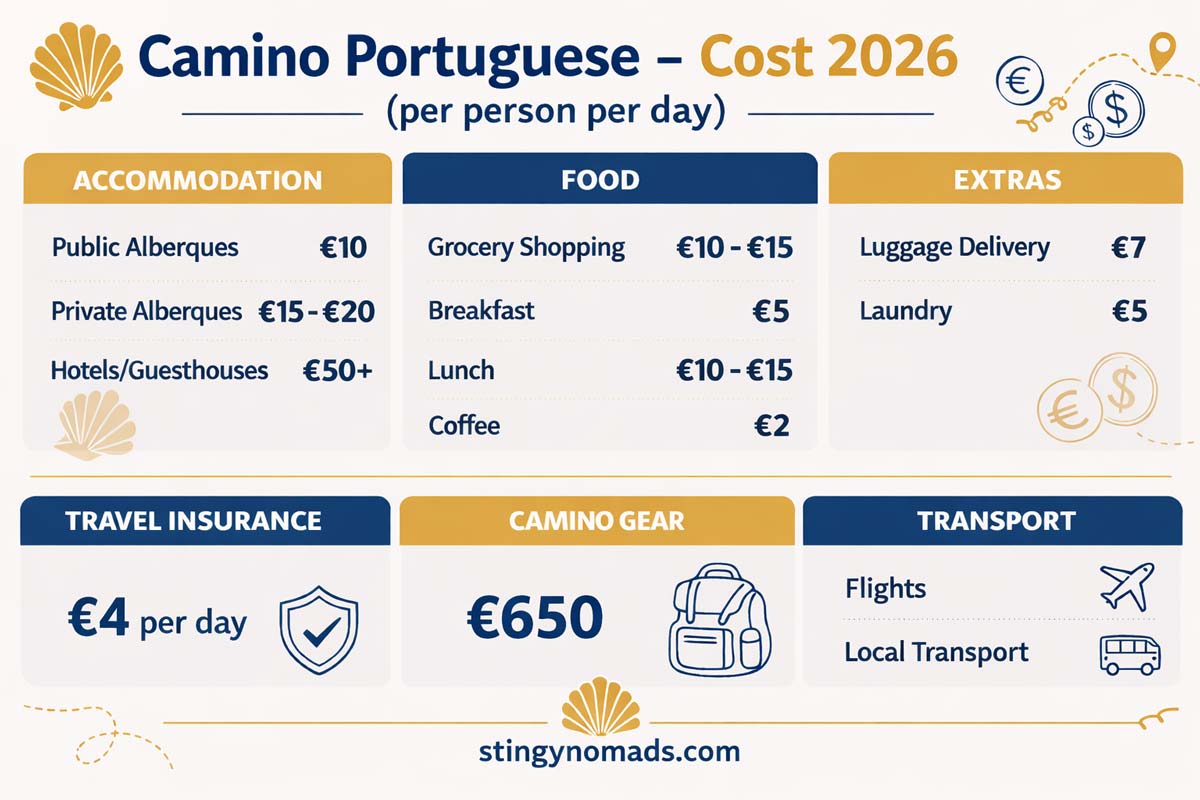
If you stay in public albergues and buy food in supermarkets your average Camino cost will be around 25 Euros per person per day. If you stay in private albergues and eat in a restaurant at least once a day, go out for a beer, or stop a couple of times for coffee be ready to spend daily 35-40 Euros per person. If you stay in hotels, eat out twice a day, and use luggage transfer service be ready to spend 55+ euros per person per day. You can find a detailed breakdown with prices in our Portuguese Camino cost post.
Prices in Portugal
- Accommodation - municipal albergues - 10-12 Euro per person, private albergues - 20 Euro pp. Hotels from 30 Euros pp. (if sharing a budget double room), from 45 euros for a single budget room.
- Eating out - Menu do Dia, a set lunch that includes a starter, main dish with sides, drink and coffee or dessert - from 12 Euro pp.
- Food shopping - 10 Euro pp per day
- A cup of coffee (Americano) - 1.5-3 euros
- A beer in a bar - 2 Euro.
- Laundry - washing 4 Euro per load.
- Backpack delivery service (optional) - 7 euros per backpack per stage.
Prices in Spain
- Accommodation - municipal albergues - 10 euros per person, private albergues - 20-25 euros pp. Hotels from 35 Euro pp. (if sharing a double budget room), from 50 euros for a budget single room.
- Eating out - Menu del Dia; starter, main dish, drink (usually house wine), coffee or dessert - from 12 euros.
- Food shopping - 10 euros pp per day
- A cup of coffee (Americano) - 1.5-3.5 euros
- A beer in a bar - 2-3 euros
- Laundry - washing - 4 euros per load
- Backpack delivery service (optional) - 7 euros per stage
Food on the Camino is a part of the experience even if you're on a tight budget I'd suggest going out sometimes to try traditional Spanish and Portuguese dishes.

What to pack for the Camino?
Make sure not to pack too much and bring only the necessary stuff. We've met many people who had to reconsider their backpack content after the first day on the Camino. You don't need much and you always can buy anything you need way there are shops, supermarkets, and pharmacies along the way.
What you will need for the Camino are a pair of good walking shoes and a comfortable backpack. These two items will make a big difference to your walk.
If you're planning on using a luggage delivery service then it doesn't matter you can pack as much as you want.
We have a detailed Portuguese Camino packing list post where you can find our recommendations on what to pack for the Camino for men and women for different seasons.

Portuguese Camino planning resources
- The three routes of the Portuguese Camino from Porto
- The Central Route of the Portuguese Camino
- The Coastal Route of the Portuguese Camino
- The Litoral Way of the Portuguese Camino
- The last 100 km on the Portuguese Camino from Tui
- Portuguese Camino packing list
- The Spiritual Variant of the Portuguese Camino
- The Portuguese Camino from Lisbon
- Best towns on the Portuguese Camino de Santiago
Questions or Comments?
Got any questions or comments? We would love to help! All questions and comments will be answered by us personally in Buy Me a Coffee. Click below and ask away.
Feel free to support our site by buying us a coffee!

The pretty half of Stingy Nomads, responsible for all our land adventures (hiking, climbing, walking the Camino) and following them write-ups. Alya loves walking since she was a child, she prefers to walk 1000 km with a backpack rather than to do a 10 000 km road trip (actually any road trip). Alya is a big fan of Latin America, the Spanish language, and dancing. Every time we go away she desperately misses our dog Chile.

Hola
I love your website and fantastic advice - I really find it very easy to navigate!
I have a question about booking accommodation. I will be starting from Porto on May 23 this year. I would prefer to wing it and find accommodation as I go along, but am concerned about how busy it may be and not finding a bed in a albergue. Is late May / early June considered "peak'ish" time? What are your thoughts??? I would really value your opinion and advice if I should look at booking any of the accommodation. Thanks!
Hello Tina. Thank you for the comment. The end of May-beginning of June is a popular time to walk the Portuguese Camino de Santiago but I think you'll be fine without booking everything in advance. If you walk more or less standard stages you should be able to find a bed at the end of every day. Small places with limited options might be a problem. I would suggest looking through the itinerary and checking if there are enough albergues in every town along your route. To do so you can use our PDF file which can be found in the second paragraph of this post https://stingynomads.com/camino-portugues-stages/.
Buen Camino
Greetings from the camino! I started the route after reading your advice. Later I found useful to load buen camino to my phone but that's all. Nice to be here in off-season, when there is a lot room everywhere. What I have found useful, is to ask other pilgrims coming back and volunteers places to stay overnight. They have given good tips! Buen camino have rankings of the places to stay overnight and they are useful. Especially those walking off-season when there is room for everyone. What I have found here, is that no use to make too strict plans for the camino. This is a route, where you take a distance from your everyday planning and routines. Spend time with yourself.
Tnx for the advice. Was worth doing.
Hello Jukka. We're glad you enjoyed the Camino. Thank you for your tips. I agree you don't have to do a lot of planning and book places in advance if you walk the Portuguese Camino completely off-season. We've walked 9 Camino routes including some in the peak season and without advanced planning, you might end up in a place with nowhere to stay and will have to keep walking or take a taxi to the nearest hotel. We've seen this happening and we had it once or twice ourselves and it's very inconvenient.
Buen Camino
Love your walking plans. So helpful on the Camino Frances we walked in 2022 and now are planning the Portugues Sept '23. Is there a luggage delivery service from Porto to Santiago for a larger suitcase? We sent one ahead from SJPDP to Santiago when we walked the Francis. This carried our clothes for the remainder of our stay off the Camino (and used it to bring our poles via checked luggage). Thanks for your help.
Hell Lynn. Thank you for the comment. If you have check-in luggage mostly because you want to bring your poles it might be easier and cheaper to buy new hiking poles in Porto or Lisbon. There are a couple of Decathlon stores in both cities where you can buy new poles for 20-25 euros. After walking the Portuguese Camino you can just leave them in an albergue or hostel. If you want to bring more clothes and need extra luggage then it's worth it to bring it.
I'd suggest contacting Tui Trans they might deliver luggage from Porto to Santiago in one go but I'm not sure if they have storage facilities. Corres is the best option but unfortunately, they don't operate in Portugal. They deliver luggage on the Portuguese Camino starting from Tui to Santiago. Otherwise, you could try to arrange delivery from Porto to Tui and from there send your to backpack with Correos to Santiago. You can contact them as well and see if they don't have a partner company in Portugal that can deliver your luggage to Tui.
Good luck
Dear Nomads, thank you soooo much for sharing your wisdom! Your site is so clear and informative. Love it!
Could you please tell me which route, Central or Coastal, is "greener", has more nature and nicer scenery? I would like to avoid walking through towns and on the busy roads as much as possible.
Thank you!
Hello Gaura. Thank you for the comment. I'd say the Coastal Route of the Portuguese Camino is more scenic with fewer towns and through the less-developed areas (except the part of walking in and out of Vigo). I'd suggest walking the Coastal/Litoral Route from Porto to Caminha and from there switching to the Central Route (walk to Tui). The Coastal Route is not very green mostly beaches and sea but the last couple of days to Santiago are through the forest. I hope it helps.
Buen Camino
Thank you for all the information. I will be completing my first Camino in May of this year and have very much enjoyed reading all your articles in preparing for this journey.
Hello Theresa. Thank you very much for the feedback. We're sure you'll have an amazing experience on the Portuguese Camino.
Buen Camino
Looking to do my first Camino in September Have found all your information very helpful. Have noticed when googling some places prices have all gone up
Hello Maggie. Thank you for the comment. The prices have changed quite a bit in the last year. The post is due to be updated next week with the current prices. You'll find more up-to-date information about the Portuguese Camino if you check the post out in a week's time.
Buen Camino
Thanks so much for your detailed information, it is really helpful. I am planning to walk this May with my 21 year old son. It is a bit overwhelming to plan as there are so many route. I think would to do the Portuguese route, part central , part costal. I will have about 12 days to walk, what is your suggestion. Also , once you get to the end, where did you fly out of?
Thanks so much,
Ann
Hello Ann. Thank you for the comment. The Portuguese Camino is an excellent route for first-time pilgrims. I would suggest starting from Porto on the Coastal Route and then switching to the Central Route from Caminha. As for flying, I don't know what country you're coming from. There is an airport in Santiago de Compostela with direct flights to several European cities.
Buen Camino
Hi, I love your website. I am planning on Porto to Santiago in June. How can I book a train or bus back to Porto from Santiago please? I can't find anything available. Is it too early?
Hello Laura. Thank you for your comment. I think you can't book anything because it's too early. I would recommend trying to book a bus ticket at month or so before the trip. A bus is a better option for getting from Santiago to Porto. There is no direct train you'll have to do one of two switches.
Buen Camino
Your guide is amazing and very helpful. Can you recommend a hiking app which can be used for direction and also works off line. We are due to start from Porto in April and I can't find a map or route which takes us from LaBruges through to the Central route.
Hello Kelvin. We have never used any app on the Portuguese Camino. I know some pilgrims use Way of Saint James (Buen Camino). You can try it. We might walk the section from Labruge in March and add a map to the post. Please, come back end of March - beginning of April to check.
Buen Camino
@Stingy Nomads,
Very grateful thank you.
Hi
For albergues it s necessary reservations in advance to stay?
Thank You!
Hello Marian. Public (municipal albergues) can't be booked in advance they work on first come first serve principle. Private albergues and hotels on the Portuguese Camino route can be booked in advance. How long in advance to book depends on when you're going to walk the Camino. If during the peak months (June to September) then it's better to book a couple of months in advance. If you're going to walk outside the peak season you can book your accommodation as you go or stay in public albergues.
Buen Camino
Hi Campbell and Alya,
I asking for your kind advise 🙂
My wife and I are intend to hike in May 2023 either
a) Portuguese Camino - Central Route from Port to Santiago or
b) Rota Vicentina - Historical Way plus some of the Fisherman trail.
c) Something other
We have about 12-14 days time and will hike with our own tent (wild or on camp sites). We never hiked before in Portugal or SpainOur focus is to relax, see beautiful & changing landscape with forests, a bit countryside , old some villages or towns for eating. We will travel via Lissabon, as we like to stay afterwards 3 days there.
Which hike would you advice for an 50ish couple in their holidays?
Many thanks
Uwe from Germany
Hello Uwe. Thank you for the comment. If you want to camp on the route I would definitely recommend the Rota Vicentina. On the Portuguese Camino there are not many designated campsites and in some areas you might struggle finding a spot for wild camping. We've walked the Historical Way, the Fishermen's Trail, and the Portuguese Camino and liked the scenery on the Fishermen's Trail the most. 12-14 days is enough to walk the entire trail from Porto Covo to Lagos. We walked it the first time in May and it was a great experience. It's easy to get to Porto Covo or Lagos from Lisbon by bus. As for the Historical Way it was nice but not as spectacular as the Fishermen's Trail.
Cheers
@Stingy Nomads,
many thanks for your recommendation. It sounds good and I already started the planning process. It will be a nice comparision to our bristish Pembrokeshire Coastpath experience 🙂
Cheers
Great info thank you!
We’ve been looking at the stingynomads website for a Fisherman’s Trail walk in Portugal first two weeks of May.
The trips we’ve seen have quite long days – could you suggest a walk that is 15k a day x 10 days? We’re happy to stay in Portugal and not end up in Santiago.
Would you have any advice please? We’re both South African and loved the Santiago walk we did a couple of years ago.
Would appreciate any advice - thank you
Hello Julie. Thank you for the comment. The Portuguese Camino from Porto is the only route I know in Portugal where you can walk 15-kilometer days. It's impossible on the Fishermen's Trail as the towns are further apart and there are no places to stay in between you can't make the walking stages shorter unless you want to wild camp. I don't know which Camino route you've already walked but I can suggest walking the Coastal Route or the Central Route of the Portuguese Camino starting in Porto and see how far you get.
Buen Camino
I am planning to do the coming Portuguese in April from Valensa
Hi, I've really enjoyed reading your descriptions of the camino routes. I can feel the excitement starting!
I am hoping to do some of the Camino Portugues from Porto to SDC in early June but only have a approximately a week. Are there parts of the route that you would think are worth leaving out or some particularly which should definitely be left in? I would be happy to take public transport to skip along some of the route.
One more question about the Rota Vincentina please. As neither my sister or myself are good with heights, are there any unguarded cliff paths or pathways near cliff edges at all?
Thanks a million and keep up the great blogging/vlogging.
Martien
Hello Martien. Thank you for the comment. If you want to get the Compostela (a certificate that you can get for completing the Camino de Santiago) you have to walk the last 100 km to Santiago de Compostela on any Camino route. For the Portuguese Camino, the last 100 km pilgrims usually walk starting in Tui. You'll need 5-6 days to walk it. I have two suggestions. The first one is walking the complete stretch from Rubiães to Santiago de Compostela. The second one is to start in Porto and walk to Vila do Conde (it's a beautiful walk along the coast) and from there take a bus to Tui and continue to Santiago de Compostela.
On the Fishermen's Trail (the Coastal Route) of the Rota Vicentina, there are parts along unguarded cliffs. You can walk the first 4 days from Porto Covo to Odeceixe. That part has mostly dunes and beaches but there are still some cliffs.
Buen Camino
The Portugal Camino starts in Lisbon, not in Porto. You missed 16 stages before Porto.
Best,
Peter Nanasi
Hello Peter. Thank you for your valuable comment. We've walked the Portuguese Camino from Lisbon there is a separate blog post on that part of the route https://stingynomads.com/camino-fatima-walk-lisbon-porto/. If you bothered to read through the post (at least the first couple of paragraphs) your remark wouldn't be necessary.
Best regards
@Stingy Nomads, Thanks, Great work!
I'm learning so much from your site, thank you!
My husband and I will be in Portugal in mid March. Is this too early to walk the Camino Portugues? We are considering starting in Porto but would only have time to walk for 3 or 4 days. Is it possible to get bus transfers back from the rural towns to Porto?
I've also been considering Rota Vicentina for our trip and have enjoyed your writings on this hike as well. Very informative!
Hello Michelle. Thank you for the comment. In mid-March in Northern Portugal and Spain, it's still quite cold and rainy. From the weather point of view walking a part of the Rota Vicentina is a better option. If you have 3-4 days you can do a part of the Fishermen's Trail e.g. walk from Sagres to Lagos, it takes 3 days to complete the route. In mid-March, it's usually warm and sunny in the south. It's easy to get by bus from Lisbon to Sagres and from Lagos back to Lisbon.
Cheers
Hi Team SN!
Thank you so much for the content you provide AMAZING! I was hoping you could give me some advice. I am looking to walk Porto to SdC with my 2-year-old daughter. From my research, I am thinking to use a Thule Sport Chariot to push her. I plan to do the walk in May or June (most likely June due to my schedule). My question is what path would you recommend is best if I will be pushing the baby? IE more even terrain? A few other details - I have some trekking experience and pre-baby was able to do some of the Camino Primitivo. I suspect with baby I could do 15-20ishK per day. I chose Camino Portuguese because I have heard terrain may be easier to push a chariot with a baby but I am open to other routes. I will have 4 weeks of time. Any guidance or recommendations for hiking with a baby would be amazing.
Hello. Thank you for the comment. We're planning to walk the Portuguese Camino in May with our daughter who will be 20 months then. We'll write a post and make a couple of YouTube videos on walking the Camino with a toddler. We haven't decided yet if we're going to use a stroller or a backpack carrier. We have a normal stroller with bigger wheels that we might use in the end but not as expensive as the Thule Sport. We walk a lot with the stroller in Portugal where we live and it works fine. You can check our blog some time in May to more updates on walking the Camino with a toddler.
Cheers
Thank you guys for making this post and awesome PDF Files : &
Question:
Day 1. Porto - Labruge
this is Costal route not the Central route, isn't it?
would be great if you make a note on Day 1 (costal route)
Thank you so much for the camino portugues infomation.
Hello Jen. Thank you for the comment. The first day out of Port is on the Litoral Way along the Coast this route is used by most pilgrims who walk the Portuguese Camino regardless if they do the Coastal Route or the Central Route. It's the recommended route because the other two go through industrial areas, are close to busy roads, etc. There is the infographic and the map in this post explaining the first day of the route.
Buen Camino
What a wonderful vlog, I was so confused , I didn’t know what Camino to choose from, I knew in my heart that I wanted to do the Camino portugués but everywhere I looked and searched for said that it’s best for first timers to to the Caminó francés , Then going back and forth maps I settled on the Camino portugués but wanted to do include some litoral, costal and central routes on my Camino and I didn’t know how to do it, and then I found your page. It combines the perfect Camino for me. Thank you for sharing and helping future pilgrims on their journey to Santiago de Compostela.
Hello Karol. Thank you very much for you comment. We're sure you'll enjoy the Portuguese Camino. It's a good route to walk for a first-time pilgrim.
Buen Camino
So helpful. Muchas gracias