
What is the Camino de Santiago?
The Camino de Santiago or the Way of St.James is a network of pilgrimage routes to the tomb of Apostle St. James (Santiago in Spanish) in Santiago de Compostela. Walking the Camino is a lifetime experience. One of the best things about it is that anybody can do it. You don't have to be an experienced hiker or good athlete to walk it.

We have the Camino de Santiago resource page where you can find all our posts dedicated to the pilgrimage. It's easy to navigate as all the posts are grouped by the topic.
As of May 2026, we've completed 12 Camino routes and several connecting and alternative routes. If you have just started planning the Camino you can follow our 10 easy steps that will help you to plan your walk.
Watch our YouTube video about things to know before walking the Camino de Santiago
Stingy Nomads participates in the Amazon Services LLC Associates Program and other affiliate programs. If you click on the link and purchase the item or make a booking, we will receive an affiliate commission at no extra cost. Thank You for supporting us and assisting us to produce quality, free content.
What is the Camino de Santiago?
The Camino de Santiago is a network of pilgrimage routes to Santiago de Compostela, a city in Galicia, Northern Spain. It's believed to be the burrier place of the remains of the Apostle St. James. The history of the Camino de Santiago goes back to the 9th century when Spanish King Alfonso II completed the first-ever pilgrimage from Oviedo to Santiago de Compostela. Nowadays this route is known as the Camino Primitivo.
Camino de Santiago has many different routes from short 120-kilometers trails to long and challenging 1000-kilometers routes. Depending on how much time you have, what you want to see, and how far you want walk you can choose any of the existing routes.

Why is the Camino so important?
The Camino de Santiago is one of the oldest pilgrimage routes in Europe. It has been walked by millions of people over the centuries. The final point of the pilgrimage, the Cathedral of Santiago de Compostela, is one of the three Christian temples built over the tomb of one of the twelve Apostles. People who walk the Camino for religious reasons see it as the way to seek penance and forgiveness.
If you get overwhelmed at the beginning of your Camino planning and have many questions that need to be answered we created a dedicated post answering many FAQs about the Camino de Santiago.
Many routes of the Camino de Santiago
The Camino de Santiago is not a single route, as some people think referring to the most popular route - Camino Frances. It's a network of routes. You can start walking to Santiago from anywhere in Europe but outside the established Camino de Santiago routes it will be difficult to find a good infrastructure for pilgrims; accommodation, route markings, etc.

There are several established routes of the Camino. They start in different places in Spain and Europe and end in Santiago de Compostela.
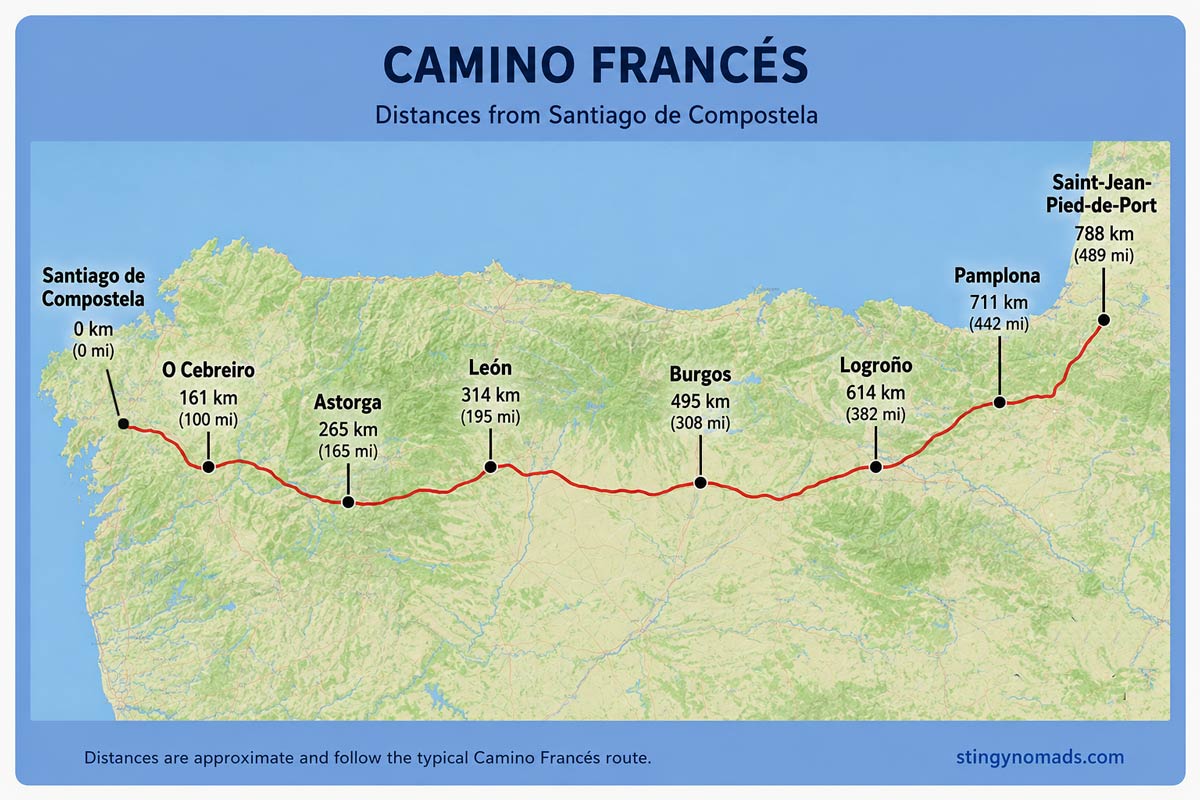
Camino Frances (the French Way) - the most popular route. In 2024 47% of all pilgrims walked this Camino. The French route starts in Saint Jean Pied de Port, a small French town near the border with Spain. The total distance is 790 km. 65% of pilgrims who completed the route walked the last 100 km from Sarria.
Camino Portugues (the Portuguese Way) - the second popular route. It starts in Lisbon but most people start their walk in Porto or Tui. Total distance from Lisbon is 644 km, from Porto 243 km, 274 km, or 280 km, depending on the route you take, 119 km on the route from Tui. There are three routes from Porto; the Coastal route, the Litoral Way, and the Central route.

Camino del Norte (the Northern Way) - this route is very beautiful but has a lack of infrastructure for pilgrims especially in terms of budget accommodation. The Northern Way is a great alternative to the French Camino. I've walked both and liked the scenery on the Camino del Norte more. The route starts in Irún, a small Spanish town on the border with France. The total distance of the Camino is 825 km.
Camino Primitivo (the Original Way) - one of the lesser-known Camino routes, about 5% of the pilgrims. It’s relatively short, 321 km. It’s considered to be one of the toughest routes due to many steep ascents and descents. The Camino Primitivo starts in Oviedo, Spain.
Via de la Plata (the Silver Way) - one of the longest Camino routes in Spain, about 1000 km. It's one of the least walked routes, only 2% of pilgrims walk it. It’s not the best route to walk as the first Camino due to prolonged stages and great distance.
Camino Inglés (the English Way) - a shorter route, 120 km. It starts in Ferrol, Spain. 5,5% of pilgrims walk. It’s probably the best option for those who want to get a taste of the Camino before embracing a longer walk.
There are many lesser-known Camino routes in Spain. All these routes combined are walked by less than 1% of the pilgrims. You can imagine how little infrastructure they have.
There is one special route Camino Finisterre-Muxía, unlike the other routes, it starts in Santiago de Compostela and goes to Finisterre and Muxía, two coastal towns in Galicia. People usually walk it after completing one of the other Camino routes.
You can find more details on route options in our post on the Best routes of the Camino de Santiago.

How long does it take to walk the Camino de Santiago?
The time required for completing the Camino de Santiago depends on the route. It can be from 4 days on the Camino de Gran Canaria to 45+ days on the Via de la Plata. The most popular route the Camino Frances takes on average between 30 and 35 days to complete. If you don't have time to complete one of the longer routes and still want to get the Compostela Certificate you can walk a 100 km on any Camino route.
If you want to complete one of the longer routes of the Way of St.James but don't have enough time you can split it into parts and walk them over a couple of years.
Where does the Camino start and end?
The starting point of the Camino depends on the chosen route. All Camino routes start in different cities across Spain, some in other European countries. All routes end in one place - Santiago de Compostela. There are only two exceptions: the Camino de Gran Canaria which is on the Canary Islands and the Camino Finisterre-Muxia which starts in Santiago de Compostela.
Santiago de Compostela is a great city with many things to do. If you have a couple of days after finishing the Camino I recommend spending them there.

How hard is to walk the Camino?
The Camino de Santiago is a challenging route, especially for first-timers who have never done a multi-day walk before. It's physically demanding to walk on average 20-25 km daily for weeks. Even if you walk one of the shorter routes or do only a 100 km it's still difficult. I would recommend doing some training for the Camino de Santiago.
On longer routes (from our experience) besides physical exhaustion you can get emotionally burned out. Just imagine getting up every day packing your stuff in a backpack, walking for 6-8 hours, sleeping every night in a different place often in a shared room with strangers. Of course, it's a unique experience, and the challenges that we overcome form a part of it.
How many hours a day do you walk?
You walk 20-25 km/12,4-15,5 mi per day on average. If you take an average walking speed of 5 km/3,1 mi per hour it'll give you 4-5 walking hours a day. Add to that an hour or two because you usually stop on the way to drink coffee, eat lunch, etc. Be ready to spend on the road between 6 and 8 hours a day. Some people walk slower some faster. Even on the same Camino route walking time may vary depending on the landscape; in the mountains (due to ascents and descents), you walk slower than on the plains.

What is the best month to walk the Camino de Santiago?
The best months for doing the Camino depend on the route you choose, some routes are great in summer e.g. Camino del Norte, Camino Primitivo - it's nice and warm, with no rain. On some Caminos, the summer heat is unbearable e.g. Via de la Plata, and the Lisbon to Porto part of the Portuguese Camino - it's scorching hot, dry with no shadow to hide.
The busiest time for most of the routes is May, June, July, and September. These summer months have the best weather for walking. If you want to escape crowds plan the walk for end of September beginning of October. We love walking the Camino that time of the year. It's still warm and sunny but less crowdy.
For walking the Camino de Santiago completely off-season between November and March, the French Camino is probably the best. There is more infrastructure, some albergues are open all year round.
Weather-wise winter is not the best time it can rain quite a lot and temperatures drop below 0C. Some mountain passes might be closed.
What do I need for walking?
Anybody can walk the Camino de Santiago. You don't need any special documents or permits. All you need is a pair of good shoes and a comfortable backpack for the Camino. Of course, you'll have to do some planning and preparation.
The only special thing you need for the Camino de Santiago is a Credential (pilgrim's passport) - a small book that contains your information (name, country, birth date, etc.) with special spaces for stamps. IYou collect stamps from albergues, churches, restaurants, and bars on the route. At the end of the Camino you go to the Pilgrim's Reception Office in Santiago de Compostela with your Credential with stamps. There you can get the Compostela certificate for completing the pilgrimage.

How much does the pilgrimage cost?
Walking the Camino is usually cheaper than going on a normal holiday. The cost depends on how much comfort you need. The cheapest way to walk the Camino is;
- to stay mainly in public (municipal) albergues
- to make food
- not to go out a lot
If you stick to these rules your Camino budget will be as little as 25 Euros per person per day.
Camino de Santiago one week cost, per person
- Accommodation - 10 Euro x 7 days = 70 Euro per week, per person
- Food shopping - 10 Euro x 7 days = 70 Euro
- Eating out (optional, you can buy all food in supermarkets) - 10 Euro x 7 days = 70 Euro
- Laundry - 5 Euro, can be divided between 2 or more people
- Other - 10 Euro
Total; 225 Euro pp. per week or 33 Euro pp. per day, plus transport to get to the Camino and back home. For a comfortable walk, I suggest budgeting 35 Euro pp. per day. If you cut off on eating out you can do it for 175 Euro pp. per week or 25 Euro pp. per day.
You can find more details on the cost of walking the Camino including money-saving tips, a detailed explanation of what you can get on 25, 35, and 50 Euro per day, and a comparison of the cost of different routes in our post The cost of walking the Camino de Santiago.

Do I have to carry my backpack?
If you don't want to walk with a big backpack every day it's possible to arrange backpack delivery on the Camino. Your backpack gets picked up in the morning from your hotel and dropped off in the afternoon at your next accommodation place. Several companies offer luggage transfer services on the Camino de Santiago. The Spanish post office Correos is the main one, they cover most Camino routes. The price is around 7 Euros per backpack per stage.
Travel insurance for the Camino
Walking like any other outdoor activity involves a risk of getting an injury or losing some of the gear. It's recommended to have travel insurance for the Camino de Santiago. Though Camino is not a high-altitude hike through remote areas it's still a physically challenging experience and injuries are quite frequent. It makes the walk less stressful when you know you're covered in case of any unpredictable emergencies.
World Nomads travel insurance has been designed by travelers for travelers, with coverage for more than 150 activities as well as emergency medical, lost luggage, trip cancellation and more.
How to plan the Camino de Santiago?
These simple steps will help you in planning and preparing for the walk.
Choose which route you want to walk. Don't be afraid to choose an off-the-beaten-track route, base your choice on what you'd like to see and experience.
Book your plane, train, bus ticket, etc.
Start training for the Camino.
Check packing recommendations and make sure you have all the essentials e.g. comfortable shoes, a good backpack, etc. Don’t leave shoe shopping till the last moment, you’ll need some time to get used to new shoes.
Get the Credential in your country or check if you’ll be able to get it at the starting point of your Camino route; some albergues, cathedrals, or information offices sell them.
Make a draft of your walking itinerary (stages) based on distances. You don't have to stick to it but it's nice to have some sort of a walking plan.
Buy travel insurance that covers the period of the walk.
When you have everything ready pack your backpack and try to walk 10-15 km with it. If it feels too heavy reconsider your luggage and leave unnecessary stuff at home. It's important to pack light for the Camino to make your walk easier.
One of my main Camino de Santiago tips is don’t stress out - as pilgrims say “The Camino provides”. Everything will work out in the end and you'll be fine.

Where do pilgrims stay?
Hostels for pilgrims are called albergues. They can be municipal (public) or private. The municipal albergues are run by the municipality with the help of volunteers. Private albergues belong to a person or organization. In high season municipal albergues on the popular routes fill up quite quickly if you want to get a spot you must be there before 1 pm and wait in the queue. Even if you don't get a spot there will be one or two private albergues where you can stay for 5-7 Euros more.
There are albergues for a donation they can be private or public. They don't have an established price, and pilgrims donate as much as they want. Donation albergues are only for pilgrims with Credentials, they can't be booked.
Of course, there are plenty of hotels and guesthouses on the Camino. It works out a lot more expensive to stay in private every night, especially on longer routes. We try to stay in private at least once or twice a week to have better rest.
Municipal albergues
- The average price is 10 Euros per person.
- They are exclusively for pilgrims (you need a Credential to stay there).
- Can’t be booked, first come first serve principle.
- Check-in usually starts between 1 pm and 3 pm.
- Check out by 8 am the next morning.
- Don't allow to stay for more than one night.
- Usually, have disposable bedding included or for 1 Euro extra.
- Normally have a kitchen, sometimes without utensils or cutlery.
- Usually, they are quite big.
Private albergues
- Price 15-20 Euros.
- Not only for pilgrims but the majority of people who stay there are pilgrims.
- They can be booked in advance through online booking system or over the phone.
- Normally open for check-in from 1 pm.
- Check out before 9 am-10 am.
- Allow staying as long as you want.
- Usually have better facilities than public albergues.
- Disposable bedding is included, some places have normal bedding.
- Usually have a kitchen.
- Normally they are smaller than public albergues.
How do I find albergues on the Camino?
You don't have to worry about it. The way to municipal albergues is always marked, just follow the arrows and you will end up at the albergue. Most private albergues have indications pointing their way (they want you to find them), some might be slightly off the route but usually, they are located pretty close to the Camino.
In the peak season (May, June, and September) if you want to stay in a specific private albergue (because it’s very nice or somebody recommended it to you, etc.) it’s better to book it in advance.
Find more information on accommodation on the Camino in our comprehensive post Albergues on the Camino de Santiago.


What is the food like on the Camino?
It's not a problem to find places to eat on the Camino. Most routes, especially the more popular ones, have plenty of restaurants and bars. Menu del Día or Pilgrim's Menu is the most popular meal. It's a set menu that includes salad or soup, a main dish (meat, chicken, fish), wine/water/cool drink to choose from, bread, coffee, or dessert. The menu costs 12 Euro on average and it's usually a big meal. Many restaurants, bars, and private albergues serve it for lunch.
Many bars and cafes offer breakfast. It's usually a cup of coffee with a sandwich or pastry and a glass of orange juice. In some places, you can find a big breakfast with eggs and bacon but it's not typical in Spain.
Tapas or pinchos are very popular in Spain. Tapas or pinchos can be anything; a small portion of paella, a little sandwich, a piece of tortilla, etc. Some bars give tapas for free with your drink, and some charge extra, usually 2-3 Euro. Pinchos are typical for Northern Spain (the Basque County, Navarra). You always pay for pinchos, the price is 3-6 Euro.
The main problem on the Camino is if you are on a specific diet e.g. vegetarian, vegan, gluten free, etc. In big cities, you find restaurants serving vegan or vegetarian menus but in smaller places, it might be difficult. The best option is to find a place with a kitchen where you can cook.
The food on the Camino de Santiago is a part of the experience. I recommend trying some of the traditional Spanish dishes and going out for tapas at least once.
How do I find the route?
All established Camino de Santiago routes are well-marked from the start to the end. The routes are marked with yellow arrows and yellow scallop shells painted on sidewalks, tiles, walls, poles, etc. In Galicia, the route markers show the distance left to the cathedral in Santiago.
We rarely had a problem finding the way. A couple of times in big cities we lost the trek because the route sometimes is marked with metal scallop shells on sidewalks, but usually, it’s very easy to follow.

Is it safe to walk the Camino?
I’ve walked four different Camino routes alone and never felt unsafe. I walked out of big cities through so-called industrial areas, through forests, fields, and along beaches. The most unpleasant for me is walking on or along the road. I just don’t like it when I hear a car or even worse a truck approaching from behind but even when I had to walk on the road it never felt like a car would drive over me.
The main “danger” on the Camino is theft, especially in big cities. Don’t leave your valuable stuff unattended anywhere; albergues, restaurants, picnic spots, etc.
Camino de Santiago planning resources
- Make sure to choose the best Camino route for you | Many routes of the Camino de Santiago - choose the right one |
- How to pack for the Camino? | Camino de Santiago packing list |
- Join the international Camino community | Camino de Santiago forum |
- Find out what churches and cathedrals on different Camino routes held masses for pilgrims | Mass on the Way |
Questions or Comments?
Got any questions or comments? We would love to help! All questions and comments will be answered by us personally in Buy Me a Coffee. Click below and ask away.
Feel free to support our site by buying us a coffee!

The pretty half of Stingy Nomads, responsible for all our land adventures (hiking, climbing, walking the Camino) and following them write-ups. Alya loves walking since she was a child, she prefers to walk 1000 km with a backpack rather than to do a 10 000 km road trip (actually any road trip). Alya is a big fan of Latin America, the Spanish language, and dancing. Every time we go away she desperately misses our dog Chile.

Hi
We’re looking to walk the Camino Frances in September, as we’re not spring chickens we’re hoping to have a bag transfer service. I know the companies that book the whole trip including hotels etc include bag transfers but we would like to find our own way and have the choice of accommodation and length of stay in any given overnight stop.
Are there any companies you know of that do this please. Or any other way around this ?
Many thanks 😊
Hello, Nigel. Thank you for the comment. We have two detailed posts on the Camino Frances; one with walking stages https://stingynomads.com/camino-frances-walking-itinerary/ and one is a complete guide where you can find information on the companies that provide luggage delivery service on the Camino de Santiago https://stingynomads.com/french-way-camino-de-santiago-guide/
Buen Camino
Hi, is there an agency that you could recommend who would assist in recommending and booking accommodation as well as bicycles etc? My husband and I have about 2 weeks (April or May) to do the camino and I'd like to walk (perhaps include a morning run) and he would cycle. We'd also be interested in advice on elevations as well. Thanks!
Hello, Swee. There are many companies providing booking services on the Camino de Santiago. If you search in Google "Camino tour" you'll find them on the first page. We have never used any company or agency so I can't recommend anybody. It's difficult to advise on elevations because I don't know which Camino route you want to walk. If you're planning to walk the Camino Frances you can find elevations and distances as well as PDF files with accommodation along the route in this post https://stingynomads.com/camino-frances-walking-itinerary/
Buen Camino
Very interesting, thank you for the information! Do you know if there is a possibility to set a tent? If someone does not want to use the hostels? Thanks!
Hello, Celine. Thank you for the comment. Unauthorized camping, especially on beaches, parks, and other public spaces, is illegal in many parts of Spain if you get caught you might end up paying a fine. I'm not sure what Camino de Santiago route you want to walk some routes have more dedicated campsites some less. Some people pitch their tent somewhere in fields or forests away from the route that nobody can see them but it's such a mission every day trying to find a place for pitching your tent that after a while many give up and stay in albergues. In this post https://stingynomads.com/camino-de-santiago-faq/ you can find a detailed answer to your question with a link to a website where you can check for campsites along different Camino de Santiago routes. Hopefully, it helps.
Buen Camino
Very useful and great book recommendations.
Love your very useful info
Hello, Catrin. Thank you very much for the comment.
Buen Camino
Oh wow, thanks so much for your extensive post. I'm impressed how often you've traveled on the Camino. I did the Frances route from Sarria back in September 2019 so we may have passed one another. I loved the hike, but have to admit I was a bit naive. I did prepare for it but my shoe work wasn't the best. Would love to do it again. Got my eyes set on the Portuguese route.
Happy travels
Carolin
I have been planning my Camino walk since 2019- before The Pandemia- it seems I’m finally going in september 2022 unless I can change it for may. I’m happy to read your detailed info. Thank you very much for sharing- 🙂
Hello, Maria. Thank you very much for the comment. Both months May and September are good for walking the Camino de Santiago. Hopefully, 2022 will be a good year. We can't wait to get back on the Camino.
Buen Camino
Thank you for the excellent advice about the Camino. My wife and I are keen to walk the Camino Porto soon. I have walked the Kokoda track in PNG several times in recent years. I am 70 years old in December. My wife is 10 years younger. We feel the Porto will be appropriate for us. How long do you think we should take to complete this walk.
Hello, Nick. Thank you for the comment. The Camino de Santiago from Porto, especially the Coastal Route is a beautiful trail. It sounds like you're a fit hiker I'm sure both you and your wife will be able to complete the Camino. I'd suggest planning two weeks for the Camino from Porto. We have detailed posts on the Portuguese Camino https://stingynomads.com/camino-portugues-stages/ and the Coastal Route https://stingynomads.com/portuguese-coastal-camino-stages/. I's sure these posts will be helpful for you.
Buen Camino
What a fabulous overview! I live in Knysna, South Africa and would like to do El Camino del Norte in June 2022, I'll be 66 and traveling solo. I speak Spanish fluently. I want to take it easy and stop for a couple of days in places I like. I was thinking of about 3 weeks. Where do you recommend I start from? Thanks and very best wishes!
Hello, Beatrice. Thank you very much for the comment! Knysna is such a beautiful place, we love coming there! If you're planning to spend 3 weeks walking the Camino del Norte you'll have to skip some parts of it by taking a bus. Our favorite part of the Camino was through the Basque Country and Cantabria, the first half of the route. I'd suggest starting in San Sebastian and spending two days in this beautiful city. If you want to get your Compostela you have to walk at least the last 100 km which means you'll have to walk from Baamonde to Santiago de Compostela. Except for that other bits can be skipped without any problem. We have two detailed posts on the Northern Way of the Camino de Santiago that might be helpful in your planning. https://stingynomads.com/camino-del-norte-stages/ and https://stingynomads.com/northern-way-camino-de-santiago/
Buen Camino
what a fabulous overview of the Caminos, it is very well written and inspiring, really well done.
I was originally going to do the camino on my own as I will be retiring in early 2023, and thought it would be a really good way of honoring my daughter who I sadly lost at age 20 10 years ago but luckily my brother is now going to join me, and I was going to do the Via Frances, but I now think that via Norte will be the best one for us, we are planning to go in early May and maybe take a couple of months to really enjoy it, do you think we will be OK not to have too much of a plan and be able to find accommodation once we arrive and not book in advance?
Hello, Peter. Thank you very much for the comment. I'm very sorry about your loss! I'm glad your brother will be able to walk with you. The Northern Camino is a beautiful route, one of our favorites. It's great that you'll have a lot of time to really enjoy the area and spend some extra days in the places you like. There are plenty of interesting cities and towns worth staying in for a day or two.
May is the beginning of the season there won't be many pilgrims and tourists so it won't be a problem to find accommodation along the route. You might have to stay in hotels or hostels sometimes because in some places in the Basque Country public albergues are open only during the peak season of July and August. Other than that I think you'll be fine walking the Camino in May.
Buen Camino
Great practical information
Someone posted on FB that there is a Spanish app/service for pilgrims on the Camino that sends out/receives emergency notices and alerts. This can be used for safety. It has "alert" in its name. Do you know anything about this service? Thank you.
Hello, Jami. I think it might be the AlertCops app from Spanish Guardia Civil that you can download and register before you start walking the Camino. We have never used or needed it on our Camino walks but if you feel safer with it it's better to install it.
Buen Camino
Hi There,
Thank you for a very detailed Camino walking guide. My friend and I both in our late fifties are looking to do the Camino del Norte. We both love the Basque country and we planing the trip in April/May 2023. Is April/May the advisable time to do the Del Norte route? Will accommodation (Albergus)be opened during that time? Is it rainy reasons? We are fairly fit and will you advise the chosen time mentioned.
Hello, Fortuna. Thank you for the comment. I think May is a good month to walk the Northern Way of the Camino de Santiago. In April it's still a bit cold and rainy in Northern Spain. We walked a couple of Caminos in May and had very pleasant weather. Most albergues will be open in April-May some municipal albergues e.g. in San Sebastian and one of two places are open only during the peak season (July and August) but there are plenty of private albergues along the route.
Buen Camino
Hi! Writing to you from Knysna, Garden Route in South Africa. Have found your comments and suggestions invaluable. Three of us, all 69 yrs old, are planning to do part of the Portuguese Coastal Camino from Vigo to Santiago de Compostela in September 2022. Would like any suggestions from folk regarding private albergues along this route.
Hello, Ronnie! We love the Garden Route and Knysna it's a wonderful place! There are plenty of private albergues on the stretch from Vigo to Santiago but not in Vigo itself there are hostels and many hotels/guesthouses there. I'm busy putting together a PDF file with places to stay along the Coastal Route of the Portuguese Camino. It'll be ready in a week or so. If you check our post in a couple of weeks https://stingynomads.com/portuguese-coastal-camino-stages/ you'll be able to download it.
Buen Camino!
The Camino is calling me...not until 2022, however. Thinking of ruta del norte from Irun, then the primitiva, including Finisterre and Muxia then southward to Sevilla (maybe Cadiz). Yea, planning on a long trek! I'll be retired by then and will have nothing else to do. 😉 Bucket list points include Guernica, Covadonga, Gijon and Astorga. This may be ambitious, but, hey, dream big and then modify as necessary. Gracias por all the information. Makes me smile!
Hello, Sheridan. Your Camino plan sounds epic I'm not sure if you have ever done a long walk before. It's not that easy for a first-timer to finish one Camino never mind to combine several routes. You still have one year to prepare though. I hope everything goes as it's planned for you and you complete your ambitious Camino route!
Buen Camino!
I am very excited to do the Camino walk hopefully in September
Hello, Pat! We too are looking forward to walking the Camino de Santiago sometime this year. Hopefully, it'll be possible.
Buen Camino!
I can understand that there is new corona rules/restrictions from today (May 9th). Does the new rules allow turist to walk the Camino?
Will there be enough Albergues open?
Can turist travel across regional borders?
I would like to walk from León to Santiago from June 1-15th.
ps: what is the easiest way to León? I´m from Denmark and I think i will travel with plane from Copenhagen to Madrid and then with train to León.
Hello, Steffen! As far as I know, Spain ended their state of emergency on Sunday from now on it's possible to do interprovincial travel. I would keep an eye on different provinces you're going to walk through (Leon, Lugo, A Coruña) because they can impose their own local restrictions based on the situation in the area.
I believe public albergues are closed (maybe they'll reopen in June depending on the situation). Judging by booking.com private albergues, hostels, and guesthouses are open, not at 100% capacity but you can find private accommodation. The travel ban for non-essential travel was extended till the end of May but it doesn't apply to travelers from the EU countries since you're from Denmark I believe you're allowed to go to Spain for holiday. I'm sure the airline you're going to fly with will have updated information regarding it I'd suggest contacting them before booking a plane ticket.
Flying to Madrid and then going by train is probably the best way of getting to Leon.
Buen Camino!
@Stingy Nomads,
Thank you!
I am planning a Portugues route September/October
IN one of your posts you recommended a hotel at the back of the cathedral in Santiago - can't find the video now. Could you tell me which hotel it was?
Hi, Philippa! Do you mean Hospedaria San Martin Pinario the hotel next to the Cathedral with special budget rooms for pilgrims? Or the private Albergue KM-0 across the square from the Cathedral? You can find more places and the e-mail address for the Hospedaria at the end of this post https://stingynomads.com/camino-frances-sarria-santiago-walk/
Cheers!
My daughter is 19 and panning on do the El Camino French route starting in St. Jean Pied de Port and then transferring from Los Arcos to Logroño to Sarria via Leon and then finishing to Santiago as she only has 2 weeks. She needs to go the first 2 weeks of August. We are considering a company to organize the lodging and the transfer- do you have any suggestions? She will carry her pack and is happy to stay in communal accomodations as she wants to meet people along the way. She is American but fluent in Spanish. Any suggestions or comments are welcome.
Hello, Elizabeth! We have never used any company to book accommodation on the Camino. Most people use them when they need a luggage transfer. I'm very confident she'll be able to book/find accommodation on her own. People manage it without speaking any Spanish. Same with the transportation it's easy to buy train and bus tickets online, you don't need a company to book it. If she wants to stay at public albergues they can't be booked they work on the first come first serve principle. Private albergues and hostels can be booked ahead, most of them are on booking.com and can be easily booked online.
We have a couple of detailed posts on the Camino Frances with walking stages and accommodation suggestions. https://stingynomads.com/camino-frances-walking-itinerary/ this is the itinerary from Sain-Jean-Pied-de-Port to Sarria. https://stingynomads.com/camino-frances-sarria-santiago-walk/ this is the Sarria Santiago part.
Buen Camino!