Camino de Santiago - the cost of walking in 2026
There is no set Camino de Santiago cost. How much you spend depends on many factors. You can walk the Camino de Santiago for 25 Euros per person a day or spend over 50 Euros pp. per day. I've had days when I spent 20 Euros as well as 50-euro days on the same Camino. It all depends on how much you can and want to spend and how much comfort you need.
In this post, I’m elaborating on what you can get spending 25, 35, and 50+ Euros per person per day on the Camino, give a detailed breakdown of my Camino budget, and give some money-saving tips.

It’s important to remember that the cost may vary depending on the chosen Camino. Some routes work out cheaper than others. We’ve walked 10 different Camino de Santiago routes and noticed the difference, especially in accommodation prices. I’m going to compare the different routes and explain why some of them are more expensive than others.
Stingy Nomads participates in the Amazon Services LLC Associates Program and other affiliate programs. If you click on the link and purchase the item or make a booking, we will receive an affiliate commission at no extra cost. Thank You for supporting us and assisting us to produce quality, free content.
Camino de Santiago cost - 25, 35, and 50+ Euros per day
I’m giving an overview of what you can get walking the Camino on these budgets. It doesn’t mean you have to stick and stay only in public albergues if you have 25 Euros per day it just shows that most of the time it’ll be your best option. Accommodation and food are two main expenses on the Camino. Laundry and luggage delivery service are two other expenses many pilgrims have, both are optional. You can wash your clothes by hand and carry your backpack.
Some days you might have some extra expenses such as entrance fees, etc.
25 Euros per person per day
It's a very tight budget so be ready that some days you might spend more than that. Budget 100-200 euros extra for your trip.
- Accommodation - public albergues, 10-15 Euros.
- Food - grocery shopping - 10-12 Euros.
- Extras - 3-4 Euros.
35+ Euros per person per day
- Accommodation - private albergues, 15-20 Euros.
- Food - 15-20 Euros depending on if you cook or eat out. Breakfast - 4-5 Euros, a set lunch (Menu del Dia) - 10-12 Euros. Dinners are usually more expensive from 20 Euros per person. It's a lot cheaper to make food. Most albergues and hostels have a shared kitchen.
- Extras - 3-4 Euros.
50+ Euros per person per day
- Accommodation - a private room in a hotel, from 25 Euros per person (if you’re two people sharing a double room), from 40 Euros for a single room.
- Food - 15-30 Euros depending on if you eat out or make food. If you eat breakfast, lunch and dinner expect to spend 35+ Euros per person per day.
- Extras - 3-4 Euros.
- Luggage delivery - 7 euros per backpack per stage (optional).

Luggage delivery service
- Luggage delivery service - 6-7 Euros per backpack per stage.
If you want to track your daily expenses, you can install one of the travel spending apps on your phone.
The cost of accommodation on the Camino de Santiago
Your accommodation options on the Camino are quite diverse (especially on the popular Camino routes) from public and private albergues to hostels, hotels, and guesthouses.
Public (municipal) albergues
Albergues are hostels for pilgrims.
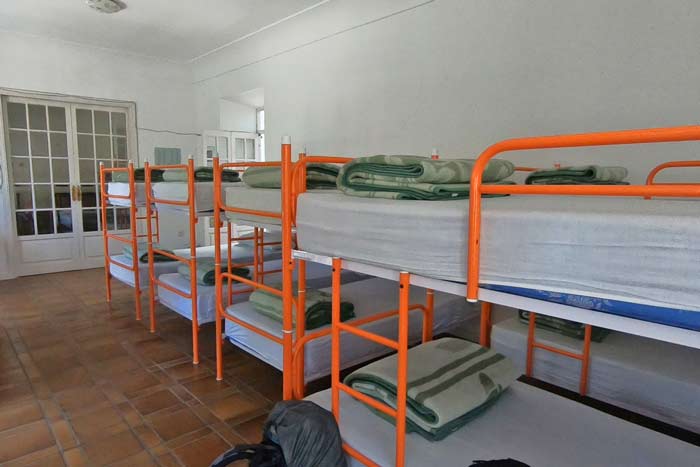
Public Albergues are the cheapest accommodation option on the Camino. They are exclusively for pilgrims walking or cycling the Camino. You need a Credential (a pilgrim’s passport) with stamps to stay at public albergues. The average price is 10-12 Euros per person per bed. Public albergues are usually quite big with a couple of rooms with bunk beds and shared facilities (showers, toilets, a kitchen).
On more popular Camino routes like the Camino Francés or the Camino Portuguese from Porto, you can plan your itinerary the way the you stay almost every night at a public albergue and pay 10-12 Euros per bed. Less popular routes have fewer public albergues - from time to time you’ll have no option but to stay in a private albergue/hostel.
Private albergues
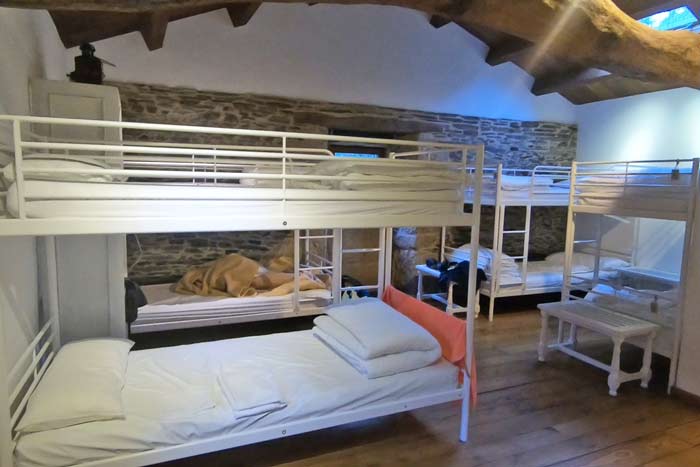
The second cheapest accommodation option on the Camino. Anybody can stay there but most of the guests are usually pilgrims. Private Albergues cost 15-20 Euros per bed. They usually have better facilities and are smaller than public albergues. Some private albergues have private rooms as well. There are many private albergues on the main Camino routes, you’ll be able to find one at the end of every day.
Sometimes you can find albergues for donation.
Hotels and guesthouses
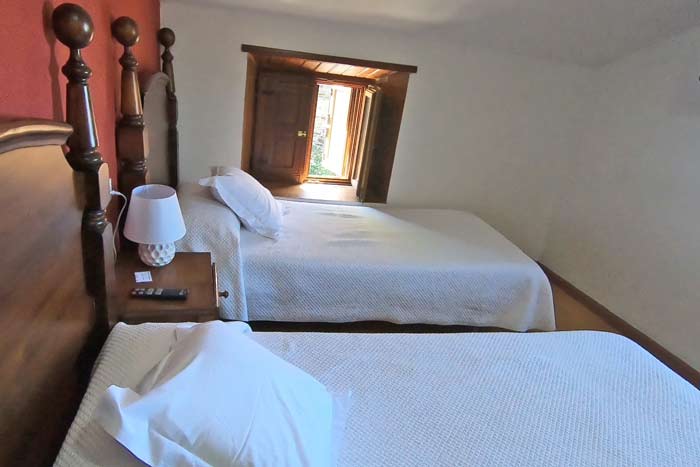
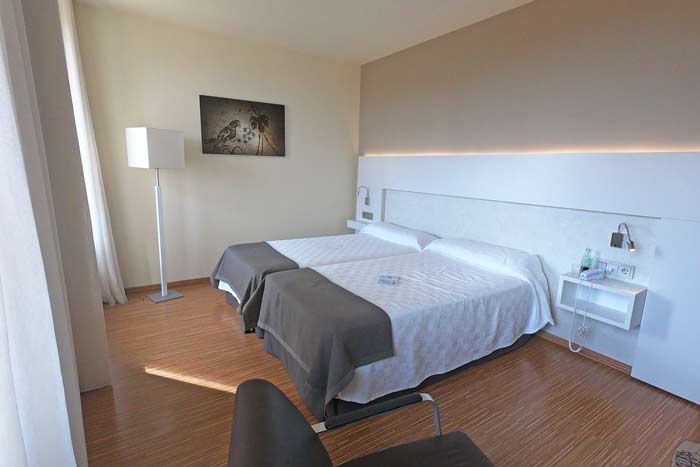
These are the most expensive and comfortable accommodation options on the Camino. Prices for a private room start at 40 Euros for a single room and 50-60 Euros for a double room. Staying in hotels every night, especially on longer Camino routes is expensive but I recommend doing it sometimes. It’s nice to have a good rest and some privacy. We usually stay in hotels at least once a week or even more often if we can find well-priced private rooms.
In some areas the prices of accommodation vary a lot depending on the season. Keep that in mind if you're planning to walk one of the coastal Camino routes.
Comparing public and private albergues and hotels
| Features | Public albergues | Private albergues | Hotels |
|---|---|---|---|
| Price | 10-12 Euros | 15-20 Euros | from 40 Euros |
| Only for pilgrims | yes | no | no |
| Need a Credential to stay | yes | no | no |
| Can be booked | no | yes | yes |
| Can stay more than 1 night | no | yes | yes |
| Allow luggage delivery | no | yes | yes |
| Accept credit cards | no | usually | usually |
The cost of food on the Camino de Santiago
Grocery shopping and cooking
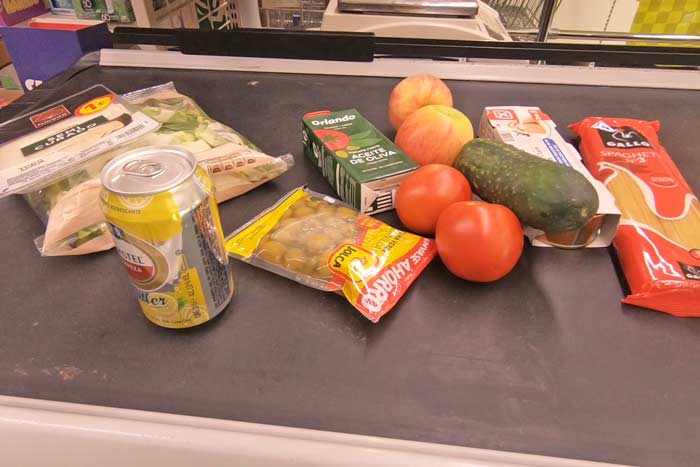
The cheapest food option is to buy food in supermarkets/shops and cooking. Most albergues have a communal kitchen that pilgrims can use. Some kitchens are well-equipped and have all you need for cooking, while some are basic. My advice is to check out the kitchen before you go shopping.
Most places on the Camino have at least a small grocery store where you can get bread, pasta, cheese, yogurt, fruit, and vegetables. Bigger towns and cities have supermarkets where you can get pretty much anything including takeaway meals that are usually cheaper than restaurants. We usually spend between 15 and 20 Euros per day on grocery shopping for two people. Depending on what you buy and for how many meals I’d recommend budgeting 10 Euros per person per day to buy enough food for 2 meals.
Breakfast
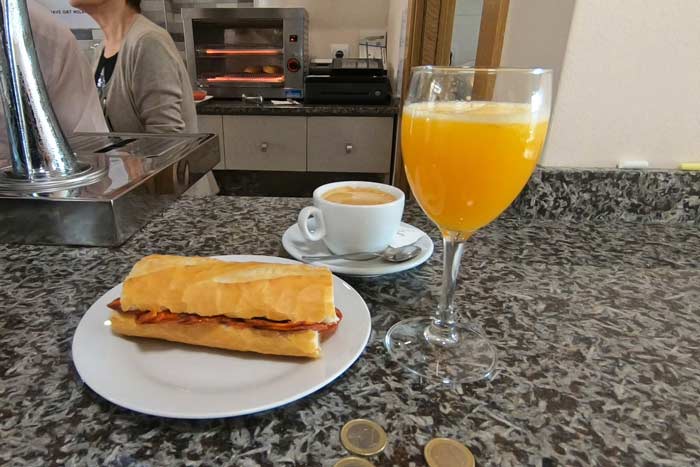
The Spanish are not very big on breakfast, most of them just drink a cup of coffee with a small pastry. Many cafes on the Camino offer breakfast that usually includes a cup of coffee, a glass of fresh-squeezed orange juice, and a sandwich or a pastry. A breakfast like that costs 4-5 Euros.
In very busy and touristy parts of some Camino routes, you can find an English (eggs & bacon) or an American (sausages, eggs, cereal, etc.) breakfast as well. It costs between 8 and 10 Euros.
Spanish Tortilla (egg and potato omelet) is a good option for breakfast or even lunch if you are not very hungry. It usually comes with bread and is quite filling.
Lunch
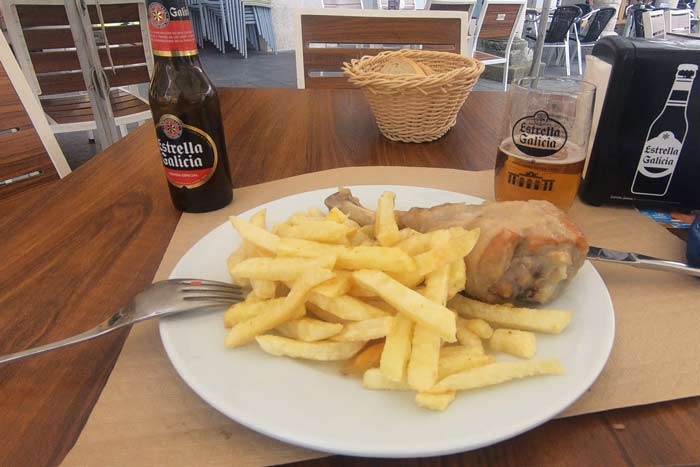
Menú del Día is a set meal that includes a starter, a main, a drink (wine, beer, water, soda), bread, and dessert or coffee. It is a very popular lunch option everywhere in Spain not only on the Camino de Santiago. A typical menu costs between 10 and 14 Euros.
The quality of the menu varies. I had some amazing menus and some poor meals on the Camino. Usually, in cities and busy towns, menus have more options and are of better quality. The worst meals I had in albergues/restaurants in the middle of nowhere. After finishing my meal I was almost as hungry as before.
If you follow a special diet e.g. vegetarian or vegan in small towns/villages it might be difficult to find a suitable menu. In cities and bigger towns, it’s not a problem as many restaurants have vegetarian/vegan menu options. The best option for you is to cook for yourself.
Dinner
The most expensive meal on the Camino de Santiago. We don't often go out for dinner on the Camino but we do go out for a drink which is not expensive. Dinner in a restaurant with a glass of wine will cost you from 20 Euros per person depending on the place and chosen meal.
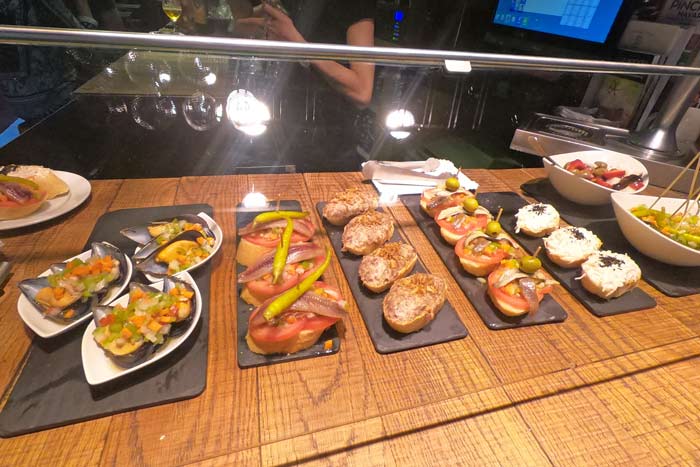
For a beer or a glass of wine at the bar, you’ll pay an average of 2-3 Euros. It may include a simple tapa. Many bars in Asturias and Galicia offer a free tapa with every drink you order. It might be a small portion of tortilla, peanuts, a small cheese or ham sandwich, etc.
Make sure to try typical Galician dishes Pulpo a la Feira (cooked octopus) and Pimientos de Padrón (fried green peppers) are great with beer. In Santiago de Compostela there are a couple of amazing tapas bars on Rúa do Franco and Rúa da Raiña streets.
If you’re planning to go out for a drink and a tapa regularly add 50 Euro (depending on how long you’re going to walk) to your total Camino budget.
Trying local food on the Camino de Santiago is a part of the experience. Some dishes are not to be missed e.g. Tarta de Santiago, tapas and pintxos, Pimientos de Padron, and Pulpo a la Feira are some of them.
Extra expenses on the Camino
Luggage delivery service on the Camino
The service is available on all major Camino de Santiago routes. The more popular the route is the more companies offer backpack delivery services. The average price is 7-8 Euros per backpack per stage. It might vary depending on the distance, route popularity, etc. You can use the service for the entire Camino or only for selective stages e.g. the tough ones that involve walking long distances or have steep climbs.
You can decide whether you need it or not on the way. Try to walk with your backpack and if it’s too heavy or too difficult you can always start using the luggage delivery service. It's important to remember that many public albergues don't allow luggage delivery which means you'll have to stay in private albergues or hotels.
Laundry
It is one of our main extra expenses on the Camino de Santiago. We do machine washing more or less twice a week. Many albergues (both public and private) have self-service washing machines and dryers that work with coins. The machines are usually quite big; you can share one load between 3 or 4 people. It’s 4 Euros per load for washing and 5 Euros for drying. If it’s a sunny day we hang our clothes outside, if it’s rainy and cold we use a dryer. Sometimes the machines are free but you have to buy detergent. Many people wash by hand.

Entrance fees
Walking is the main activity on the Camino. Usually, you’re too tired after a full day of walking to do any sightseeing but some attractions just can’t be skipped. Like the Cathedral of León on the Camino Francés or the Guggenheim Museum in Bilbao on the Camino del Norte. I suggest adding 20-30 Euros extra for entrance fees and tickets.
The cost of transportation
You’re probably not going to use any on the Camino itself but you’ll have to get to the starting point of the route and back home from Santiago de Compostela. If you’re from Europe your transport expenses won’t be very high if you use one of the budget airlines. You can get to Madrid or Barcelona and from there catch a local flight, bus, or train to the starting point of your Camino route.
If you come from overseas e.g. US, Australia, Canada, etc. your international flight will be one of your biggest expenses.
To get back from Santiago, you can take a bus or a trail to Madrid, Porto, etc., and from there fly back home. I’d suggest adding 60-70 Euros to your Camino budget for local transport expenses.
There are direct flights with budget airlines from Santiago to the UK, Switzerland, Ireland, Italy, Malta, etc. If you buy your ticket a couple of months in advance you can get a really good deal e.g. a flight to the UK for 25 Euros.

The cost of travel Insurance for the Camino
This is an important thing to have if you're going to travel abroad and planning to do outdoor activities. Walking the Camino is not a high-risk venture but it's always recommended to have travel insurance that can cover your medical expenses (in case you need any), gear loss, or trip cancellation. Note, if you have a European Health Insurance card you don't need any extra medical insurance for Spain or Portugal. The cost of Camino travel insurance varies depending on the company, the policy, a person's age, etc.
World Nomads offers simple and flexible travel insurance. Buy at home or while traveling and claim online from anywhere in the world.The cost of essential gear
For walking the Camino de Santiago you don't need any special gear. There are two important items that you can bring for the Camino - comfortable walking shoes and a suitable backpack. These two you're going to use every day walking for hours. I'd recommend investing in both. You don't need heavy hiking boots for walking the Camino unless you're planning to walk it in winter.
In our opinion, a pair of light hiking shoes are great for walking the Camino. As for your pack, a 30-40l backpack should be enough. if your stuff doesn't fit in it means you're trying to pack too much. If you're planning to do some Camino training to prepare better for the pilgrimage it's best to wear the same hiking shoes and backpack you're going to use on the Camino.
The average cost of the essential Camino gear
| Essential gear | Average price |
|---|---|
| 36l backpack | from 100 US$ |
| Hiking shoes | from 100 US$ |
| Merino wool socks | from 20 US$ for 3 pairs |
| Quick-dry towel | from 9 US$ |
| Light sleeping bag | from 25 US$ |
| Water bottle | from 15 US$ |
| Headlamp | from 15 US$ |
| Hiking clothes (pants, T-shirts, a rain jacket, a cap) | from 150 US$ |
| Total | about 484 US$ |
This is the list of essential items one will need on the Camino. The given examples are for women, men's gear costs more or less the same.
More details on what to pack for the Camino for different seasons for men and women can be found in our Camino de Santiago packing post.

Comparing the cost of different Camino routes
As I mentioned above up to now we’ve walked 9 Camino de Santiago routes: Camino Francés, Camino Portuguese from Lisbon, Camino del Norte, Camino Primitivo, Camino Inglés, Camino Finisterre-Muxía, Via de la Plata, Camino del Salvador, and Camino de Gran Canaria. We’ve done all the major routes in Spain and Portugal. Portugal overall is a bit cheaper than Spain. Things like transport (local trains), hotels, and eating out.
The following routes can be walked on 25 Euros per person per day.
- Camino Francés
- Camino Portuguese from Porto
- Camino Primitivo
- Camino Finisterre-Muxía
- Camino Inglés
- Camino de San Salvador
It doesn't mean you can't walk other routes spending 25 Euro per day but it'll be more difficult due to the higher cost of accommodation and lack of public albergues.
Camino Francés, Camino Portuguese, and Camino Primitivo
The most popular Camino routes are the cheapest ones because they have more infrastructure for pilgrims; many municipal and private albergues, special pilgrim’s menus at restaurants, etc. The Camino Frances, the Portuguese Camino from Porto (both the Central and the Coastal Route), and the Camino Primitivo have public albergues pretty much at the end of every stage. You can plan your walk the way you stay 90% of the time at public albergues which means you’ll pay 10-12 Euros per person per night on average.
We have a detailed post on the cost of the Portuguese Camino.
Vía de la Plata & Portuguese Camino from Lisbon
On less popular Camino routes like the Via de la Plata or the Portuguese Camino from Lisbon, accommodation is more expensive. All public albergues on the Via de la Plata cost 12 Euros which is a bit more than on the Camino Frances. On the Portuguese Camino from Lisbon, there are few public albergues every other night we stayed at a guesthouse or a private albergues. On the other hand, eating out on these routes was less expensive.
Camino Finisterre-Muxía and Camino Inglés
Both routes are very short, 3-5 days even if you stay at hotels all the time it won’t ruin your budget. Both the Camino Finisterre and the English Way have enough public albergues and many private albergues you’ll be able to walk spending 25 per person Euros a day. The only problem on both routes is there are not many supermarkets but most of the towns have at least a small grocery store.
Camino del Norte
The Camino del Norte (the first half of it) was our most expensive route. The part of the route through Asturias and Galicia was more or less the same as other Camino routes. Northern Spain (the Basque Country and Cantabria) is overall more expensive than the rest of the country. Accommodation is significantly more expensive in the popular touristy cities such as San Sebastian and some small coastal towns in the Basque Country.
There are very few public albergues in the Basque Country. Most of the time pilgrims stay in hostels or hotels. Eating out is more expensive in Northern Spain. If you're on a tight budget it's not the best route to choose.
Camino de Gran Canaria
Out of the 9 Camino routes, the Camino de Gran Canaria worked out the most expensive per day. It's only 3-4 walking days so it didn't cost us a fortune. There are no albergues on the route pilgrims stay in hotels or guesthouses which are a lot more expensive. Cooking is not possible because most places don't have a kitchen which means you have to eat out 2-3 times a day. Our average our budget was 60 euros per person per day for this route.

Camino de Santiago money-saving tips
First of all, always make sure to have some cash with you. Public albergues and some private albergues don't accept credit cards. It's advisable to have some cash enough to pay for accommodation, food, etc. for a couple of days. On most routes, you find an ATM every day. We usually draw 300 Euros and when we have less than 40 Euros left we draw again. Most hotels, supermarkets, grocery stores, and restaurants accept cards.
Tip 1. Eating out every day adds quite a bit to the cost if you want to save money cooking is the way to go.
Tip 2. Book your international flight in advance many airlines have special prices for early booking. Find out which airlines fly from your destination and subscribe to their newsletter to make sure you won't miss their special offers. Use sites like Skyscanner to search for the cheapest flights. Book your local flights in advance. Many budget airlines often have great early booking deals, you can get a flight for 20-30 Euros.
Tip 3. From our experience, it's cheaper to walk the Camino if you're two or more people. A double or a triple room works out cheaper per person than a single room. If you're going to walk along you can always team up with another pilgrim and rent a twin room (with two single beds) it'll be cheaper than paying for a single room.
Tip 4. Cooking together is another way to save money. If you're several people cooking together you can split the cost of shopping. If you buy pasta, rice, etc. it's usually too much for one person and you end up leaving half of it in the kitchen.
Camino planning resources
- Choose the best Camino route for you | Many routes of the Camino de Santiago |
- Practical information for planning the walk | The Camino de Santiago - all you need to know |
- Use our recommendations for planning the Camino | The best Camino de Santiago tips |
- Find answers to the most popular questions about the Camino | Camino de Santiago FAQ |
Questions or Comments?
Got any questions or comments? We would love to help! All questions and comments will be answered by us personally in Buy Me a Coffee. Click below and ask away.
Feel free to support our site by buying us a coffee!

The pretty half of Stingy Nomads, responsible for all our land adventures (hiking, climbing, walking the Camino) and following them write-ups. Alya loves walking since she was a child, she prefers to walk 1000 km with a backpack rather than to do a 10 000 km road trip (actually any road trip). Alya is a big fan of Latin America, the Spanish language, and dancing. Every time we go away she desperately misses our dog Chile.

Hi! I did the Camino de Santiago a couple years ago and loved it. I used the luggage/backpack delivery service for 5 euros a day, which was great.
I now want to do the Camino Portuguese Costal. Does that route have luggage delivery services?
Hello, Sharonne. There are companies that do luggage delivery on the Coastal Route of the Portuguese Camino. You can find more details and names of the companies here https://stingynomads.com/portuguese-coastal-camino-stages/#Luggage_transfer_on_the_Coastal_Way_of_the_Camino_Portugues.
Buen Camino
Hi, thank you for so much detail.
I have a few questions maybe someone can answer
1. how is the route from the french border in mid-late October to start and how long on average does it take?
2. do I need to stay in accommodation always? meaning, are there opportunities to sleep under the stars (and of course) save some money?
3. if #2 is not an option, and I started in late october, would walk-ins be possible? I do not know how far I will go each day, maybe some days I have more energy than others and do not want to prepare too far in advance.
4. if the mid-late october window is not good, what is the weather like in november-february? I live in Mallorca, and it gets a bit cold here in the winter (as low as 6-8), but I imagine it is much colder in the northern part of spain. Or maybe you could recommend the best time to start with a break in the weather (jacket, pack, sun)
Thank you in advance.
Thanks for the comment, David.
1. Do you mean how long it takes to walk the French Camino? It takes about 1 month. I walked this route in September the weather was great. Mid-end of October it starts getting colder and rainier. We walked the Northern Camino about that time and by the end of October, we got a lot of rain and even snow in some parts of the route. If you want to know more details on the French Camino, please, read our posts https://stingynomads.com/camino-frances-walking-itinerary/ and https://stingynomads.com/french-way-camino-de-santiago-guide/
2. You don't have to stay indoors you can do bush camping but I'm not sure you'll be able to find good spots for pitching your tent every day. I guess if you camp you do save some money but on the downside, you have to walk for 1 month with a very heavy backpack carrying camping and cooking gear. I'm not sure it's worth it considering that you can stay at municipal albergues for 6-7 Euro on average with a hot shower, electricity and a kitchen. We never camped on the Camino. On the Northern Camino, we met a person walking with a tent he camped for a couple of nights and in the end decided to stay at albergues as it was much more comfortable especially if you walk in the fall/winter time.
3. October is not a busy time on the Camino you don't have to book accommodation in advance.
4. From our Camino experience the wintertime (late November - February) is not the best season for walking. First of all, the weather is not great; cold, rain, snow, etc. It's definitely worse than in Mallorca. Second, many albergues (both municipal and private) close for the off-season you'll be more limited with accommodation options. More information about the best time for walking the Camino you can find here https://stingynomads.com/camino-de-santiago-best-time-to-do/
I hope our answers will help you to plan your Camino walk.
Buen Camino!
Hello! Diana here - because I only have 4 weeks give or take 2-3 days prior and post trip I will be doing the Lisbon to Santiago route..question..although I am a pretty flexible traveler however how would I book a place to stay on the "fly" without advanced reservations...I would like to start hiking April 1st 2022...given this pandemic and who knows how these countries will be..do you believe there will be accommodations available during this time along the way? what's a good travel book to purchase? Thanks!
Hello, Diana. You can book accommodation just a day or so before arriving I'm sure it won't be a problem. April is a quiet month on the Camino at the very beginning of the season so there won't be many pilgrims. The part from Lisbon to Porto is not a busy route at all. Even on the Porto to Santiago stretch, there won't be many people at that time of the year. We like David Brierley's A Pilgrim's Guide to the Camino Portuguese guidebook we used his when we walked it. I'm not sure if you've read our post on the Portuguese Camino from Lisbon. It might be helpful in your planning https://stingynomads.com/camino-fatima-walk-lisbon-porto/
Buen Camino
Whoops sorry, I hit the wrong button. Lol anyway, back to my questions, it keeps talking about, Pilgrams, and public albergues, and needing a “passport” for stamps available to be part of the travel. Where and how do you get these documents, or “credentials” that you keep talking about? Also, I have been traveling for almost a year now, and I I’m looking to do the Camino as the last bit of my trip. I want to do the full trek, from beginning to end, and I’m wanting to do it with very little planning, as I am traveling on the fly, so I planned on getting to the beginning of the hike in the next week or two. My questions are… First, which route would you recommend most coming from Paris, and ending in Spain? Which city, do I go into, and how many days should it take. (Sounds as if most treks take approx. 30-35days) I’ve been training for about a year, and walk between 10-20miles a day, but I’m bringing camera gear with me, so my pack will be significantly larger than usual, and I got a jogging carriage to help me with the load, do you think I should be able to get this through the terrain? Last, and not least, how safe is your gear in the Albergues? Will I feel comfortable leaving gear in rooms, and going out for the day or evenings to explore, or do you need to remain with your gear at all times? Thanks so very much for all the info, and any questions you can help out with. You can email me or answer here on your page. I look forward to hearing from you. Cheers 🙏
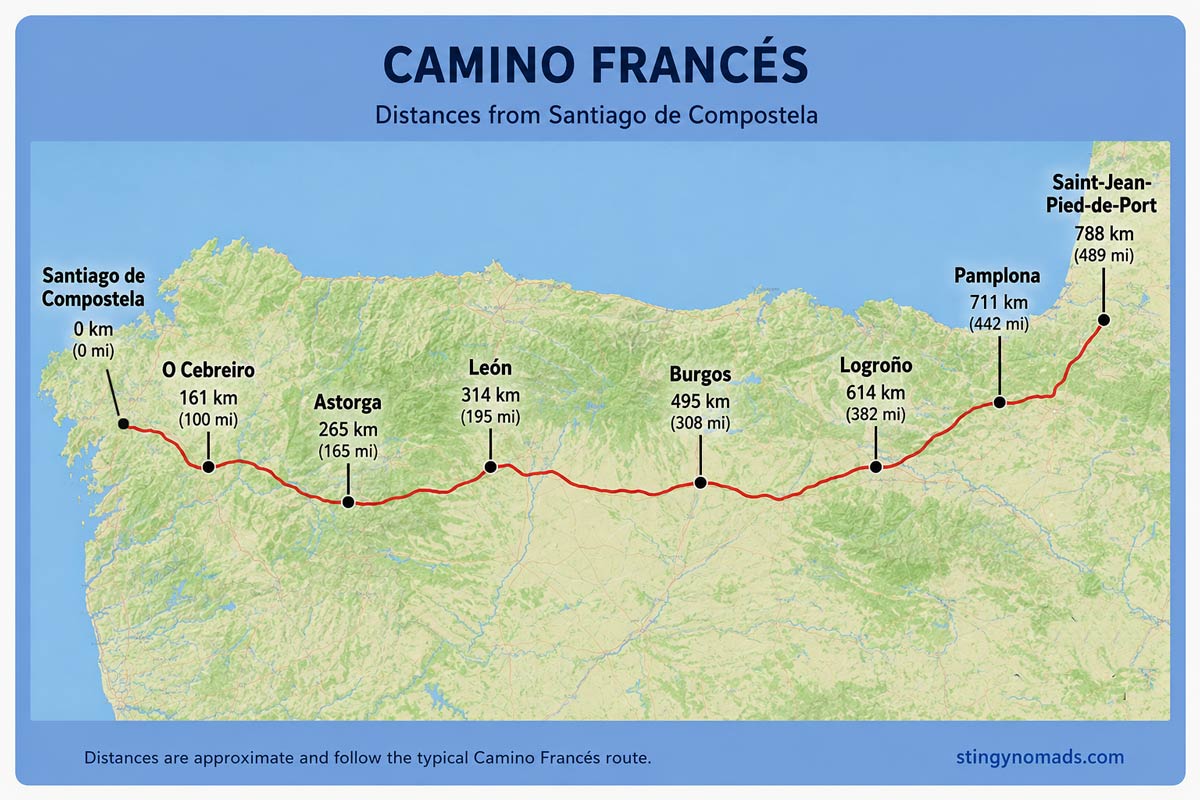
Hello, Hunter. Thank you for the comment. The only "document" you need is a pilgrim's passport or credential (the same thing). You can get it in many albergues and pilgrims information offices. The Camino Frances will probably be the best option for you. It starts in St.-Jean-Pied-de-Port (France) and finishes in Santiago de Compostela (Spain). To get there from Paris you can take a train/bus to Bayonne and from there a train to St.Jean. It takes about a month to complete this route. This Camino has the most infrastructure including public and private albergues. You can get a pilgrim's passport at a pilgrim's office in St.-Jean-Pied-de-Port most people get it there.
I think you'll be fine pulling your running cart the terrain is good enough for that.
Many albergues have lockers you just need to bring a lock with you. I wouldn't recommend leaving your gear or any valuable unattended in albergues even when you go to the bathroom especially in big albergues for 50+ people. If there are no lockers I'd suggest taking all your valuable stuff with you every time you go out. We met people whose wallets, phones, and other valuables got stolen in albergues.
We have a lot of posts on different Camino routes, itineraries, albergues, packing, etc. If you open our Camino de Santiago menu you'll be able to find them.
Buen Camino
@Stingy Nomads, given covid, is it more difficult starting in France? I live in Spain, so, if crossing the border for those few miles causes problems, I would just skip it.
Hello, David. As far as I know, currently, there is no border control on the Camino to cross from France to Spain. The part from St.Jean to Roncesvalles is the toughest part of the Camino Frances though for the scenery it's one of the most beautiful days on the route. If you can I'd recommend walking that part.
Hi there, thank you for all the info. I did the Camino from St Jean to Santiago in 2002, 28 days walking, 30 days total (needed two rest days due to blisters). I’m looking to do the Portugal route now, all these years later. I feel fortunate to have done the Camino pre-social media and smartphones and loved the freedom I had last time, stopping when it suited me as opposed to a set itinerary. I’ve heard that now many people book their accommodations in advance and that this may be a better idea ..would you say it is a fair assessment or do you think it is possible to still have a spontaneous journey? I have more money than I did back then at 28, so not so worried about cost. Last time I only did the public refugios and almost all of them were donations only, so it was a very frugal trek (though I befriended 5 other solo walkers on my second night and we agreed to meet in the same town most evenings, especially in the last sections, and going out for dinner & drinks was our common fun..that was amazing!). Thank you for any guidance!
Hello, Beth. Thank you for the comment. It's possible to walk the Camino without booking your accommodation in advance but it depends a lot on the season. We walked the Portuguese route in May there were people but not as many as in July and August. We didn't book anything in advance and stayed almost every night in a public albergue. I walked the French Camino beginning of September and a couple of times I had to book accommodation in advance because in small towns there were too many pilgrims and not enough beds. If you want to have a spontaneous walk try to do the Camino outside the peak season; May-June and September are good months for the Portuguese route.
Buen Camino
@Stingy Nomads, thank you for this.. it is what I wa shoping to hear. I actually want to go the first chance I can
Thanks for very good information !
@Leif Eriksson,
Hi
My name is Rhonda
Avid traveler, excited to do the Camino...
hoping to do a Portugese route...I do not wish to walk more
than 5-7 miles a day...can you help me plan a trip?
I want to stay in hotels, or private places...
I want a luggage service....single...it is not exactly
that money is no object, but it is not my highest prioity.
I would love to do the coastal route, but the other route
is fine too...I hope to go in March-April 2022...
Hello, Rhonda. We don't do customized itineraries for the Camino de Santiago or book accommodation for our readers. We don't have resources for that. It's a personal blog where we write about our experience to help people to plan their trip or give some tips and advice. There are several companies that specialize in customized Camino routes, book accommodation, and luggage transfer for you. It's their business. You can contact Camino Ways, Santiago Ways, Macs Adventure, etc., and ask for a quotation.
Cheers
So useful all this info and advice! Invaluable! Thankyou!
Hello, Dee. Thank you very much for the feedback! We're glad you've found our post useful.
Buen Camino!
Thank you for this detailed breakdown! By chance, do you know if both the public and private albergues are open and if there is a website to reserve the private ones? I have a trip planned in September 2021 (hopefully) and want to make sure I have as much planned and booked in advance as possible!
Hello, Meredith. Thank you for the comment. I can't tell you if albergues are open or not without knowing which Camino route you're planning to walk. On some routes, many albergues are open on some only few. Besides nobody knows what's going to happen in September we live in Portugal and here everything changes every week, in Spain is the same. As for booking albergues, we have detailed posts with itineraries for all major Camino routes. If you open the one that you're planning to walk you'll find downloadable PDF files with walking stages and accommodation along the route. Some albergues can be booked through booking systems or over e-mail (you'll find booking links and e-mails in PDFs), some only over the phone.
Buen Camino!
Whata fantastic resource this is for pilgrims looking to do the Caminis, I would love to read more of the writers travels, I have always wanted to do these pilgrim routes, I walked many in the UK but sadly now my knees are in a very poor way and I can hardly walk but I enjoy reading the travels of others.
I would love to sit down and listen to the stories of the people the writer met, the colours of the flora and fauna, how to chose the best route, what were the markers like, how much of the route is off road and are their detailed books on each camino.
I have just spent a very pleasant morning reading this in my villa in Olivella south of Barcelona and about 10 kms inland from the sea.
I just hope one day when My knees have been operated on that I can at least do a short walk over a long weekend with my walking partner of old from the UK.
Many thanks for the wonderful information.
Neil Scott
Hello, Neil. Thank you very much for your comment! We haven't done any walks or hikes in the UK yet but we have quite a few there that we'd really like to complete. It's very sad that you can't walk long distances anymore I sincerely hope after the operation your knees will allow you to walk parts of the Camino. There are many wonderful routes across Spain including the Camino Catalan (the Camí de Sant Jaume) that start at Montserrat.
All the best!
I am preparing an application for a Architectural Travel Scholarship due next Friday 28 May 2021, but I have to send an travel outline by this Friday 21 May 2021. Your blog has helped me to cost the Camino itself! However, the travel scholarship budget is much higher than my final cost calculation. I was wondering how much I should add, or how I can expand the itinerary beyond the Camino. I am interested in the early Christian /religious Architecture on the route, since my masters thesis (which will be conducted before this trip) is based on the design of a Catholic Monastery in the middle of a South African City. What other places could I use to expand my travel study itinerary beyond the Camino? I was thinking of Barcelona (Gaudi) but also considered Fatima (being a devout Catholic). So 1. any suggestions? 2. How much might it cost extra?
Thank you so much for all this helpful information.
Hi, Garry! I'm not sure what Gaudi and the Sanctuary in Fatima have to do with the early Christian Architecture both were built in the XX century. There are plenty of religious sights in Spain that date back to the Middle Ages in Salamanca, Barcelona (the Gothic Quarter), Zaragoza, Toledo, and many other Spanish cities. I believe it's close to your topic that Art-Noveau style of Gaudi. As for the cost, it's easy to calculate check for bus and train tickets or flights online, add accommodation that you can find in booking.com (hostels for a cheaper option otherwise hotels), and food expenses (can be the same or a bit higher than on the Camino), and of course entrance fees to museums.
Good luck!
@Stingy Nomads, Thank you very much!
i am going to be planning an 18 day trip looking for best options or ideas from others.
All help is greatly appreciated.
Hello, Greg! I'm not sure what suggestions or ideas you're looking for. It's not a forum, it's a personal travel blog we write about our Camino experience here. If you have a question we'll be happy to help.
Cheers!
Hi- planning on doing a walk in two years. Please sign me up!
Buenas Tarde Stingy Nomads,
Is it too late to plan a trip for June this year? What are the most recent CODVID-19 rules/ restrictions?
Hello, Rosalynn! I don't know what country you're from so I can't tell you what kind of restrictions are in place and if you're allowed to travel to Spain as a tourist on your passport. Some of our readers are walking the Camino right now but they're from Europe. As for Spain different provinces have different restrictions some allow to move around and cross interprovincial borders some don't. We live in Portugal and here everything is slowly getting back to normal after several months of restrictions. I'd suggest keeping an eye on the situation in Spain and in your country. I believe both Spain and Portugal are planning to welcome international tourists for the summer season but I can't say tourists from what countries will be allowed to come.
Buen Camino!
We are busy planning the Lisbon-Santiago route in April 2022
Hi, I am planning to do the Camino Frances in May 2022. I am 72 years old and have some medical condition that need the use of a toilet during the night several times. My question is do private room in private albergues have their own private bathroom? , same question for guesthouse/ B&B.
Hello, Carlos! There is no general rule for private accommodation some have in-suite bathrooms some have shared facilities. Usually, more expensive private rooms, from 30 Euro per person have private bathrooms, cheaper rooms 20-25 Euro have shared facilities. I'd suggest using booking.com to look for private accommodations with en-suite bathrooms.
Buen Camino!
I have enjoyed your website thus far and am just about ready move forward with a trip. Since I am from the US, all depends on the Covid 19 rules and when I can travel to Spain. Keep up the good work, Hopefully you can pass on any new info on the Covid situation as regards to the Comino.
Hello, Charles! Thank you for the comment. Hopefully, we can walk the Camino this year as many of us had to cancel our plans for 2020.
Cheers
I walked the French Way three years ago and a friend of mine wants to do the Primitivo. Hopefully we will be there in Oct or Nov of 2021!
Hello, Rick! The Primitivo is a very beautiful route but November is not the best time for walking it I'd rather aim for the first half of October. We had some experience walking the last part of the Northern Camino end of October and the Camino Finisterre in November and the weather was terrible; snow, heavy rains, wind, cold. In the mountains on the Primitivo, it starts snowing quite early you might get stuck due to snowfalls (it happened to our friends).
Cheers!
Thanks for the information! I'm walking Camino Frances June 2022 (pushed it back from 2021 just due to Covid). Thanks for your breakdowns!
Hello, Matt! Thank you very much for the feedback! June is a good time for the French Camino it won't be too hot or too busy yet.
Buen Camino!
I am travelling from South Africa in April 2021 to walk from Porto - thank you for this insightful information.
Hi, Lise! Thank you for the comment! We might be somewhere on the Portuguese Camino in April as well. We really hope next year everything goes back to normal and we all will be able to walk the Camino.
Cheers!