The Coastal Route of the Portuguese Camino - a 2026 guide
The Coastal Route is one of the trails of the Portuguese Camino from Porto. The total distance of the route is 274 km/170 mi. It starts in Porto and goes along the coast till Vigo. It merges with the Central Route in Redondela. In 2025 a half of pilgrims who completed the Portuguese Camino walked the Coastal Route. The Portuguese Camino is getting increasingly popular, and many pilgrims choose this route as an alternative to the Camino Frances.

Despite the name only 30% of the route (between Porto and Redondela) is along the coast. If you want to walk by the sea as much as possible the Litoral Way (80% along the coast) might be a better option.
Affiliate disclosure. This post contains affiliate links. If you make a purchase or book a place, we may receive a small commission at no extra cost to you. Thank you!
Coastal Route PDFs
To make your planning easier we created downloadable PDF files for the Coastal Route of the Portuguese Camino. One file is with walking stages from Porto to Santiago de Compostela. One has a list of places to stay (municipal and private albergues, hotels, and guesthouses) along the route.
- Portuguese Camino Coastal Route - walking stages PDF Download
- Portuguese Camino Coastal Route - places to stay PDF Download
Portuguese Camino planner
You can use our free Portuguese Camino planning tool. Combine routes, add the Spiritual Variant, choose the daily distance, and a starting point get a customized itinerary with recommended places to stay.
GPX files of the route
If our PDFs and GPX files helped you plan your Camino, consider buying us a coffee ☕ — it’s a small gesture that means a lot and helps us keep creating quality content for fellow pilgrims!

The Coastal Camino - route overview
- Distance – 274 km/170 mi
- Number of days (stages) – 12-15 days
- Starting point – Sé Cathedral, Porto, Portugal
- Finishing point – Santiago de Compostela Cathedral, Spain
- Difficulty level – moderate
- Total ascent – 3990 m
- Total descent – 3716 m
- Walking surface 155 km/96 mi - asphalt/tar; 29 km/18 mi - cobblestones; 65 km/40.3 mi - footpath/gravel road; 24 km/15 mi - boardwalk; 1 km/0.6 mi - beach.
- Walking along the coast - 77.5 km/ out of 274 km/170 mi. The last 86 km/53.4 mi to Santiago are inland on the Central Route.
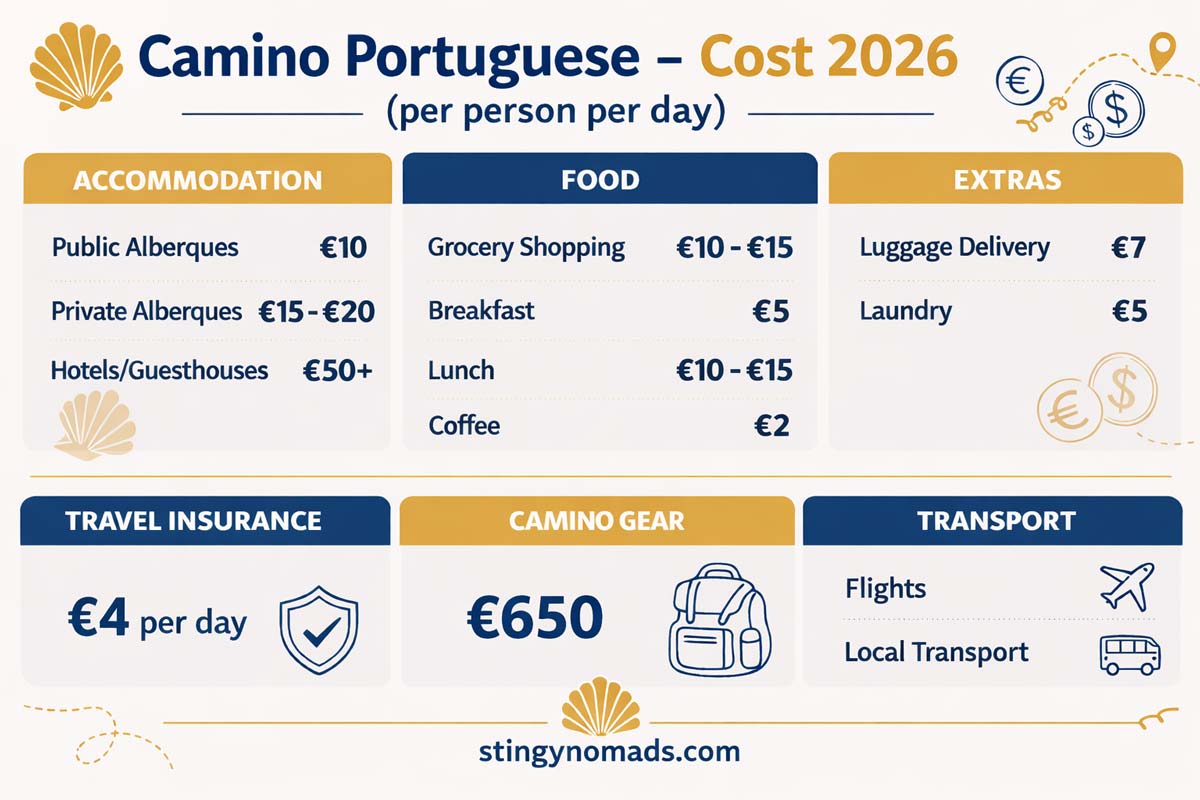
- Average cost – 30 euros per person per day if staying in albergues, from 50 euros pp. if staying in hotels.

Travel Insurance for the Camino
Walking like any other outdoor activity involves a risk of getting an injury or losing some of the gear. The Portuguese Coastal Camino is not a high-altitude hike through remote areas but it's still a physically challenging experience. Light traumas like blisters, knee pain, shin splints, etc. are quite common. Read more about Camino travel insurance or get an instant personalized quote from two companies right here. And decide which one works best for you.
World Nomads offers simple and flexible travel insurance. Buy at home or while traveling and claim online from anywhere in the world.How long is the Coastal Route?
The total distance of the Coastal Route from Porto to Santiago (Porto - Vigo - Redondela - Santiago) is 274 km/170 mi. It takes 12-15 days on average to complete the route. If you incorporate the Litoral Way into your walk the total distance will be around 280 km/173 mi. The stages stay the same but your daily distances might vary.

How to combine the Coastal and Central Route?
You can easily combine the Coastal and Central routes. There are two places along the Coastal Route of the Camino Portugues where pilgrims can switch to the Central Route.
- Vila do Conde - about 30 km from Porto (the second stage for most pilgrims). There is a route from Vila do Conde to Rates, that connects the Coastal Camino/Litoral Way with the Central Route.
- Caminha - about 107 km from Porto (the fifth stage for most pilgrims). The connecting route from Caminha goes along the Minho River to Valença where it merges with the Central Route.
There is another split on the Portuguese Camino after Redondela. From Pontevedra, there are two routes: the Spiritual Way and the main route of the Portuguese Camino.
If you want to know the difference between the two routes you can read our detailed post where we compare the Coastal and Central Route.
What is accommodation like on the route?
Like any other Camino de Santiago route the Coastal Way has public and private albergues, hotels, guesthouses, and a couple of campsites along the route.
Albergues are hostels for pilgrims. They usually have dormitory rooms with bunk beds and shared ablution facilities. Albergues can be public (run by a local municipality) and private.
Comparing public (municipal) and private albergues
| Features | Public albergues | Private albergues |
|---|---|---|
| Only for pilgrims | yes | no |
| Need a credential to stay | yes | no |
| Can be booked ahead | no | yes |
| Can stay as long as you want | only 1 night | yes |
| Price | 10-12 Euro | 20 Euro |
| Accept backpack delivery | usually no | yes |
Public albergues are the cheapest accommodation option on the Camino de Santiago. To stay in public albergues you'll need a Credential.
You can find public (municipal) albergues on the Coastal Route in
- Labruge (1st stage)
- Vila Chã (1st stage)
- Vila do Conde (2nd stage)
- Póvoa de Varzim (2nd stage)
- Aguçadoura (2nd stage)
- Marinhas (3rd stage)
- Castelo do Neiva (4th stage)
- Viana do Castelo (4th stage)
- Caminha (5th stage)
- A Guarda (5th stage)
- Vigo (8th stage)
- Redondela (9th stage)
The campsites on the Coastal Portuguese Camino can be found in
- Labruge
- Vila Cha
- Caminha
- A Guarda
- Baiona
- A Ramallosa
- Vigo

The cost of walking
The Portuguese Camino can be done on a different budget from 30 to 50+ Euros per person per day depending on how much comfort you need. The average cost of walking the Coastal Route is 35-45 Euro per person per day. We have a detailed post on the cost of the Portuguese Camino where you can find a lot of information for planning your estimated Camino budget.
Walking the Camino Portugues with 30, 40, and 50+ Euro per person, per day
| 30 Euro | 40 Euro | 50+ Euro |
|---|---|---|
| Accommodation | ||
| Public albergues, 10 Euro | Private albergues, 15-20 Euro | Private room, from 50 Euro pp. |
| Food | ||
| Cooking, 10 Euro | Eating Menu del Día, 10-12 Euro | Eating out twice a day, 20-25 Euro |
| Backpack delivery (optional) | ||
| 7 Euro | 7 Euro | 7 Euro |
| Extra (entrance fees, coffee, laundry, etc.) | ||
| 8 Euro | 8 Euro | 8 Euro |
What to pack for the Camino?
It's important to remember not to overload your backpack, make sure to bring only the necessary stuff. The two most important items to bring are good walking shoes and a comfortable backpack.
If you're planning on using a backpack delivery service (see the next paragraph) then you can pack as much as you wish.
For more details on what to pack for the Coastal Portuguese Camino for men and women for different seasons read our packing list for the Portuguese Camino post.

Best guidebooks
I believe Camino de Santiago guidebooks by John Brierley are the best. We used his A Pilgrim’s Guide to the Camino Portugués Lisbon – Porto – Santiago: including Camino Central, Variente Espiritual, Camino da Costa, & Senda Litoral on the Coastal Route and it was very helpful.
Looking for some interesting reading on the Camino? See our reviews of some of the Top Novels on the Camino de Santiago.
Coastal Route apps
- Camino Ninja. One of the pilgrims' favorite apps. Free. Available for Android and Apple
- Portuguese Way Premium. Free. Available for Android and Apple.
- Buen Camino de Santiago. Free. Available for Android and Apple.
Luggage transfer
If you don't want to walk with a heavy backpack you can use one of the luggage transfer services on the Camino. Tuitrans, Correos, and Pilbeo offer luggage delivery on the Coastal Route of the Portuguese Camino.
It works very easily a car picks up your backpack at your hotel or albergue in the morning and drops it off at your next accommodation place by lunchtime. The service costs 7 Euros per backpack per stage. If you decide to use the delivery service keep in mind that you'll have to stay in private albergues or hotels. Public albergues usually don't accept backpack delivery.
If you have some extra luggage that you won't need on the Camino you can send it directly to Santiago de Compostela using one of the above companies.

Porto, the beginning of the route
Porto is an amazing place to reserve a couple of days before or after the Camino to explore the city.
Tours & Activities in Porto
If you have extra time to stay in Porto before you start walking the Camino you can do a tour or a guided walk to discover this beautiful city.
- Porto Historic City Center walking tour
- Fado Show with Port Wine
- Douro Valley Wine Tour Including Lunch and River Cruise
- Half Day - Private TukTuk All Around Porto
Places to stay in Porto
There are many albergues in the city including one municipal albergue N.S. do Rosario de Vilar and one private albergue Albergue de Peregrinos do Porto.
If you rather stay in the center there are several options from hostels to luxury hotels depending on your budget.
- Low-end | CATS Porto Hostel | Onefam Ribeira |
- Mid-range | Portuense Alojamento Local | A Portuguesa Guest House |
- High-end | Maria da SÉ Historic House |

How to walk out of Porto: Coastal vs Litoral route?
You can walk out of Porto following the Litoral Way or the Coastal Route. Both routes start from Se Cathedral. The main difference is that the Litoral Way follows the coast from the beginning when the Coastal Route goes inland till Vila do Conde. Both routes merge in Vila do Conde and from there continue along the coast.
I've walked both routes and prefer walking out of Porto following the Litoral Way. It's a lot more scenic than the first stage of the Coastal Route. We have a detailed post on the 3 different routes of the Portuguese Camino from Porto.
The distance on the Litoral Way to Vila do Conde is longer than on the Coastal Route; 33 km/20.5 mi vs 29 km/18 mi. I'd suggest stopping in Labruge (24 km/15 mi) or Vila Cha (26 km/16 mi) instead of walking to Vila do Conde.
We have a detailed post comparing the Litoral Way and Coastal Route.

Coastal Route walking stages
Stage 1. Se Cathedral, Porto to Vila Chã, 26 km/16 mi
Porto - Matosinhos - Lavra - Labruge - Vila Chã
- Distance – 26 km/16 mi
- Time – 5-6 hours
- Accumulated ascent – 242 m
- Accumulated descent – 273 m
- Walking surface – 15 km/9.3 mi – asphalt; 10 km/6.2 mi – boardwalks; 1 km/0.6 mi – cobbled
- Walking along the coast - 23.5 km/14.6 mi are along the Douro River and coast
It’s a beautiful walking stage along the river and later the coast with plenty of restaurants and cafes.
The described stage is technically the Litoral Way, not the Coastal Route but most pilgrims (including myself) choose this route to walk out of Porto.
The first sage on the official Coastal Route from the Cathedral to Vila do Conde is inland. The route exists. It’s well-marked but the scenery is not as spectacular as on the Lirotal Way. In my opinion, the only reason to choose it is the distance. From Se Cathedral to Vila do Conde on the Coastal Route is 29 km/18 mi and on the Litoral Way is 32.5 km/20 mi.

Challenges
The route marking on the first 10 km/6.2 mi from the Cathedral is non-existent. It’s not difficult to find the way, just follow the river till you get to the information office in Matosinhos (10 km) from there you can follow the yellow arrows.
Relatively long distance for the first day on the Camino. There are towns and places to stay before Vila Chã you can shorten your first walking day.
Highlights
- Se Cathedral in Porto, the starting point of the Coastal Route.
- Walking along the Douro River
- Walking along the coast and past beautiful beaches
Stage 1 route description
0-6 km/0-3.7 mi along the Douro River. You can take the famous yellow tram (#1 and #18) for the first 5.5 km/3.4 mi. It follows the same route as the Camino. Passeio Alegre is the name of the tram stop where you get off.
6 km/3.7 mi – São João Baptista da Foz Fortress and Barra do Douro Lighthouse
10.5 km/6.5 mi – Tourist Information Office in Matosinhos. They sometimes sell Credentials. You can get a stamp here. From there the route is well-marked. Some pilgrims get to Matosinhos by bus or metro train. Bus #500 and metro line A go from Porto to Matosinhos. If you do so you can easily walk to Vila do Condo which is 22 km from Matosinhos.
10.5–13 km//6.5-8 mi – the Camino goes inland through Matosinhos. It is the only part of the stage where you have to pay attention to the Camino signs.
11.7 km/7.2 mi – go over the bridge Ponte móvel de Leça to the other side of the river.
13 km/8 mi – the information office where you can get a stamp.
From 13 km/8 mi you walk along the coast to Vila Cha.
15 km/9.3 mi – the beginning of the boardwalks. From here the walk is almost entirely on boardwalks.
20 km/12.4 mi – a big supermarket (ALDI, 400 m away from the boardwalks)
24 km/15 mi – Labruge, a small beach town with cafes, guesthouses, and a municipal albergue 900 m away from the Camino route. You can stop here instead of walking another 2 km/1.2 mi to Vila Chã. Then your next day's walk will be 20 km/12.4 mi instead of 18 km/11 mi. It's a good option if you don't want to stay in the public albergue as accommodation options are quite limited in Vila Chã.
Places to stay in Labruge
- Parque de Campismo Orbitur (1 km/0.6 mi before Labruge)
- Blue Beach Apartment – Caminhos de Santiago (1 km/0.6 mi before Labruge)
- Casa da Praia Labruge
- Municipal Albergue de S.Tiago (900 m inland away from the Camino)
26 km/16 mi – Vila Chã, another small beach town with two or three restaurants and guesthouses. The municipal albergue in Vila Chã is about 800 m from the coast and the Camino route. There are not many accommodation options in the village if you walk another 1.5 km/0.9 mi to Mindelo Beach you'll find more places.
Places to stay in Vila Chã
- Municipal Albergue de S.Mamede in Vila Chã
- Parque do campsimo in Vila Chã
Places to stay in Mindelo, 1.5 km/0.9 mi past Vila Chã

Stage 2. Vila Chã to Aguçadoura, 18 km/11 mi
Vila Chã - Vila do Conde - Póvoa de Varzim - Aguçadoura
- Distance – 18 km/11.1 mi
- Time – 4-5 hours (moving time)
- Accumulated ascent – 119 m
- Accumulated descent – 116 m
- Walking surface – 7.7 km – boardwalk; 4 km - tar road; 6 km – cobblestones; 300 m – sand
- Walking along the coast - 12 km/7.4 mi out of 18 km/11 mi
It’s a relatively short and easy walking day with plenty of places to stop for coffee and lunch.
From Villa Chã the marked route goes parallel to the coast through the town but you can walk along the sea on the boardwalk from the start. After 2 km/1.2 mi the marked route continues on the boardwalk.
At 6 km the Camino trail turns inland across the bridge. It takes you through the towns of Vila do Conde and Póvoa de Varzim and returns to the coast at 12 km/7.4 mi.

Challenges
- Short parts of the boardwalk are covered in sand you walk on dunes which is more tiring
- Walking through the cities (Vila do Conde and Póvoa de Varzim) between 6 km/3.7 mi and 12 km/7.4 mi.
Highlights
- A beautiful walk along the coast between Vila Chã and Vila do Conde
- The historical center of Vila do Conde
- A picturesque coastal walk between Espozende and Aguçadoura

Stage 2 route description
0-6 km/0-3.7 mi - walking along the coast on the boardwalk
2.5 km/1.5 mi - Mindelo, a bar and a cafe
4.8 km/3 mi - Praia do Árvore, hotels, restaurants, cafes, a shop
5.6 km/3.4 mi - a restaurant
6 km/3.7 mi - the Coastal Route turns inland
6-12 km/3.7-7.4 mi - the route goes inland. It’s possible to continue along the coast. After crossing the bridge in Vila do Conde go to Avenida do Brasil.
7.5 km/4.6 mi - Vila do Conde. It’s a big town with many cafes, shops, restaurants, hotels, and a public albergue. From Vila do Conde you can switch to the Central Route of the Portuguese Camino and walk to Rates following the river or the aqueduct route.
7.5-12 km/4.6-7.4 mi on the Litoral Way (along the coast). From Vila do Conde to Póvoa de Varzim the Coastal Route goes inland. It’s possible to continue along the coast. After crossing the bridge in Vila do Conde get to Avenida do Brasil and continue walking along the coast. You’ll see Camino signs again on the promenade in Póvoa de Varzim. Note! You have to go through Vila do Conde to cross the river.
11 km/6.8 mi - Póvoa de Varzim. It is another big town with cafes, shops, and hotels.
12-18 km/7.4-11 mi - the Camino goes along the coast.
18 km/11 mi - Aguçadoura, a small beach town with a public albergue, a couple of guesthouses, shops, and restaurants.
Places to stay in Aguçadoura

Stage 3. Aguçadoura to Marinhas, 18 km/11 mi
Aguçadoura - Praia Estela - Apúlia - Fão - Esposende - Marinhas
- Distance – 18 km/11 mi
- Time – 5 hours
- Accumulated ascent – 81 m
- Accumulated descent – 72 m
- Walking surface – 6 km/3.7 mi – boardwalk; 4.7 km/2.9 mi - tar road/asphalt; 5.4 km/3.3 mi – cobblestones; 2 km/1.2 mi – footpath
- Walking along the coast - 7 km/4.3 mi out of 18 km/11 mi.
It’s another easy and short walking day on the Coastal Route. The first half is on the boardwalk along the beach, the second half is inland except for the walk on the promenade in Esposende.
Challenges
- Nothing, in particular, an easy walk along the beach and through towns with no hills or walking on the sand.
Highlights
- A beautiful walk along the beach between 0 km and 4 km.
- A beautiful small church in Apulia
- The small historical center of Fao
- The historical center and the promenade in Esposende.

Stage 3 route description
0-4 km/0-2.4 mi - on the boardwalk along the beach
4 km/2.4 mi - a bar and a route split. The left route continues on the boardwalk close to the coast, the right route goes inland. Both routes join after about 1,2 km. It’s recommended to take the left route and stay on the boardwalk. The right route goes along the road.
7.5 km/4.6 mi - a small church where you can get a stamp. Apulia, is a small town with a private albergue, guesthouses, cafes, restaurants, and shops.
7.5-12 km/4.6-7.7 mi on the Litoral Way. You can walk from Apulia to Fão along the coast instead of going inland through the forest. In Apulia go to Avenida da Colonia, and continue along the coast till Rua Capital Jorge Larcher. Turn right at the Rua and head to the bridge. The coastal route from Apulia to Fão is 1.5 km longer than the official Coastal Route.
8.7-10.3 km/5.4-6.4 mi - walking on a footpath through the forest.
11 km/6.8 mi - a small church where you can get a stamp. Fão is a small town with a couple of hostels, restaurants, cafes, and shops
11.5 km/7.1 mi - a metal bridge across the Cadavo River
12 km/7.4 mi - a cafe
12.8 km/7.9 mi - Hotel Rio Cavado/restaurant
13 km/8 mi - Esposende, a bigger town with hostels, hotels, restaurants, supermarkets, bars, and ATMs.
13-14.5 km/8-9 mi on the Litoral Way. In Esposende the Camino goes inland through the town for 1.5 km. You can continue walking along the coast. At the runaround after Hotel Mira Rio continue walking along the river and the cycling road (soon you’ll see a boardwalk). You’ll start seeing the Camino signs again after 1.5 km.
14.5-15.5 km/9-9.6 mi - walking along the coast
15 km/9.3 mi - Aparthotel Pinhal da Foz, Hotel Suave Mar
16 km/10 mi - a restaurant, the Coastal Route turns inland
17.5 km/10.8 mi - Vila Ribeiro Guesthouse
18 km/11 mi - Public Albergue in Marinhas. There is a shop, a pharmacy, and a couple of restaurants near the albergue. There is a tap with drinking water outside.
Places to stay in Marinhas

Stage 4. Marinhas to Viana do Castelo, 21 km/13 mi
Marinhas - Castelo do Neiva - Chafé - Viana do Castelo
- Distance – 21 km/13 mi
- Time – 5 hours
- Accumulated ascent – 346 m
- Accumulated descent – 361 m
- Walking surface – 7.5 km/4.6 mi - tar road/asphalt, 8 km/5 mi – cobblestones, 5.5 km/3.4 mi – footpath
- Walking along the coast - 0 km, the entire stage is inland

The walk today from the start to the end is inland. Unlike the previous 3 stages that are flat, today's walk has some ascents and descents. In one day you total ascents more than in the first three days combined.
Challenges
- Several ascents and descents along the route
- Walking on hard surfaces e.g. cobbled stones which are tougher on your feet
- Walking on the sidewalk along a busy road for the last 2 km/1.2 mi to Viana do Castelo
Highlights
- A spectacular forest with a river between 6.4 km/3.9 mi and 7.7 km/4.7 mi. One of the most beautiful forest walks on the Portuguese Camino.
- Several beautiful churches where you can get stamps
- A nice forest walk between 9.2 km/5.7 mi and 10.6 km/6.5 mi
- The historical center of Viana do Castelo

Stage 4 route description
Between 3 km/1.8 mi and 5 km/3.1 mi, there are several cafes and small shops
Between 6.4 km/3.9 mi and 7.7 km/4.7 mi - walking on a footpath through the lush green forest next to the river
8 km/5 mi - Public albergue Don Nausti, Castelo do Neiva
9 km/5.5 mi - the church of St.Iago where you can get a stamp
9.2-10.6 km/5.7-6.5 mi - a nice forest walk
10.5 km/6.5 mi - a food stop
13.5 km/8.3 mi - a cafe
16 km/9.9 mi - the small town of Anha with restaurants, cafes, a couple of hotels, and a shop
18.5-20.5 km/11.5-12.7 mi - walking along a busy street with many cars
20 km/12.4 mi - the Eiffel Bridge across the Lima River
21 km/13 mi - The Public Albergue of Viana do Castelo. The Albergue is about 500 m away from the historical center.
Places to stay in Viana do Castelo

Stage 5. Viana do Castelo to Caminha, 28 km/17.3 mi
Viana do Castelo - Carreço - Vila Praia de Âncora - Caminha
- Distance – 28 km/17.3 mi
- Time – 6-7 hours
- Accumulated ascent – 391 m
- Accumulated descent – 385 m
- Walking surface – 16.5 km/10.2 mi - tar road/asphalt, 8.5 km/5.2 mi – cobblestones, 3 km/1.8 mi – footpath
- Walking along the coast - 4 km/2.4 mi out of 28 km/17.3 mi are along the coast

It’s a long and challenging walking day with several ascents and descents. You often can see the sea but not from close by. The route goes through peaceful towns, small villages, forests, and fields. The Camino gets to the coast after Vila Praia de Âncora.
Challenges
- A long walking day, over 28 km/17.3 mi
- Several ascents and descents
- Walking on hard surfaces (tar roads, cobblestones) for most of the day
Highlights
- Narrow cobbled streets with high stone walls in the first half of the walk
- 6th-century convent Sao Joao de Cabanas, 30min. walk Carreço
- 14 km/8.6 mi - a wonderful cafe in the middle of the forest with outside tables and chairs
- A beautiful forest in the middle part
- The historical part of Vila Praia de Âncora
- The walk along the coast between 20.5 km/12.7 mi and 24.5 km/15.2 mi
- The historical center of Caminha

Stage 5 route description
The Camino route loops around Viana do Castelo. The easiest way to get from your accommodation place to the route is to walk to Igreja dos Santos Martires and continue on Rua Dom Moises Alves Pinho.
0-4 km/0-2.4 mi - the route goes through the town and neighborhoods
4-10 km/2.4-6.2 mi - the Camino passes small villages and fields
10 km/6.2 mi - Carreco, a small town with a private albergue Casa do Adro, a shop, an ATM, and cafes.
11 km/6.8 mi - our favorite Albergue on the Coastal Route Casa do Sardão
Between 12 km/7.4 mi and 13 km/8 mi - walking through a beautiful forest
14 km/8.6 mi - a wonderful cafe in the forest by the river with good coffee and nice desserts. It’s a perfect place to stop for a light lunch or coffee.

17 km/10.5 mi - a bar
18 km/11 mi - Vila Praia de Âncora, a town with hotels, restaurants, shops, and cafés.
20.5-24.5 km/12.7-15.2 mi - a beautiful walk along the coast and past several beaches
24.5 km/15.2 mi - the route turns inland and goes through the town of Moledo
25.5-27.3 km/15.8-17 mi - a long straight stretch on the sidewalk along the road
28 km/17.3 mi - Caminha. The end of the Portuguese part of the Coastal Route. From Caminha you can continue on the Coastal Route or switch to the Central Route. To cross from Caminha to A Guarda (Coastal Route) pilgrims can use a boat. Instead of continuing on the Coastal Route and taking a boat, you can walk from Caminha to Valença/Tui and do the last 100 km from Tui to Santiago on the Central Route.
Places to stay in Caminha

Stage 6. Caminha (Portugal) to Viladesuso (Spain), 21 km/13 mi
Caminha - A Guarda - Oia - Viladesuso
- Distance – 21 km/13 mi
- Time – 5-6 hours
- Accumulated ascent – 375 m
- Accumulated descent – 360 m
- Walking surface – 11 km/6.8 mi - tar road/asphalt; 10 km/6.3 mi – footpath/gravel road
- Walking along the coast - 14 km/8.6 mi out of 21 km/13 mi
It's a beautiful walking day that starts with a boat ride across the river, then the Coastal Route goes through the forest to Caminha, and after the town continues along the coast.
First, you take a boat to the other side of the Minho River. There are several departures scheduled throughout the day depending on tides. You can buy a ticket and find departure times online. Tickets can be purchased at the pier as well. The price is 9 euros per person, 10 euros per person with a bicycle. The ride is around 10 minutes.
After a short boat ride you arrive at the pier in A Pasaxe. Keep in mind the time difference, Spain is 1 hour ahead of Portugal. Once you’re on the other side of the river it’s 1 hour later than in Caminha.

Challenges
- A steep ascent from A Pasaxe (the pier)
- It’s a relatively easy walking day mostly along the coast with short parts along the road on the cycling route with coastal views.
Highlights
- A beautiful forest walk from A Pasaxe
- The historical center and beaches in A Guarda
- The spectacular coastal scenery from A Guarda
- The Monastery of Oia

Stage 6 route description
0-2.2 km/0-1.3 mi - the route climbs up
1.2-2.2 km/0.7-1.3 mi - a beautiful forest walk
3 km/1.8 mi - A Guarda, a small beach town with a public albergue, hotels, restaurants, and shops
3-5 km/1.8-3.1 mi - walking through the town
4 km/2.4 mi - a public albergues
5 km/3.1 mi - Praia de Area Grande, a small sandy beach. The Coastal Route and the Litoral Way merge there.
5.2 km/3.2 mi - a restaurant
8-9.6 km/5-6 mi - on a cycling route along the road
11 km/6.8 mi - Portecelo, a small town with hotels and restaurants. Loft As Casetas Peregrinos has excellent reviews.
12.5 km/7.7 mi - Casa Alicia holiday house
14 km/8.6 mi - A Marinha guesthouse
17 km/10.5 mi - Oia, a small beautiful town with a famous monastery
20 km/12.4 mi - Viladesuso, a small coastal town stretched along the road with hotels and restaurants. Loft Oia hotel
20.7 km/12.8 mi - Hotel/restaurant Glasgow, Albergue Caminho Portugues
21 km/13 mi - Albergue da Estrela

Stage 7. Villadesuso to A Ramallosa, 19 km/11.8 mi
Viladesuso - Mougas - Baiona - A Ramallosa
- Distance – 19 km/11.8 mi
- Time – 5-6 hours
- Accumulated ascent – 344 m
- Accumulated descent – 362 m
- Walking surface – 15.5 km/9.6 mi - tar road/asphalt; 3.5 km/2.2 mi – footpath/gravel road
- Walking along the coast - 9 km/5.5 mi

It is a short and easy walking day with several ascents in the second half of it. Unfortunately, if you follow the official Coastal Route you walk inland most of the day. If you want to walk along the coast at 8 km/5 mi continue following the cycling road instead of turning inland.
Challenges
- Several steep ascents in the second half of the day
Highlights
- Beautiful coastal views
- A picturesque forest walk between 8 km/5 mi and 9.5 km/5.9 mi
- The historical center of Baiona
- The Old Bridge at the entrance to A Ramallosa
- The historical center of A Ramallosa

Stage 7 route description
2.6 km/1.6 mi - Aguncheiro Albergue/cafe
4 km/2.4 mi - a campsite/restaurant O Muiño
7 km/4.3 mi - Soremma hotel/cafe, camping Mougas
8 km/5 mi - a right turnoff, the Camino route goes over the hill
8-19 km/5-11.8 mi on the Litoral Way. You can continue walking along the coast on a cycling route to Baiona. The distance is about the same as on the official Coastal Route with no hills. In Baiona you can follow Avenida Montreal to Ladeira Beach. From the beach continue on Avenida Praia Ladeira to A Ramallosa. If you choose this route your entire walk will be along the coast without the hills.
8-9.5 km/5-5.9 mi - a beautiful forest walk with a steep ascent
11 km/6.8 mi - a restaurant
14 km/8.6 mi - Baiona, a coastal town with a nice historical center, many bars and cafes
17.5 km/10.8 mi - Sabaris, a neighborhood
19 km/11.8 mi - A Ramallosa, a nice town with beautiful beaches and a promenade along the river
Placesto stay in Sabaris/A Ramallosa
- Albergue Playa de Sabaris
- Hotel Vasco Da Gama
- Hospedaria Paso Pias (they have a special price for shared rooms, not available for online booking)

Stage 8. A Ramallosa to Vigo, 21.5 km/13.3 mi
- Distance – 21.5 km/13.3 mi
- Time – 5-6 hours (moving time)
- Accumulated ascent – 381 m
- Accumulated descent – 345 m
- Walking surface – 13.5 km/8.3 mi - tar road/asphalt; 8 km/5 mi – footpath/gravel road
- Walking along the coast - 0 km the entire stage is inland

This stage of the Coastal Route is not my favorite. The entire route goes inland you get to the sea only in Vigo. You walk bits and parts through the forest but most of it you walk through towns, neighborhoods, and next to roads.
I’ve walked this stage twice following two routes and prefer the Litoral Way over the Coastal Route. It goes along the coast, offers breathtaking scenery, and less walking through industrial areas and near busy roads. For me, the advantage of the Coastal Route is that it’s better marked.

Highlights
- A forest walk between 10 km/6.2 mi and 12 km/7.4 mi
- A beautiful waterfall at 11 km/6.8 mi
Challenges
- Walking along a busy road between 12 km/7.4 mi and 14 km/8.6 mi
- Walking through the city for 4 km/2.4 mi at the end of the stage
- The lack of route marking in Vigo

Stage 8. Route description
After 1 km/0.6 mi you’re out of the town, walking in the forest.
From 1 km/0.6 mi to 12 km/7.4 mi the Coastal Route goes through the forest and villages/towns, sometimes along the road.
1.6 km/1 mi - a bar
4 km/2.4 mi - a cafe, a restaurant
8 km/5 mi - Albergue San Xurxo, a cafe
Between 10 km/6.2 mi and 12 km/7.4 mi walking on a footpath through the beautiful forest.
11 km/6.8 mi - a route split, the left route goes to the road, the right route continues through the forest
11.3 km/7 mi - a small waterfall
11.6 km/7.2 mi - another route split; the right route goes to an Albergue in Freixo (which is 5 km/3.1 mi away from the Coastal Route), and the left route continues to Vigo
12-14 km/7.4-8.6 mi - the Camino goes on a sidewalk along a busy road
14 km/8.6 mi - left turn, you’ll see the Camino sign
14.3 km/8.8 mi - right turn at the small red bridge, follow the river
14.3-17.5 km/8.8-10.8 mi - along the river through the forest and then the city
17.5-21.5 km/10.8-13.3 mi - through Vigo
Places to stay in Vigo

Stage 9. Vigo to Redondela (the Central Route), 16.5 km/10.2 mi
- Distance – 16.5 km/10.2 mi
- Time – 4-5 hours (moving time)
- Accumulated ascent – 203 m
- Accumulated descent – 210 m
- Walking surface – 11.5 km/7.1 mi - tar road/asphalt; 5 km/3.1 mi – footpath/gravel road
- Walking along the coast - 8 km/5 mi (between 5 km/3.1 mi and 13 km/8 mi) beautiful coastal views from the route

The last 100 km on the Coastal Route start in Vigo so there might be more people on the route.
It’s a short and easy walking stage. The most difficult part is to find the Coastal Route in Vigo as there are very few Camini signs in the city. The easiest is to get to Rua de Urzaiz from your accommodation place and follow that street till the end (the last part is pedestrian). At the end turn left to Rua de Toledo (you’ll see yellow arrows). From there you can follow the Camino signs.
Challenges
- Finding the Camino route in Vigo
- No place to stop for coffee or food once you’re out of Vigo till you reach Redondela
Highlights
- The historical part of Vigo
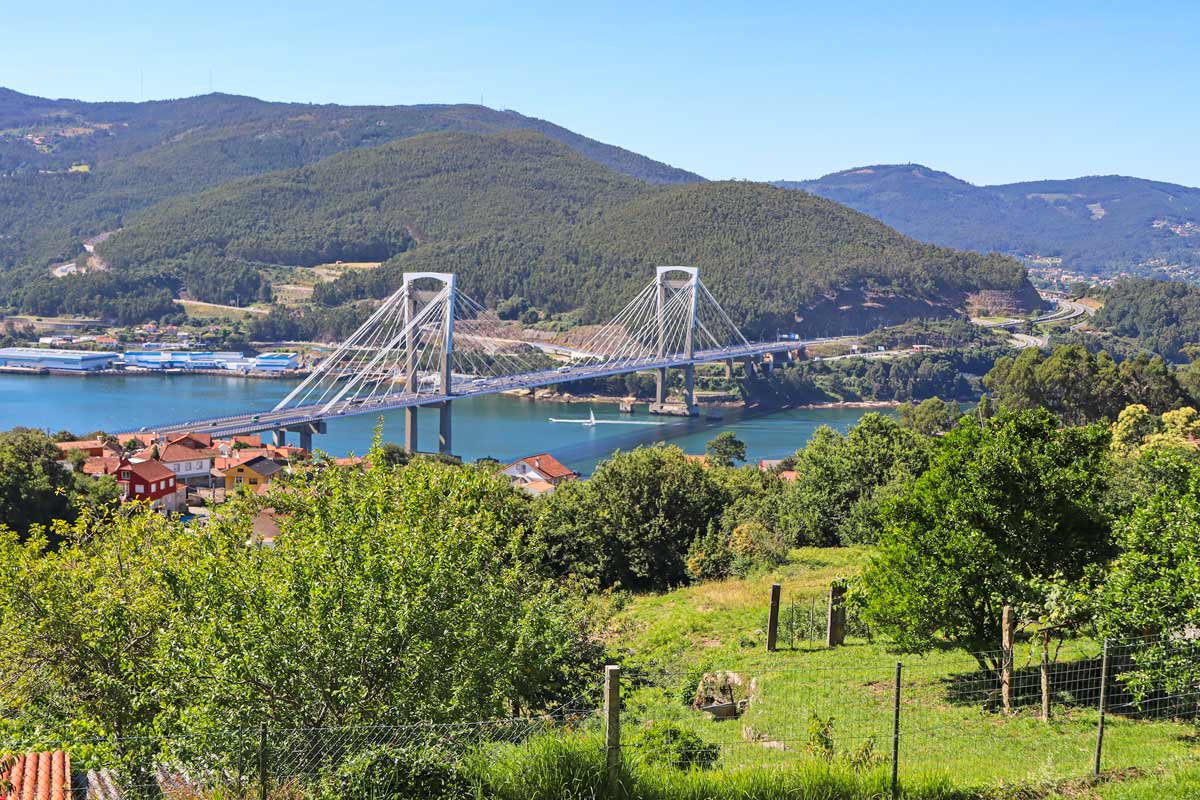
- Spectacular views of the coast, the bay, and the bridge from the route
- A beautiful waterfall in the forest
- The historical part of Redondela

Stage 9 route description
0-3 km/0-1.8 mi - through the city
5-13 km/3.1-8 mi - on a slope of the hill with beautiful views of the coast
9 km/5.6 mi - a picturesque waterfall in the forest
14 km/8.6 mi - the beginning of a steep descent
16.5 km/10.2 mi - Redondela. Here the Coastal Route merges with the Central Route. Expect to see a lot more pilgrims.
Places to stay in Redondela

Stages 10-13. Redondela to Santiago
You can follow our itinerary from Redondela to Santiago HERE.
Coastal Route planning resources
- The Portuguese Camino de Santiago – a detailed guide
- Comparing the Coastal and Central Route of the Portuguese Camino
- Coastal vs Litoral Way of the Portuguese Camino
- The Spiritual Variant of the Portuguese Camino
- How to switch from the Coastal Route/Litoral Way to the Central Route in Vila do Conde?
- Switching from the Coastal Route to the Central Route in Caminha
Questions or Comments?
Got any questions or comments? We would love to help! All questions and comments will be answered by us personally in Buy Me a Coffee. Click below and ask away.
Feel free to support our site by buying us a coffee!
Liked this post? Pin it!


The pretty half of Stingy Nomads, responsible for all our land adventures (hiking, climbing, walking the Camino) and following them write-ups. Alya loves walking since she was a child, she prefers to walk 1000 km with a backpack rather than to do a 10 000 km road trip (actually any road trip). Alya is a big fan of Latin America, the Spanish language, and dancing. Every time we go away she desperately misses our dog Chile.

Great information. Thanks.
Do you have advice, or an itinerary to complete the Coastal Camino in 10 or 11 days instead of 12?
Hello, Anna. Thank you for the comment. I can suggest walking days 8, 9, and 10 (from Vigo to Caldas de Reis) in 2 days: Day 8 - Vigo to Pontesanpaio, 25 km; Day 9. Pontesanpaio to Caldas de Reis - 34 km. This way your itinerary will be 11 days instead of 12. You can use our downloadable PDF file with the itinerary for the Coastal Route of the Portuguese Camino to plan your walk.
Buen Camino
Thanks for all of the great info
Thanks SM, as others say, you are not stingy with information and advice. Really appreciated. We are planning on walking next May. Probably the Coastal to Central but not sure about all the hard surface walking. We like some quiet and softer surfaces where possible. Would Central the whole way be better for us? The 12 days walking suits us, leaving us some time to go back and hang out in south Portugal or Spain.
Hello, Anne-Marie. Thank you very much for the feedback! I'd suggest starting on the Coastal Route (Porto to Caminha) in the first half there are many boardwalks along the coast, some stretches you can walk on the beach as well. From Caminha switch to the Central Route and continue inland to Santiago. This way you combine the best of both routes and skip long stretches of walking on hard surfaces in the second half of the Coastal Route through Vigo.
Buen Camino
@Stingy Nomads, thanks for this advice. Will map it out and figure out some nice rest days based on your notes.
Planning to walk the Camino Portugues starting from Vigo via Coastal Route in mid September, and wonder where's best to get the first stamp? Staying at the NH Vigo before setting off in case that helps.
Also this seems to be a good 140+ km from Santiago de Compostela but is it an 'accepted' starting point?
Thanks for any guidance beyond these excellent webpages.
Hello, John. You can get a stamp at Colexiata de Santa María de Vigo (Cathedral of Santa Maria). It's usually open Mon-Sun from 9.30 to 13.00, on weekends as well from 18.00 to 20.30 though nowadays the hours might vary depending on the restrictions. If the Cathedral is not open you can get a stamp at one of the nearby bars e.g. Restaurante La Comidilla (next to the Cathedral), Taberna A Pedra but you can ask at any bar around the Cathedral for a stamp.
It's not 140 km from Vigo to Santiago on the Coastal Route, it's about 105 km. It's about 135 km if you take the Spiritual Route from Pontevedra but 28 km out of 135 km you go on a boat (it's a part of the route). To get the Compostela you have to walk at least the last 100 km to Santiago de Compostela if you start in Vigo (whichever route you choose) it'll be enough to get it. Just remember to get 2 stamps per day we usually get one at albergues/hotels and one at a cafe/bar along the route.
Buen Camino
Just found your site and appreciate the informatio presented.
Hope to walk the coastal route in the fall and was concerned about walking on the side of busy roads on the way to Vigo which I have also heard mentioned and seen on videos. Would I be able to avoid these areas by taking side roads/paths if skipping this part of the walk is not an option?
Is there an especially dangerous section that I should avoid?
I would appreciate your help in my finding a safe route to and from Vigo. Thank you.
Hello, Linda. Thank you for the comment. I wouldn't say the walk to and from Vigo is dangerous, it's might be unpleasant and not very picturesque as you walk through some industrial areas and next to the road. I'm sure it's possible to take a bus from Ramallosa to Vigo if you want to skip that part. The walk from Vigo wasn't too bad, there was a bit of walking on a sidewalk next to the road but once you're out of the city you get some nice views of the bay and bridge. As an option, you can walk on the Coastal Route from Porto to Caminha, and from there instead of continuing along the coast go inland to Valença/Tui and continue on the Central Route of the Portuguese Camino.
Buen Camino
Hello, I would like to walk the Coastal Camino starting in Porto, but there may be only 10 days available for my trip... and from your description it seems that the beginning of the walk from Porto might be quite nice. If I had to skip a part of the walk (and take bus to further location), which parts would you find to be a minor loss to the experience? OF course, I intend to walk at least the last 100km continuosly. Thank you.
Helo, Josef. If you have only 10 days to walk the Coastal Route of the Portuguese Camino you can walk from Porto to A Guarda (Spain) and from there take a bus to Vigo, it'll cut off 2 days of walking and make it possible to finish the Camino in 10 days. From Vigo, it's about 105 km to Santiago you'll be eligible for getting a Compostela. The part to and from Vigo wasn't our favorite on the route there was some walking through industrial areas and along the road, I think if you have to skip a part it'll be the best one to do so.
Buen Camino!
Hello. So appreciate your detailed posts.
I’d like to ask your opinion...my husband and I are planning to walk the Coastal route starting in Vigo. Is this 100 km to SDC, that we would be eligible for a Compostela? We will be doing this end of December to early January. Is this a good idea, or would it be too tricky during this time.
Thank you in advance.
Hello, Gia! Thank you for the comment. The walk from Vigo is over 100 km you'll be able to get Compostelas for completing that part of the Coastal Camino. I haven't walked the Camino in December but from our experience of walking in Northern Spain in November, the weather in winter is quite bad; it's cold, rainy, and windy with occasional snowfalls. Many places close for Christmas if you decide to walk the Portuguese Coastal Route in December-January I'd recommend doing it before Christmas or after New Year it might be difficult to find accommodation over the Christmas holidays.
Buen Camino
I have been dreaming of walking Porto to Campostella del Santiago for several years. Have been walking daily and getting fit. COVID has definitely put a pause on the timing of the journey...Where is the area known as Costas? On the coastal route? Think I may do this alone. How common is that? Thanks! Love your post!!!
Hello, Carol Ann! Thank you for the comment! I'm not sure what area you're talking about "Costa" in Portuguese means "coast" so pretty much anywhere along the coast is Costa. There is only one specific area I know that contains Costa in its name it's Costa Vicentina. It's an area along the coast south of Lisbon there are a couple of walking routes but they have nothing to do with the Camino. The Coastal Route of the Portuguese Camino is a popular route (in normal times) there are quite a lot of pilgrims walking it you won't be alone or lonely, it's very social especially if you stay in albergues.
Buen Camino!
Bon Dia, dear Stingy Nomads. I have had the privilege of walking from Lisboa to Campostella del Santiago in 2017. It took me 27 days of walk and three extra nights, one each in Coimbra, Porto, and Campostella. Then I had made the booking with an UK company. They were okay but not great and I found them to be extremely expensive. I was, however, impressed by the selection of accommodations they afforded me. I’m a fairly fit old man, would be 67 next year 2021, when I intend to reprise my pilgrimage. I’m wondering if you have any itineraries that would give me Pilgrimage from Lisboa to Fatima and then all the way to Campostella del Santiago with extra nights in Fatima, Coimbra, Porto and Campostella. I’m looks for private accommodation with with reasonably okay COVID19 precautions, an ensuite and breakfast also transfer of my mochila. I intend to start the walk first week of September 2021. Or if you don’t do the such tours, would you kindly direct me to any Portugal-based travel agency should help me. Grateful to you for your kind help. Have a safe and pleasant day.
Hello, Zahid! We're not a travel agency, we don't do tours or bookings. We write about our personal experience and provide practical information that helps to plan a trip. We have a detailed post on the Portuguese Camino from Lisbon with the itinerary and accommodation options. You can find it if you click the Camino de Santiago menu. The route to Fatima has fewer accommodation options, especially the day before Fatima and the day after it. We have never used any company on the Camino as we find it unnecessary I can't recommend any. We're busy creating downloadable PF files with walking stages and accommodation along the route for all our Camino posts. If you come back in a couple of months you'll find it.
Buen Camino!
@Stingy Nomads, love your detailes itineraries and appreciate that you give a range of lodging options. I wish you were a travel agency though I fully respect your decision to stick to writing. Thank you.
He,
What a great blog! I was just wondering what would be the best time to do the Camino Portugues? Is that in spring or another period of the year? I am planning to do mine at the end of March, beginning of April and was wondering is you would recommend that.
Hi, Sophie! Thank you for the comment! We walked the Coastal Route in May (second half) and had really nice weather. It was warm and sunny but not too hot like it gets in July or August. There were not too many people, May is still early in the season for the Camino. Spring is our favorite time for walking the Camino. End of March-beginning of April you might get some rain especially in Galicia. We walked the Via de la Plata about the same time and it was great but the route is more south from Seville. I'm sure it'll be fine walking in April just be prepared for the rain and pack a rain poncho and a rain cover for your backpack.
Buen Camino!
Hi, Thank you for this really extensive post. I do have a question...You say in the beginning that the path is busy, how busy is that? On a scale of crowded like the Louvre or Christmas markets in Vienna in December being 10 and really peaceful and calm with a couple of hikers being 0, where would the Portuguese coastal path fit?
Hi! Thank you for the comment! I'm not sure where I say the Portuguese Coastal Route is busy I do say it's getting more and more popular with about 30% of pilgrims walking the Portuguese Camino choosing the Coastal Route. I wouldn't compare it with a market or a museum. I can compare it with the most popular Camino route the last 100km on the Camin Frances that is walked by hundreds if not thousands of people a day in the peak season. I'd say the Coastal Route is 4 out of 10 compared to the Camino Frances.
Buen Camino!
Thank you for sharing this! Precious information and very well organized.
Just a quick question, is it worth buying a guide book? To me, your explanations are more than enough. Is there any other info on the books that it's important to learn about?
Many thanks, guys!!!
Hello, Paola! Thank you very much for the comment! We used Briely's guidebook for the Portuguese Camino quite a lot on the walk from Lisbon to Porto, for the second part from Porto to Santiago we didn't use it that much, the route is very clear, there are many accommodations on the way, it's not difficult to walk without a guidebook. Some people like having it to make notes on the places they really like etc.
Buen Camino!
Thanks for all the great information. Can you please tell me if biking the Porto to Santiago is possible? I'd like to bike the coastal route, (or the central route if the coastal route is not good for biking.) Provided this will work, are you able to recommend a bike rental shop or two in Porto?
Many thanks, Sarah
Hello, Sarah! Thank you for the comment! Both routes can be cycled we did see people doing it. We've never rented a bike in Porto. I'd recommend checking waytosantiago.com site, they do bicycle rental (fully equipped) for the Portuguese Camino you can pick it up in Porto and drop it off in Santiago. I think it's the easiest option. Not sure about the price but you can contact them via their site.
Buen Camino!
Hello 😉 I am very happy to find this blog. I am planning my trip on June. I have read before about Camino Portuguese. I have found it is road without nature, nice landscape. But yours blog changed my opinion. Could you send PDF file to my email. I would be very happy!
Hello, Adalee! Thank you for the comment! The Coastal Route is quite picturesque we enjoyed walking it and going to walk it again this year. Currently, we don't have PDF for our Camino posts I think they'll be available on our site soon.
Buen Camino!
Thank you for this information. I have never done this before, but am hoping to go with my son this summer (late June). A question - when staying in the alberques, is it easy to get a bed or is there anyway to reserve beds ahead of time?
Hello, Robin! Thank you for the comment! You can book a bed in private albergues online or over the phone, public albergues can't be booked in advance they work on first come first serve principle. Late June is a quite busy time for the Portuguese Camino there might be not enough beds in public albergues you can walk shorter days to make sure you arrive early enough to get a bed or book beds in private albergues and not worry about accommodation at all.
Buen Camino!
In one of your videos about budget you mentioned a hotel in Santiago That was right beside the cathedral and had pilgrim rooms . I cannot remember the name of it . Could you tell me what it was please
Hello, Debbie! I guess you mean Hospedaria Seminario Mayor the hotel that has special rooms for pilgrims.
Regards
Thank you so much for your brilliant blog on the Portuguese Camino! I'm using it as a tool to work out our itinerary. I'm wondering if you could offer some thoughts about transfer of luggage? My husband and I are travelling from Australia and will be in UK for several months, so we will have a suitcase each as well as our back packs. We fly into Lisbon, stay in Porto for a few days and fly out of Santiago d C to London. How do we manage our luggage? Should we leave it somewhere in Lisbon, or Porto or should we pay for it to be delivered daily to the next albergue/hotel? I would greatly appreciate your advice. Many thanks in advance.
Hello, Jennifer! Thank you for the comment! I'd suggest leaving your suitcases somewhere in London, don't bring them with you at all, take only the necessary things that you'll definitely need for the Camino. If your backpacks are still too big and heavy to carry with every day you can use backpack transfer service every day, they deliver your backpacks from albergue/hotel to albergue/hotel every day when you arrive your backpack is already there. There are several companies that do it but not all operate on the Coastal Route, I can recommend contacting waytosantiago(dot)com or Pilbeo for more details. We had a lot of luggage too and left it in Lisbon in the hostel we stayed but it was a real pain afterword because our flight was from Madrid but we had to go first back to Lisbon to fetch our luggage (by bus it takes the whole day) and from there go to Madrid to catch our flight.
Buen Camino!
Thank you for the information! I will be traveling with my fourteen y.o. son. I am wondering whether the albergues are a good idea if we won't be sleeping in the same room. He is a big and confident kid who seems older than he is, and he is friendly and has nice manners, so I'm not worried about his safety or the annoyance of other travelers, but I'm just trying to gauge the atmosphere. I was thinking we might alternate hotel stays with albergues to save a little money and have that part of the experience but not rely on the albergues entirely. I appreciate your advice!
Hello, Meredith! Thank you for the comment! Why don't you think you won't be sleeping in the same room? I've walked 6 Caminos with my husband out of hundreds of albergues we've stayed only once there were different dormitories for men and women, it was in Fatima. When you check-in in an albergue they always try to put you in the same room and give you two beds next to each other. Staying sometimes in private might be a good idea if you want to rest, sleep late or just have some privacy but I'm sure you'll be able to stay in the same room with your son on the entire Camino.
Buen Camino!
Hi Stingy's,
I know a few people have asked, but I can't seem to find the PDF for the Coastal Route. Is it currently available? Cheers, Chris
Hello, Chris! Yes, the PDF file is back, you can download it again.
Cheers!