Everest Base Camp Trek - Complete Guide (2023 update)
The Everest Base Camp (EBC) trek is a spectacular high-altitude trek in the mountains of Nepal. Prepare for jaw-dropping scenery and a unique cultural experience exploring the challenging trekking routes around the highest mountain in the world. Doing the Mount Everest Base Camp trek, hiking on the Khumbu glacier through small villages over many suspension bridges looking at Mt. Everest and the Khumbu Valley is a fantastic round trip. This fascinating EBC trek combines both Buddhist and Tibetan culture following in the footsteps of Sir Edmund Hillary. Local culture can be seen in sherpa villages and Buddhist monasteries. Don't miss the fascinating Tengboche Monastery.
Stingy Nomads participates in the Amazon Services LLC Associates Program and other affiliate programs. If you click on the link and purchase the item or make a booking, we will receive an affiliate commission at no extra cost. Thank You for supporting us and assisting us to produce quality, free content.
- Best Rated Tour Trekking to Everest Base Camp.
- Independent? Book Your Flight from Kathmandu to Lukla Here.
We have done a lot of trekking in Nepal including two treks to Everest Base Camp (EBC). In this post, we discuss cost, itinerary, guides, porters, altitude sickness, how to get to EBC, and give packing and money-saving tips.
Everest Base Camp Trek Overview
- Distance – 120 km/75 mi
- Days required – 12 days
- Total ascent – 6015 m/19 734 ft
- Total descent – 5821 m/19 097 ft
- Highest point – 5640 m/18 500 ft Kala Patthar
- Difficulty – difficult
- Permits – Local Government fee (NPR 2000/US$17 pp.) and Sagarmatha National Park permit (NPR 3000/US$25 pp.) is required. No TIMS card is needed for the trek.
- Cost per day – US$29 (without flights) $58 per person per day including permits and transportation.
- Guide – not compulsory
- Accommodation – guest houses
Important Updates – There have been some important announcements regarding guides 2023.
Is a Guide Mandatory to Trek to Everest Base Camp in 2023?
The Nepal Tourism Board (March 2023), announced that all tourists visiting Nepal will be required to hire a licensed guide or porter before trekking. However, the municipality under whose jurisdiction the Everest region falls subsequently decided not to comply with this decision and that solo trekking will still be allowed in the Everest area. See The Kathmandu Post Article – Nepal ends solo trekking era. Everest region is an exception. So the additional cost of hiring a local guide is not compulsory.
Where is Everest Base Camp (EBC)?
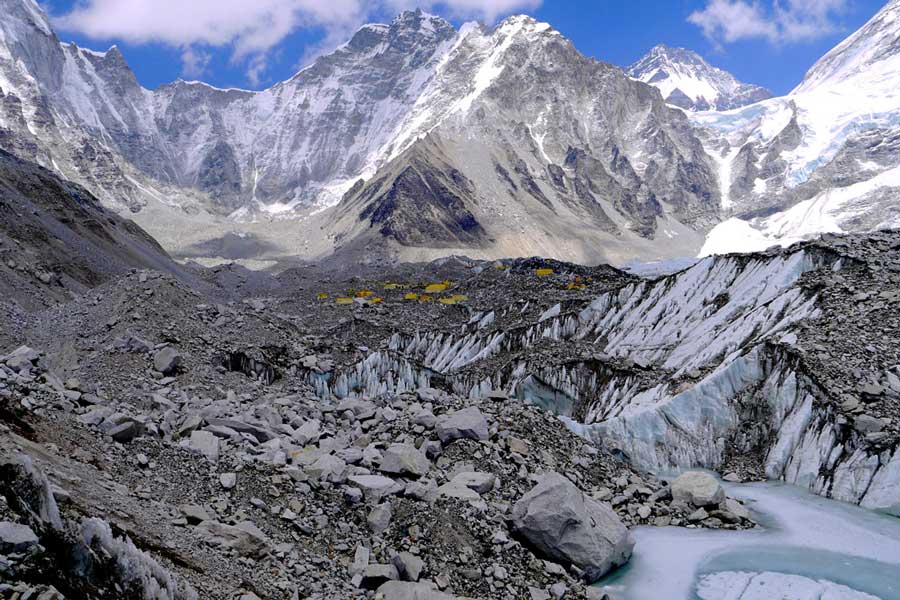
Everest Base Camp is a camp where climbers stay and prepare before starting to climb the world’s highest mountain. There are actually two base camps for climbing Mount Everest, the North Base Camp in Tibet and the South Base Camp in Nepal. The Nepalese camp is the Everest Base Camp that most people refer to. Mount Everest and EBC are located in Sagarmatha National Park, a UNESCO World Heritage Site preserving Himalayan flora and fauna.
EBC is located about 150 kilometers (90 miles) northeast of Kathmandu in the Khumbu region of Nepal at an altitude of 5,364 meters
How to hike to Mount Everest Base Camp?
You have three main options on how to do the trek to Everest Base Camp, you can either do a package tour through an agency, do it by yourself (no group or guide) but hire a porter or guide, or do it completely independently.
- Doing an organized tour through an agency is a good option if you are alone or not confident to do the trek unassisted, it is an easier but more expensive option.
- Finding porters and guides in Kathmandu is easy, just go to any local agency they will assist you to organize staff for your purposes. The Sherpa guides usually know the trail, best views and area very well.
- Doing it yourself is not hard and plane, bus, or jeep tickets from Kathmandu to Lukla are the only thing that you have to organize. You follow a very clear main trail, everybody stays in the same little “towns” with many tea houses enjoying sherpa culture, and it is not necessary to book anything.
We have done the EBC trek independently twice, trekking independently on a fairly frugal budget our cost was $645 (including the flight) beginning and ending in Kathmandu in March 2020. You can see our optimized Everest Base Camp Trek Itinerary we recommend.
Organized Everest Base Camp Trek
For some great treks with reputable international companies take a look at these great tours.
- Excellent Rated Everest Base Camp Trek tour with Mosaic Adventure Trekking
- Everest Base Camp Trek with Klook
If you are trekking in season escape the crowds by hiking the more quiet way and experience unreal views of famous mountains such as K 43, Taboche, Cholatse, Nuptse, and Everest. Climb the tough Gokyo Ri peak for spectacular panoramic views, and check out this awesome 16-day trek itinerary, hiking to EBC via Gokyo Lakes!
How Much Money Do I Need for Everest Base Camp Trek?
For a complete cent-by-cent cost breakdown of our trek to Everest Base Camp in 2020. Cost of trekking to EBC in different ways in a nutshell:
- Package tour EBC trek with international agency $1700
- Package tour EBC trek with local agency $1600
- Independent EBC trek with a guide and porter $1370
- Independent EBC trek with a guide $1085
- Independent EBC trek with a porter $930
- EBC Trek completely independent $645
If you budget around $700 for an independent 12-day EBC trek you should have sufficient money for the trek including flights, food, water, tea, snacks, and accommodation. The biggest possibility to save money is to go to Lukla overland instead of flying, we discuss this later in the post.
There are only 2 places where you will find ATMs on the Everest Base Camp hike that is Lukla and Namche Bazaar.

Accommodation on the Everest Base Camp Trek
Accommodation on the Everest Base Camp trek is in Teahouses. Teahouses are bed and breakfast lodges designed to host trekkers. EBC teahouse accommodations in Nepal are simple, clean, and comfortable. It is great that you can check in and have an early start the next day with a good breakfast hassle-free.
Cost of tea house accommodation – price varied between free and $3 as long as you order food at the teahouse.
The walls are thin and the outside and inside temperatures are about the same. You do get blankets at the teahouse and sleeping in a thin sleeping bag in our clothes under the blankets provided was sufficient at the higher altitudes when it got very cold at night.
Shower on EBC Trek – Everything gets more expensive as you ascend. From Namche Bazaar we had to pay for hot showers. The average cost of a hot shower was NPR 500 and after a long day walking it is definitely worth it! If you trek early in the season the water is often frozen in the pipes and you can only have a bucket shower, a bucket filled with hot water, which is fine, but in February at Gorkshep it is just too cold. We packed Wet Wipes and did a ‘dry shower’. Pack hand sanitizer for washing hands when water or soap is not available.
Charging – there are lights in the rooms, but no plugs at most tea houses and you have to pay for charging in the communal area, usually 200 NPR per item or per hour.
There are no electricity sockets in the bedrooms, charging is available in the dining room at extra cost.
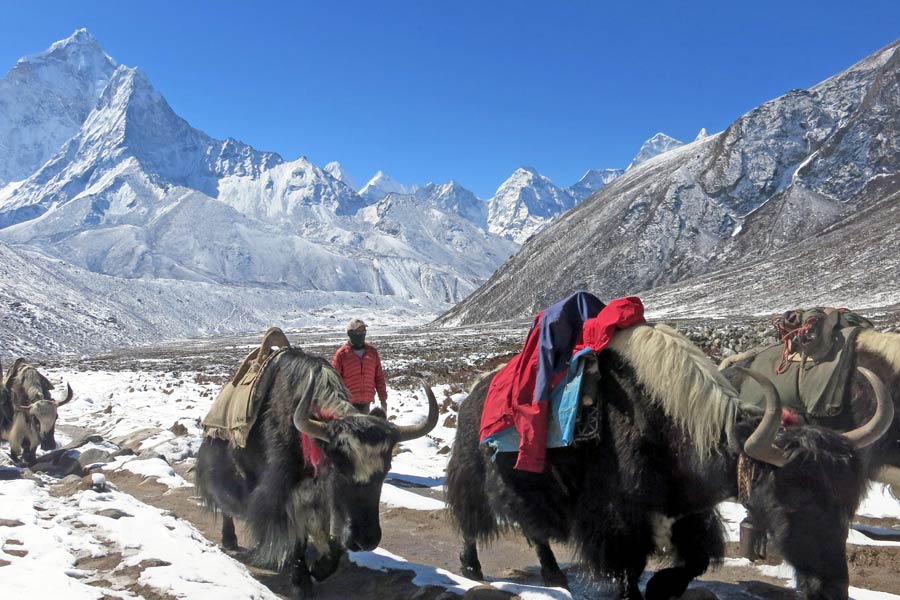
The tea house usually has a large dining hall where you eat and relax with other guests. In the center of the dining room is a fireplace that burns wood and yak dung.
At all the lodges we stayed there were now Western toilets. You have to take your own toilet paper.
There are nice lodges available in some of the villages ($20 -40) see the itinerary later in the article.
Food on the Everest Base Camp Trek
The tea houses sell nice meals and most people eat 2 or 3 meals per day at the tea houses where they stay. It is expected that you will eat dinner and breakfast at the tea house where you overnight, if you don’t you are charged a lot more for accommodation ($15 instead of $3).
You can eat well if you budget about $25 per day ($8 per meal).
See our detailed article on Food on the Everest Base Camp Trek.
Dhal Bhat is the staple many people live on during the trek and the porters always eat this. At most places it is ‘bottomless’, when your plate gets empty they will refill your dahl, rice, and potatoes if they don’t offer just ask!
We usually had a late lunch when arriving (15:00) and not too long after a fairly early dinner (19:00), leaving the following day. We do not drink the water from the taps on the EBC trek, you can buy a water bottle at each teahouse, we prefer to use our Lifestraw Bottle to make tap water potable.
Flights to Lukla, the start of the Everest Base Camp Trek
Book your flight from Kathmandu to Lukla with Tara Air Here.
The easiest way to start the trek is to fly from Kathmandu to The Tenzing-Hillary Airport in Lukla.
Flights from Kathmandu to Lukla were suspended in 2022 due to maintenance with only flights from Ramechap being available. Flying from Ramechap Airport to Lukla is still possible and is a very short flight. Tara Air is flying again from Kathmandu to Lukla at the time of writing, in July 2023. Changing the flight dates is easy and free even while trekking. Our return date changed during our trek and we phoned Tara from a tea house on the way to change our date. I will always recommend you reserve the first flight in the morning since flights from Lukla get canceled due to wind very quickly, we have been stuck here for days due to weather conditions.
You are allowed only 10kg of luggage, hopefully, you were not planning to carry more! If you are traveling with more luggage check that you stay somewhere in Kathmandu that will store your luggage safely without charge.
The sloping Tenzing Hillary airport in Lukla is considered by some as the most dangerous runway in the world.
Hiking to Lukla from Kathmandu
Lukla is high in the Himalayan mountains with no roads reaching all the way here, most people fly from Kathmandu to Lukla to start the EBC trek. The flight from Kathmandu to Lukla has one of the scary landings in the world with the Lukla runway on an incline (fun/interesting land). The flight from Kathmandu to Lukla is expensive.
The biggest possibility for saving money on the Everest Base Camp trek is by going from Kathmandu overland and skipping the flight. This is also a good way to experience local cultures.
Flights between Kathmandu and Lukla often get canceled due to wind and I have heard many stories of trekkers spending a couple of days waiting in Kathmandu to fly out or in Lukla to fly back. Our flight from Lukla to Kathmandu was canceled the first time we trekked to EBC.
We walked from Lukla to Salerri (2 days) and took an uncomfortable jeep journey from Salerri to Kathmandu for $20.
Coming from Kathmandu you can do the reverse and take a jeep from Kathmandu to Salleri. Salleri is 265 km away from Kathmandu. The ride is about 8 hours costing about NPR 1,100 ($10) for Buses and NPR 1700 ($17) for Jeeps, buses go daily from Kathmandu. You can walk from Salleri to Lukla in 2 or 3 days.
Another option is to take a bus to Jiri taking about 9 hours, from here the trekking route does not pass through Lukla to EBC, it goes as follows Salleri – Ringmo – Kharikhola – Puiyan – Phakding – Namche, joining the main route after 5 days at Namche Bazaar so there is an extra four days of trekking.
A good way to hike is walking the Jiri to Namche EBC route on the way up and taking the route to Salleri on the way down.
Everest Base Camp Trek Permits
Two permits are required a national park permit and a trekking permit, both can be bought on the trail while trekking.
Everest Base Camp permits required in 2022
Local permit cost NPR 2000 ($20) in Lukla. – All foreign nationals can buy the Khumbu Rural Municipality Permit, which cost NPR 2,000 per person for the first four weeks. After four weeks, the cost of the permit goes to Rs. 2,500 per person. The permit office lies on the trail in Lukla.
Sagarmatha National Park Entry Permit (NPR 3000/$25 + 13% Govt. Tax) are available at the entrance gate in Monjo or at the Department of National Park and Wildlife Conservation (DNPWC) counter at Bhrikuti Mandap in Kathmandu.
Do you need a TIMS permit to trek to Everest Base Camp?
In the past, a TIMS ( Trekkers’ Information Management Systems) card was necessary for trekking in the Everest region. The TIMS card is no longer required for the Everest Base Camp Trek. The TIMS card has been replaced by the local area permit. TIMS might be required for other regions such as Annapurna or Langtang
If you hike from Jiri or Salerri to Lukla you pass through areas controlled by different local governments and a TIMS might be necessary.

Insurance for the Everest Base Camp Trek
Everest Base Camp is a high altitude trek and altitude sickness can happen. Evacuation by helicopter is the most common way to get off the mountain if you have an emergency. Travel insurance that covers you for hiking to an altitude of 6000m is a ‘yes’ for Everest Base Camp at 5364m. Insurance can be purchased for your whole trip or only for the duration of your trek.
Want to know how much insurance will cost? Get an instant online quote here!
Designed by travelers, for travelers, World Nomads covers more than 150 adventure sports and activities so you can explore your boundaries
How Difficult is the Everest Base Camp Trek?
For a person of medium to good fitness level, the Everest Base Camp trek is of medium to strenuous difficulty. You walk 4 to 6 hours a day for 12 days, with a resting day or two for acclimatization. If you are reasonably fit you should be able to do this carrying your own backpack. Having porters make it easier. No technical climbing skills are required. Irrespective of how fit you are, climbing too fast can result in altitude sickness. In some parts of the Everest base camp trek route, the trek is a steep climb to higher elevations.
Our EBC trek was 120 km/75 mi, so you walk more or less 15km per day for about two weeks. It is not a flat walking surface and typical of treks in Nepal there is a lot of going up and down. The distance you cover does not require super fitness, the altitude does however make it quite tough, you start at 3000m and climb 2400m further to reach base camp at 5365m. The difficulty of the Everest Base Camp Trek is influenced by; your pack weight, a porter can make it much easier here and season, if you are cold and miserable it is definitely harder.

Best time to trek Everest Base Camp
There are two main seasons for trekking to EBC. The best months to trek to Everest base camp are in the pre-monsoon season through March, April, and May or in the post-monsoon season from late September, October, and November. It is not pleasant and can be dangerous to hike in bad weather. Hiking is possible in the Winter months (Dec-Feb) but it is very cold, up to -30C at night! Sometimes a lot of snow falls on the trail, and passes might be closed.
See our detailed article on choosing the best time to do the Everest Base Camp trek.
Everest Base Camp Trek Tips
Where to stay before and after the EBC trek?
We’ve stayed at several hotels in Kathmandu in different parts of Thamel and preferred the location Keshar Mahal Marang Street. A small and quiet dead-end street in Thamel with only hotels, hostels, restaurants, and coffee shops. The street is a 5-minute walk from the main touristy area with hundreds of shops and agencies. There are a couple of great restaurants and coffee shops nearby.
We had a good time staying at Aryatara Kathmandu Hotel, a nice place, with big rooms, comfortable beds, good breakfast (included), a great hot shower, AC, wi-fi, TV, etc. The room price includes free airport pick-up (for international flights only). Helpful and friendly staff. We stored our extra luggage here every time we went hiking for free without any problem.
More options in the same street
- Budget | Shangri-la Boutique Hotel |
- Middle price | Oasis Kathmandu Hotel | Hotel Blue Horizon |
- Luxury | Fairfield by Marriott Kathmandu |

Guides and Porters on EBC
Hiring a porter and guide in Kathmandu is more common than doing this in Lukla. You do get approached by touters or guides themselves in Kathmandu, but the safest way of doing this is by going to a local agency. This way you do have someone to turn to if there was a problem, your guide cannot just disappear.
Some agencies in Kathmandu organize that you meet your guide in Lukla while some prefer to send a guide with you from Kathmandu, in this case, you will have to pay for the guide’s flight, Nepalese citizens fly at a reduced price of $100 for the return flight. You do not have to pay for food or accommodation for your guide, they get this for very cheap at the tea house or for free for bringing you to the teahouse.
I will recommend that you meet with the guide before, check if he speaks good enough English if you trust him and if you get along. I have met guides that have climbed Everest, some of these guys are extremely knowledgeable.
- Make sure you are using a registered guide
- The guide should be insured
Two people can thus share a porter as long as you don’t make him carry too much, I would say a maximum of 15kg for a porter, but many companies let the porters carry 20 kg.
You can budget $30 per day for a guide, which can be shared by up to four people, and $20 per day for a porter.
Tipping the porter and guide on EBC
Please keep in mind that a good tip for the porter/guide is expected. These guys are unreal and work very hard. Tipping is a big part of their income.
Risks During Everest Base Camp Trek
Altitude sickness (AMS) is the biggest risk during the Everest Base Camp trek. Other risks are stomach problems (diarrhea) and flight problems landing at Lukla airport, rated as one of the most dangerous airports in the world.
Stomach problems on the EBC trek
Meat is carried by porters and not always refrigerated, try being vegetarian. The biggest chance of an upset stomach comes from water. Filter your water, it is a good idea to carry a lifestraw bottle, buying plastic bottles everywhere costs a lot and is very bad for the environment, ending up in a landfill somewhere in the mountain or getting burned.
Preventing Altitude Sickness (AMS) during the hike.
Altitude sickness or Acute Mountain Sickness (AMS) is caused by ascending too quickly, climbing slower to prevent it. When we walked to EBC the second time we had a spare week before our flight to Lukla and decided as training and acclimatization to do the Langtang trek. By the time we started the EBC trek, we were used to hiking at that altitude. The highest altitude on the EBC trek is 5,364m (17,598ft) above sea level, you will spend most of the trek at lower elevations.
Altitude sickness is very common on the Everest Base Camp trek. It can happen to anybody, irrespective of how old or fit you are or if you have previous trekking experience.
During our first trek to EBC, we were feeling very strong and did not stop to acclimatize at Namche Bazaar, when we got to Tengboche we had headaches during the night, staying a second night did not make AMS symptoms disappear and we turned around and walked back to a lower altitude, descending 600m. This worked and we started ascending again a day later without any further problems. We stick to the rule of thumb now, not ascending more than 600m per day.

During our last trek to Everest Base Camp we did acclimatization stops at Namche and Dingboche and never had any problems. These acclimatization stops were nice rest days relaxing at the guest house and enjoying good food and reading during our free time.
Hydration – Drink enough! Very important to stay hydrated.
Trekking Pace -Don’t go too fast, not more than 600m increase in altitude per day.
Drugs
Many people take Diamox. At high altitudes the air pressure is low and less oxygen available, Diamox prevents AMS by acting as a respiratory stimulant.
We took Diamox along in our first aid kit but did not use it. We met several other trekkers that were taking Diamox they did not have AMS or any bad effects from taking the drug, one of the guys said he had some ‘needles and pins’ feelings in his fingertips when he started taking Diamox, but it got better with time.
Contraindications Diamox is a diuretic so you constantly have to urinate, I believe it is a pain to go to the toilet in the cold at night. Needles and pins (paraesthesia) in hands in feet are experienced by some people.
AMS Symptoms
- Poor appetite
- Fatigue
- Headaches
- Dizziness
- Difficulty sleeping

If you have only mild headaches you should be OK, but be careful AMS is dangerous and trekkers have died on EBC ignoring it and pushing through. You can ask the advice of the experienced sherpas that own many of the tea houses. At Periche there is a clinic with international doctors working there and a daily talk on AMS.
Remember if you keep on pushing through severe symptoms and you do not have insurance a helicopter to take you down can cost a couple of thousand dollars.
You should never be too fixed on an itinerary, walk at a comfortable pace, and if you don’t feel well rest.

Everest Base Camp Trek Alternative Routes
There are many amazing trekking routes and peaks to hike and climb on this amazing mountain. These are some of the most common hikes and climbs trekkers do around EBC.
- Lukla to Salleri – it is possible to take a bus from Kathmandu to Salleri and walk from here to Lukla, no flights are required to trek to EBC! This hike is great for acclimatization and will save you a couple of hundred dollars on flights!
- Hike to Everest Base Camp via Gokyo Lakes – Add three or four days to your EBC trek by trekking to Goyo Lakes, six spectacular glacial lakes, located between 4,700m and 5,000m. Beautiful panoramic views of famous mountains such as K 43, Taboche, Cholatse, Nuptse, and Everest and the famous glacial lakes, cross the beautiful and challenging Cho La Pass.
- Climb Island Peak (6,189m/20,305ft) – It is a real climb, serious mountaineering, meaning it is not trekking. Learn the required skills and conquer a 6000m peak! Usually done as an extra 3 days with an EBC trek.
Packing Tips
We have done several treks in Nepal see our complete Everest Base Camp trek packing list and video to see what we packed for this trek.
Questions or Comments?
Got any questions or comments? We would love to help! All questions and comments will be answered by us personally in Buy Me a Coffee. Click below and ask away.
Feel free to support our site by buying us a coffee!
Liked this post? Pin it!

Disclosure: Stingy Nomads take part in the Amazon Services LLC Associates Program. We earn advertising fees by advertising and linking to Amazon.com. If you click on the link and purchase the item, we will receive an affiliate commission at no extra cost for you. Thank You!
The strong half of Stingy Nomads, a nomadic aquaman that would be happy to spend all his life in the water diving, surfing and spearfishing but often has to compromise with Alya and go hiking instead. Campbell is responsible for all our marine adventures and following them with write-ups. He loves traveling, braai (BBQ in South Africa), red wine and spending the day in a wetsuit.


Hi Campbell & Alya,
Thank you so much for this write-up.
i am doing EBC in late November 2018. I am planning to go EBC Independently starting from June or July 1st week 2019. I have couple of quick questions, it would be great if you could help me out on this.
1. Can we hire porters on spot from Lukla itself, at what cost?
2. How strenuous it would be to trek from Lukla to Salleri & how much time will it take?
Thank you for sharing!
Hello Mark, I assume you are doing the trek middle 2019, you should be able to organize a porter in Lukla, off course I cannot guarantee this, but I have heard of people that organized it this way. You can also organize it from Kathmandu. Some things to consider if you organize an independent guide; you will not have the back up of an agency, the guide is unlikely to be insured, they might not be licensed, if you hire an independent guide paying him in three payments during the trek is a good idea (that your porter does not disappear if there is a problem).
Which dates did you trek?
Sorry if this has already been said somewhere.
Hello, Simon! We did the trek in the mid April.
Cheers!
Hi Campbell & Alya,
Thank you so much for this write up.
I'm planning to trek EBC independently as I'm tight on the budget.
I asked a local on the internet for porter-guide service and he listed down things I have to prepare.
Among them is local government entrance tax - $20 (this is not the TIMS permit or the national park fee).
But I don't see this fee in your list.
Do you know this fee? Is this new or is this some extra I have to pay to him?
Hello Rara, from what I understand there are 2 fees, a Local permit that cost NPR 2000 ($20) in Lukla. and the Sagarmatha National Park Entry Permit (USD 30 + 13% Govt. Tax) available in Kathmandu or Monjo. TIMS is no longer required for EBC. If however you are going to walk from Jiri to EBC you will require a TIMS permit and then there is another conservation permit of $20 required. I have not been in Nepal in a while, this is my current understanding, so I would recommend that you confirm with local/official sources.
Just a quick correction on this. I did Jiri to EBC in November and December.
You need 3 permits, 2 you mentioned for EBC which is 2,000 for Khumbu region and 3,000 for Sagarmatha National park.
For the Jiri to Namche section there is Gaurishankar Conservation Area permit which you get in Shivalaya. It's 3,000 rupees. It's such BS as if you look at the map you literally are only in the national park for about 2 hours of walking. You can avoid if you start after Shivalaya.
You DO NOT need a TIMS card for this though. All the permits you get on the way. I don't see the point getting them in advance.
While this blog is too late for me I love entries like this that give daily costs and such like so good work none the less!
Hi Rob, thanks for the info, we will add it to our post. Safe Travels!
Hi Rob, I'm gonna do the trek in 4 weeks, how was the weather, lots of snow?
Hi,
Really good post thanks! Just wondering if it as easy to do the Gokyo lakes trek independently aswel or is advisable to get a guide do you know?
Hello Grace, thanks for reading, from what I understand from other trekkers that did the route, trekking to Gokyo independent is completely possible. This should add about an extra 4 days to your trek from Kala Pattar to Dzongla, from Dzongla over Chola Pass to Thagnak, from Thagnak to Gokyo, from Gokyo to Dole, from Dole to Namche Bazaar, you will also need a rest day or two and time to see the lakes. Hiking to EBC with Gokyo is often done in about 16 days. We have not done this so I am telling you this on hear-say and would recommend you do more research. Goodluck and safe travels
Hi, Thanks for the detailed article on this, I am doing EBC in late September 2018, i couple of quick questions, it would be great if you could help me out on this
1.Can we hire porters on spot from Lukla itself, at what cost?
2.Can we hire a guide maybe from Dingboche to Dingboche/Periche, at what cost? as to what I've understood by reading numerous blogs, till Dingboche there is no need of guide as the path is well laden and we can seek help from locals in case required.
3. What would be approximate permit cost for an Indian for doing the EBC?
4. What is the current state of Salleri to Kathmandu roads? can they be considered for returning after EBC?
5. How strenuous it would be to trek from Lukla to Salleri & how much time will it take?
6. If we do it independently without any operator, will spot booking an accommodation in tree houses be a challenge? (our travel dates, 20th September to 6th October)
Thanks in advance.
Hi Shivam, thanks for reading. You can hire a porter in Lukla, the advantage is you do not have to pay for a flight for him. The problem is that trekking permits are different depending if you use staff or not, apparently best way to stay within the rules here is to organize a porter through an agency in Kathmandu to meet you in Lukla.
We thought the trail was clear to follow the whole way, you might be able to find a guide at Dingboche at a tea house or can ask at an agency in Kathmandu.
EBC permits https://www.everestbasecamptrek.org/permits-necessary-everest-trek/
Lukla to Salleri was not a very steep trail compared to the rest and took us 2 days.
I think without booking anything you should get available tea houses in every town.
safe travels!
Thanks Alya& Campbell for reverting but you missed on cost front for porters and guide, it would be great if you give me an estimate for hiring porters exclusively from Kathmandu and guide from Dingboche.
Also current situation of roads from Salleri to Kathmandu.
Hello Shivam, we live in Cape Town, South Africa, not Nepal. We share our experiences in this travel blog, aiming to help as much as we can with your travels at no cost. The best way to find the info you are looking for would be to contact a couple of agencies in Nepal and compare the prices, they will also be able to tell you the state of the road, from what I found on recent forums online, the state of the road seems to be good enough to hike. Goodluck!
I know that you don't live in Nepal but i thought you might be having an idea as you have a quite active forum here where there is incredible exchange of information. Anyways thanks for all your help, Keep up the good work, Cheers 🙂
Thanks Shivam, hope you have a fantastic trip!
Hey! Did you book in advance the accomodations in pangboshe, perishe, leboushe and gorak shep? Or did you search for accomodations the moment you arrived there? I ve seen a lot of info about what the accomodation provide and the prices but nothing about how you book them in advance. And one more thing, where can you get life ensurence? Great info btw!
Hi! We've done EBC trek twice and never booked anything in advance there are enough guesthouses along the route it's never been a problem to find a place to sleep. I don't think most places can be booked in advance unless you do the trek in a group then agencies book accommodation to make sure everybody stays at the same place. Travel insurance can be bought online. We recommend World Nomads but before buying it I'd recommend checking their terms and conditions they have some special terms for the EBC trek.
Cheers!
Thanks for the great story. Awesome
thanks for posting this article about the everest basecamp Trek! I enjoyed reading it!
thanks for sharing this useful article.....
Amazing post. Really appreciate the details you've gone through and also the updates. This is one of my bucket list items. Just a quick question: I plan on making a daily vlog while trekking. Would it be too much to carry a Mirrorless DSLR, a Gimbal, a monopod and three lenses while on the trek apart from all the luggage you mentioned?
What about electricity on the way for recharging the batteries and is there any special permit required for videography along the way.
Thanks in Advance
Hi Chandan, thanks for reading, always nice if our posts can help. Most of the tea house have no outlets in the rooms, most of them have electricity but you might have to pay per hour for charging. Twelve days is a long trek, but you can get away with packing light since you wont need to carry a tent, a stove or any food! I think if you pack all your stuff and your pack is about 10kgs you should be ok to carry it, the porters carry up to 30kgs! Paying a porter to carry video equipment is always an option. I don't think you need a permit for your equipment, but check some of the official Nepalese websites - If you are thinking of taking a drone check with Civil Aviation Authority of Nepal (CAAN)
Hello,
Is it still possible to do it on your own without a tour? I recently heard that they dont allow it anymore, is this true? And what are the options for sleeping in your own tent, would you advice it or is it simpy too cold to do this.
Thanks in advance and thanks for your great post!
Hi, glad you enjoyed the post. As far as I am aware you can still do it independent and I can not find anything suggesting otherwise online. It looks like this rumor was floating around as early as 2007. Send me a link and I will take a look at it. There are no campsites, but you could ask to camp next to one of the tea houses. It is never to cold to camp if you have an appropriate sleeping bag, but it does get very cold our water froze inside our room at the last tea houses. Sleeping in a tent won't save you much on accommodation since you stay in the tea houses for about a dollar as long as you eat there. Carrying your tent, food and gas for 12 days would be very tough. Goodluck!
I'm 63 years old and I did the EBC tourist highway this year between April, 23 and May, 7, uneventfully and on a budget (accommodation and guesthouse food for 14 days: US$ 190, internet-booked return flight Kathmandu - Lukla: US$ 296; permits: US$ 52.50). In the years before I did Langtang, ABC and Annapurna Circuit on a similar budget. I never carry a sleeping bag, just a cotton liner (single-bed cover). All the guesthouses provided enough clean blankets/duvets. In my personal experience, the biggest risks/nuisances when you go trekking/hiking are: (i) a group, (ii) a guide, (iii) an itinerary. Happy Trekking!
Hi Matt, thanks for your valuable input, we appreciate you informing us of the latest prices. Well done on completing all those hikes in Nepal, they are still on our list 🙂 Glad you had a good and safe trek. We just finished climbing Mount Elbrus in Russia, it was great keep an eye out for the post coming soon. Keep on trekking!
So glad to read this Mike as we're heading off in 2 days and at this point we've decided not to take sleeping bags. Forecast up there right now is nothing below minus 10, I don't honestly think we'll need them and they're such a pain to carry. A couple of years ago we went to Tengboche and didn't need bags and that was at a colder time. But...famous last words. With kids I do tend to worry more, but we're well used to low winter temps through living in Romania with no heating and no sleeping bags. We're generally fine to about minus 17 then it starts to get chilly at night. Just too many decisions.
really good tips for budget travellers and backpackers to visit the Everest base camp Nepal
Great to know about your trip in detail! Thanks much 🙂
Hello, Induj! Thank you! Hope you found it helpful!
Cheers!
Great report. Many thanks.
Two short remarks:
(i) I did Langtang (in autumn 2014, before the quake), ABC (in spring 2015, during the quake) and Annapurna Circuit (in spring 2016) without a sleeping bag. A liner or single bed cover (for hygienic reasons) was good enough. All tea houses and lodges supplied clean and thick duvets/blankets.
(ii) I have just bought tickets Kathmandu - Lukla (and return) over the internet, only two days ago. I went directly to the website from Yeti Airlines. It was US$ 148.- one way (US$ 296.- return); payable by credit card or PayPal. It worked and I received immediately printable e-tickets. They charged my Visa card US$ 296.-, at no extra costs.
Hello, Matt! Thank you for reading and providing updated info!
Concerning sleeping bags we were very cold last two nights before reaching the Base camp and we had many blankets and sheets but slept in all our clothes and sleeping bags. It was below C0 inside the room, water froze in our bottles.
It's a good upgrade from Yeti that you can buy a ticket online now, it wasn't possible three years ago when we did the hike. Thank you we'll update it in the article.
We really enjoyed your site you have great photos, very catching and inspiring!
Good luck in your new Nepal adventure!
Thanks for your prompt reply.
If anyone wants to add ABC after EBC, here is my diary with many details about the ABC trek: https://konniandmatt.blogspot.my/2015/05/22-apr-06-may-2015-annapurna-sanctuary.html
Keep up the lekker travelling and blogging.
Best, Matt.
hi ! how can i go from Kathmandu to jiri and tracking to lukla. How many days will it takes?
Hello Lita, thanks for your question. You can take a minibus or bigger bus from Kathmandu to Jiri. We went in the opposite direction, from Jiri to Kathmandu by Jeep. This is what I get from forums regarding Kathmandu-Jiri: Departure in the morning from south of Ratna Park (in the middle of station) Usually 6 and 8 o'clock. Buy tickets the day before (by noon is fine), same place. You can choose your seat number. It took us 3 days to walk from Lukla to Jiri, I think the opposite direction should take you 3 to 4 days.
Alya, Campbell. Thank you for the great info.
I am heading to EBC on 1 Apr 2017, and wanted to ask you about booking a guide/porter. If you book your porter in Kathmandu, are you expecting to pay for his airfare to Lukla? Or is it fairly easy to find a porter in Lukla? There are two of us, and we plan on organizing independently, by booking our flight KMT-LUK, hiring some porter help and not bother with a guide, for the same reasons you described above.
Also, given that April is the beginning of high season, do you think there would be a problem with finding a room in a teahouse without booking in advance?
Hello! Thank you for your question! We didn't have any guide or porter but if you need one you can book it in Kathmandu through an agency (check the one that we used to book our flight) it's very likely they have some contacts in Lukla and can arrange a porter from there. As you say April is a high season so with finding a porter in Lukla. We heard some people hired porters in Kathmandu and paid for their tickets to Lukla but being locals they pay less for the flight. One porter should be enough for two people they carry up to 15kg. You can't really book tea houses in advanced but we did a hike in April as well and never had any problem with finding place to sleep. For our hike we didn't book anything in advanced except tickets to Lukla and it worked out good.
If you have more question we'll be happy to answer them!
Good luck!
Hi Alya and Campbell thank you so much for sharing your experience!!!! Since I'm also a backpacker traveling around the world trying to spend as little money as possible I found your content very helpful!:)
I am actually thinking to do the same, gonna trek back from Lukla to Jiri and you said it's two days? How many hours a day you hiked? Is the path well signed? And will I be able to find tea house or anything on the way? Also is it always easy to find jeep head back to Kathmandu from Jiri? Thank you for your time and best luck for your upcoming travels!!!!
Hello Stephanie,
Such a nice and simple information by both of backpackers , even I am planning to do the same trek in this April , if you have any such plans , do let me know .
Hi Stephanie, thanks for your question! We walked about 9 hours a day for 2 days and then another day in the jeep. There were many jeeps going from Jiri when we arrived. There were not too many markings on the trail, but it was easy to follow. Tea houses were few, but they were right on the trail. Another money saving tip, take a little stove, tea and oats and cook your own breakfast. Take water purification tablets and drink tap water. Pack a chocolate for each day, they get expensive as you go higher.
Safe Travels
C + A
Hi, this is really nice blog. Helping fellow trekkers planning to go EBC. I am planning to go EBC independently starting from Feb 1st week 2017. is it require to book the lodges upfront or will I get one when I reach there ? Also, if I find difficulty at some part of trek, will it be possible to hire guide for that particular part ? My plan is to go overland from Jiri to Lukla. I heard that most of the trekkers directly fly to Lukla. So is the path from Jiri to Lukla clear and will I get lodges in this path? Please help me.
Hello, Naresh! Thank you!
February is out of two main seasons (October-November and March-April) so there will be few tourists and most lodges will be empty you don't need to book anything beforehand. In fact you can find a place to stay even in high season. We never needed a guide because there were always many people to follow and the trail was very clear but I think it's possible to find a guide for a particular part in one of the teahouses/lodges. Be ready that in February it's colder up there so you need proper warm clothes and sleeping bag. And there won't be many other travellers.
We walked back from Lukla to Jiri and from there took a jeep the trail was clear with several teahouses where you can stay and buy food.
If you have more questions we'll be happy to help!
Good luck!
Thank you. can I get good sleeping bag and down Jacket ( as per February climate) in Khatmandu ?
Yes, you can rent or buy both in Kathmandu but don't take very fake things they will fall apart in one or two days. We rented one sleeping bag it was cheap and fake and after one night it was broken (the zip and the stitches). Good luck!
I read on Internet that temprature can fall down to -20c during February and I planned to go in same month. If I carry sleeping bag range upto -5c, will it be ok?
Hi, Naresh!
We were there in April and in last two huts before the Base Camp it was very cold almost as cold as outside, during the night water in our bottles got frozen. But our sleeping bags weren for above 0C. In all huts you get many blankets especially in winter and some nights we slept in all our clothes (hiking pants, fleece, jacket, beany etc.). But in general February is a good month for Nepal there are no big crowds.
Good luck!
looks amazing!!! those porters r crazily strong, omg.
Hi Tammy, yes those guys are unreal. We couldn't believe all the cargo humans were carrying at that altitude!
Great read!!!! thanks!!!!
Glad you liked it, please ask if you need anymore details and enjoy your trip!
Hi ! Good recap. I wondering in which month did you do your trek ?
Thank you Lulia. We did it in mid April, the weather was great. We had a little bit of snow at altitude and no rain on the trek itself, it started raining when we walked back to Kathmandu.